July 11, 2026 · Bizware
Facebook Ad Campaigns: A Complete 2026 Strategy Guide
Master Facebook ad campaigns in 2026 with proven strategies for targeting, creative optimization, and AI-powered automation to maximize ROI.

Facebook advertising continues to dominate the digital marketing landscape in 2026, offering businesses unprecedented opportunities to reach highly targeted audiences. For companies providing custom AI solutions and sales systems, understanding how to structure and optimize facebook ad campaigns is essential for driving qualified leads and supporting client acquisition. The platform's sophisticated targeting capabilities combined with advanced automation tools make it an ideal channel for marketing services that need to demonstrate measurable ROI and engage decision-makers at scale.
Understanding Campaign Structure for Maximum Performance
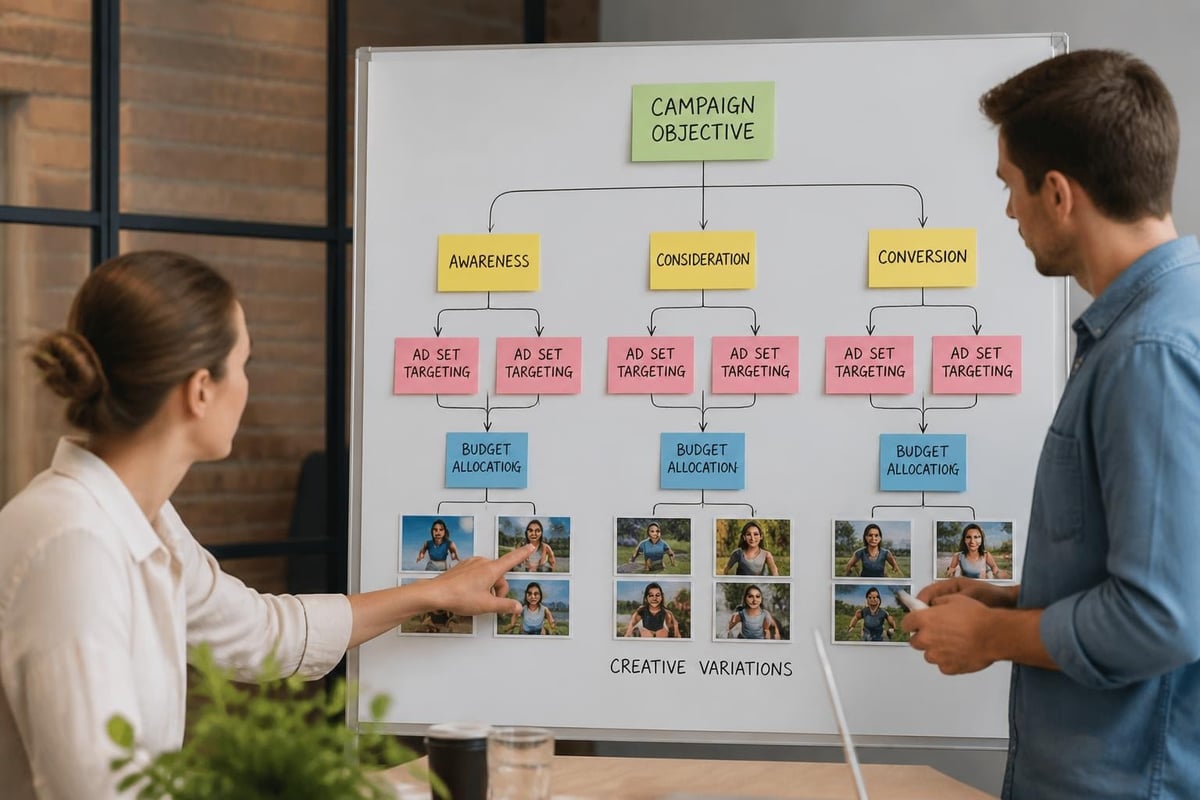
Modern facebook ad campaigns require a strategic approach to account organization that goes beyond simply creating ads and hoping for results. The foundation of successful campaigns starts with proper structure at the campaign, ad set, and ad levels.
The Three-Tier Hierarchy
Facebook's advertising platform operates on a hierarchical system where each level serves a distinct purpose. At the campaign level, you select your objective, whether that's lead generation, conversions, or brand awareness. The ad set level controls targeting parameters, budget allocation, and schedule, while individual ads contain the creative elements and messaging that users actually see.
Key structural considerations include:
- Separating campaigns by business objective rather than product type
- Creating dedicated ad sets for different audience segments
- Testing multiple ad variations within each ad set
- Maintaining clear naming conventions for easy tracking
This organization becomes particularly important when running multiple facebook ad campaigns simultaneously, as many marketing services firms do when managing client portfolios or promoting different service offerings.
Budget Allocation and Bidding Strategies
The way you distribute budget across your facebook ad campaigns significantly impacts performance outcomes. In 2026, the platform's algorithm has become increasingly sophisticated at optimizing budget distribution, but strategic oversight remains crucial.
Campaign Budget Optimization (CBO) allows Facebook to automatically allocate budget across ad sets based on performance, which works well for established campaigns with sufficient data. However, for new campaigns or those testing dramatically different audiences, ad set budgets provide more control during the learning phase.
| Budget Strategy | Best For | Typical Use Case |
|---|---|---|
| Campaign Budget Optimization | Proven campaigns with similar audiences | Scaling successful lead generation |
| Ad Set Budgets | Testing new segments or offers | Initial campaign launches |
| Lifetime Budgets | Time-sensitive promotions | Event marketing or limited offers |
| Daily Budgets | Ongoing campaigns | Continuous lead flow systems |
The best practices for Facebook ads emphasize that bidding strategy should align with your business goals and the maturity of your campaigns.
Audience Targeting and Segmentation Strategies
Effective audience targeting separates profitable facebook ad campaigns from those that drain budgets without delivering results. The targeting landscape has evolved significantly, with privacy changes forcing advertisers to rely more on first-party data and broader targeting parameters.
Core Audience Building Blocks
Building the right audience starts with understanding who you're trying to reach and what data points Facebook can leverage to find them. For businesses offering AI solutions and sales systems, this typically means targeting decision-makers in specific industries or company sizes.
Primary targeting options include:
- Demographic filters (job title, company size, industry)
- Interest-based targeting (relevant to marketing and sales technologies)
- Behavioral signals (engagement with business content)
- Geographic parameters (location-based targeting for service areas)
Advanced campaigns layer these targeting criteria while avoiding over-narrowing that prevents Facebook's algorithm from optimizing delivery. The platform performs best when given some flexibility to find the right users within your defined parameters.
Custom and Lookalike Audiences
The most powerful targeting for facebook ad campaigns comes from custom audiences built on your existing data. These audiences leverage people who have already interacted with your business in some way, making them significantly more likely to convert.
Website custom audiences track visitors to specific pages, allowing you to retarget people who viewed your AI solutions but didn't convert. Email list audiences enable you to reach existing contacts or prospects from other channels. Engagement audiences target users who interacted with your social media content or watched your videos.
Lookalike audiences expand your reach by finding users similar to your best customers. For marketing services providers, creating lookalike audiences based on closed deals or high-value clients can dramatically improve lead quality while maintaining scale.
Creative Optimization and Testing Frameworks
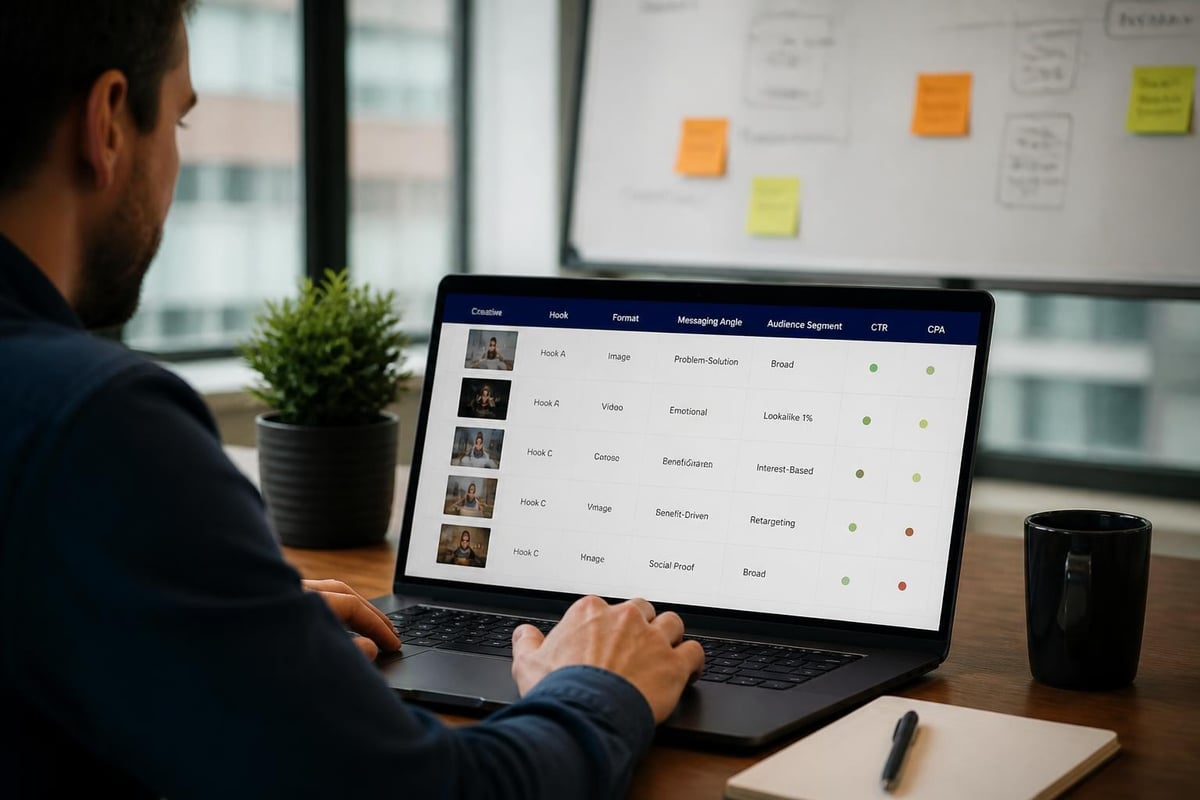
Creative content drives facebook ad campaigns performance more than any other factor in 2026. The platform's algorithm has shifted focus from targeting precision to creative quality, meaning the ads themselves largely determine success or failure.
Video-First Creative Strategy
Short-form vertical video dominates Facebook's feed, making it the primary creative format for most campaigns. Videos between 15 and 30 seconds consistently outperform longer content, with the first three seconds being absolutely critical for stopping the scroll.
Effective video ads for marketing services should immediately communicate value without requiring sound. Visual demonstrations of AI systems in action, quick customer testimonials, or problem-solution narratives work particularly well for technical B2B offerings.
The Facebook ad design guide provides comprehensive frameworks for creating high-performing visual content across all ad formats.
Static Image and Carousel Formats
While video leads in engagement, static images and carousel ads still deliver strong results, particularly for bottom-funnel campaigns targeting warm audiences. High-quality product screenshots, infographics explaining complex processes, or before-and-after comparisons can effectively communicate value propositions.
Carousel ads allow you to showcase multiple features or use cases within a single ad unit, making them ideal for businesses with comprehensive service offerings. Each card can highlight a different aspect of your AI solutions, from sales automation to marketing integration to onboarding systems.
Copy That Converts
Ad copy works in tandem with visuals to drive campaign performance. The Facebook ad copy best practices for 2026 emphasize benefit-first framing that immediately addresses user pain points.
Effective copy structure includes:
- Attention-grabbing hook addressing a specific problem
- Clear value proposition explaining how you solve it
- Social proof or credibility marker building trust
- Direct call-to-action telling users exactly what to do next
For AI and sales system providers, copy should translate technical capabilities into business outcomes. Rather than focusing on features like "machine learning algorithms," emphasize results like "reduce sales follow-up time by 60%" or "automatically qualify and route leads."
Campaign Optimization and Performance Management
Launching facebook ad campaigns is just the beginning. Ongoing optimization determines whether campaigns achieve their full potential or plateau at mediocre performance levels.
The Learning Phase and Beyond
Every new facebook ad campaign, ad set, or creative enters a learning phase where Facebook's algorithm gathers data to optimize delivery. During this period, which typically requires about 50 conversion events, performance may be volatile and costs higher than steady-state.
Avoiding actions that reset the learning phase is critical. Significant budget changes, audience modifications, or pausing campaigns for extended periods all trigger a restart. The Facebook ads best practices guide emphasizes that patience during learning phases often separates successful campaigns from abandoned ones.
Key Performance Metrics to Monitor
Different objectives require different success metrics, but certain KPIs remain essential across all facebook ad campaigns focused on lead generation and customer acquisition.
| Metric | What It Measures | Optimization Target |
|---|---|---|
| Cost Per Result | Efficiency of objective achievement | Decrease over time |
| Click-Through Rate | Creative engagement | Above 1% for cold traffic |
| Conversion Rate | Landing page effectiveness | 5-10% for warm audiences |
| Return on Ad Spend | Revenue generated vs. spend | 3x or higher for profitability |
| Frequency | Ad saturation level | Below 3 for active campaigns |
Regular monitoring prevents common issues like creative fatigue, where audiences see the same ads too often and stop engaging. The common mistakes in Facebook ad campaigns include ignoring these warning signs until performance has already declined significantly.
Creative Refresh Cycles
Maintaining consistent performance requires a pipeline of fresh creative content. High-performing facebook ad campaigns typically rotate new creative into the mix every 2-4 weeks, even when existing ads still perform well.
This proactive approach prevents fatigue before it impacts results. When an ad's frequency climbs above 3 or engagement rates start declining, having new creative ready ensures smooth transitions without performance gaps.
Advanced Strategies for Scaling Campaigns
Once you've established profitable baseline performance, scaling facebook ad campaigns while maintaining efficiency requires sophisticated approaches that go beyond simply increasing budgets.
Horizontal vs. Vertical Scaling
Scaling can occur in two primary directions. Vertical scaling increases budgets on existing campaigns and ad sets, while horizontal scaling expands into new audiences, placements, or creative variations.
Vertical scaling works best when:
- Campaigns consistently deliver strong ROAS
- Audience size supports larger budgets
- Creative performance remains stable
- Conversion volume trends upward
Horizontal scaling makes sense for:
- Campaigns hitting audience saturation
- Testing new market segments
- Diversifying campaign risk
- Expanding geographic reach
Most successful strategies combine both approaches, gradually increasing spend on winners while continuously testing new angles. This balanced methodology, similar to what sales performance management systems recommend for quota achievement, prevents over-reliance on single campaigns.
Funnel-Based Campaign Architecture
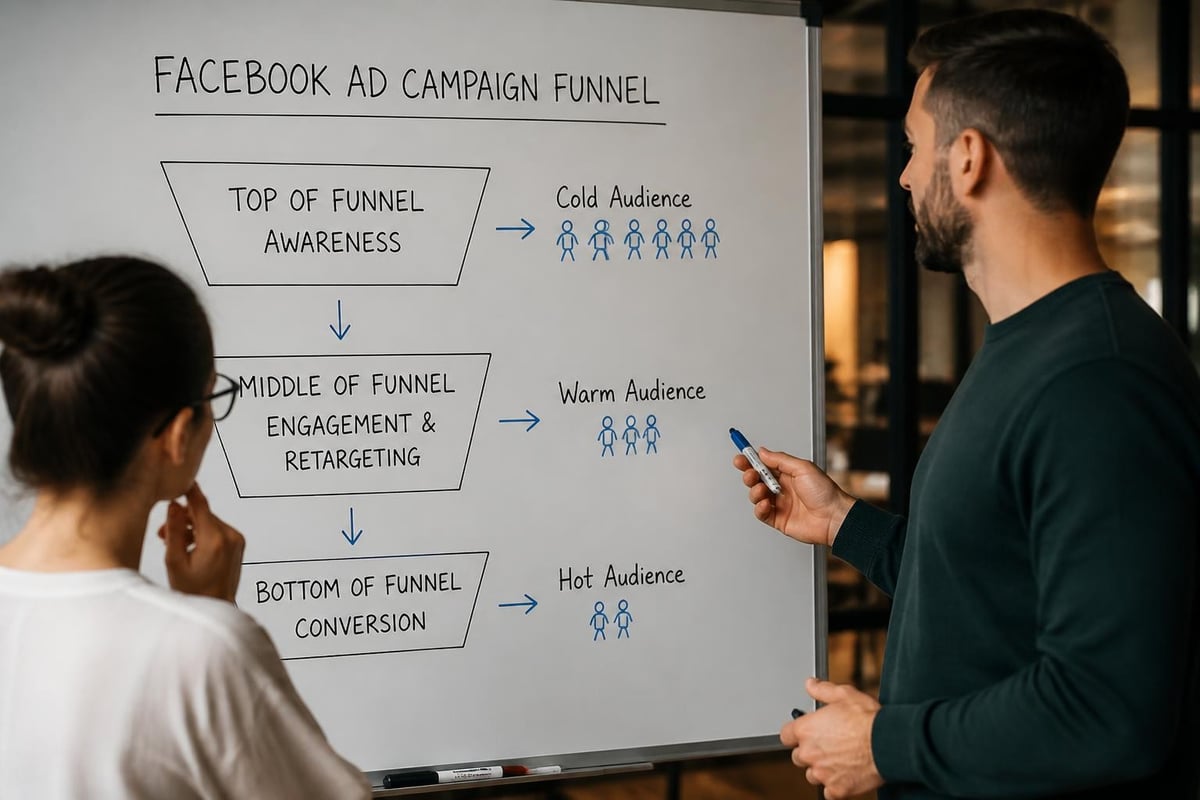
Sophisticated advertisers structure facebook ad campaigns around the customer journey rather than treating all prospects identically. This approach creates different campaigns for top-of-funnel awareness, middle-funnel consideration, and bottom-funnel conversion.
Top-funnel campaigns might use engagement or video view objectives to introduce your AI solutions to cold audiences at low cost. These campaigns build custom audiences of engaged users who can be retargeted with more direct response messaging.
Middle-funnel campaigns target these engaged audiences with content that builds credibility, such as case studies, webinars, or detailed product demonstrations. The goal is moving prospects from awareness to active consideration.
Bottom-funnel campaigns focus exclusively on conversion objectives, targeting the warmest audiences with direct calls-to-action and compelling offers. These campaigns typically have the highest cost per result but generate the most qualified leads.
Integration with AI and Automation Systems
The intersection of facebook ad campaigns and AI-powered automation creates powerful opportunities for marketing services firms in 2026. Connecting advertising data with CRM systems, lead scoring algorithms, and automated follow-up sequences maximizes the value of every advertising dollar.
Automated Lead Qualification and Routing
When facebook ad campaigns generate leads, immediate qualification and routing dramatically improves conversion rates. AI systems can analyze lead data in real-time, score prospects based on fit and intent signals, and automatically assign them to the appropriate sales team member or nurture sequence.
This automation eliminates the lag time that traditionally exists between ad click and sales contact, striking while prospect interest peaks. For businesses offering AI implementation services, demonstrating this capability through your own lead management becomes powerful social proof.
Dynamic Creative and Personalization
Advanced facebook ad campaigns leverage dynamic creative optimization (DCO) to automatically test combinations of headlines, images, descriptions, and calls-to-action. The platform's algorithm identifies which combinations perform best for different audience segments and serves them accordingly.
Taking this further, personalized ad experiences based on user behavior or profile data significantly boost engagement. Showing different messaging to prospects who visited your pricing page versus those who only read blog content creates more relevant experiences that drive higher conversion rates.
Performance Tracking and Attribution
Understanding which facebook ad campaigns contribute to pipeline and revenue requires robust tracking infrastructure. The Conversions API provides more reliable data than pixel tracking alone, especially given browser privacy restrictions that limit third-party cookies.
Integrating campaign data with your CRM reveals the full customer journey from initial ad click through closed deal. This visibility enables accurate calculation of customer acquisition costs and lifetime value metrics that inform budget allocation decisions across all marketing channels.
Testing Methodologies for Continuous Improvement
The most successful facebook ad campaigns treat advertising as an ongoing experiment rather than a set-it-and-forget-it channel. Structured testing reveals insights that compound over time, creating sustainable competitive advantages.
Multivariate Testing Frameworks
Rather than testing one variable at a time, sophisticated campaigns employ multivariate testing that examines multiple elements simultaneously. This approach identifies interaction effects where certain combinations outperform what individual tests would predict.
For example, a specific headline might work best with video creative but underperform with static images. Testing these elements independently would miss this nuance, while multivariate testing captures the full picture.
Statistical Significance and Sample Sizes
A common mistake in facebook ad campaigns is making decisions based on insufficient data. Determining statistical significance requires adequate sample sizes, which varies based on your baseline conversion rate and the effect size you're trying to detect.
Generally, each variation in a test should receive at least 100 conversions before making conclusive decisions. For lower-volume campaigns, this might mean running tests for several weeks to accumulate sufficient data.
Testing best practices include:
- Running tests for full business cycles (typically 7-14 days)
- Ensuring budget is split evenly between variations
- Testing only one major element at a time for clarity
- Documenting all test results for future reference
- Implementing winning variations quickly to capitalize on insights
The Facebook advertising best practices guide emphasizes that systematic testing separates campaigns that improve over time from those that stagnate.
Platform Updates and Future-Proofing Strategies
Facebook's advertising platform evolves constantly, with algorithm updates, new features, and policy changes affecting campaign performance. Staying ahead of these changes protects your advertising investment and uncovers new opportunities.
Adapting to Privacy and Tracking Changes
Ongoing privacy regulations and platform policies continue reshaping how facebook ad campaigns track and target users. Successful advertisers have shifted focus from granular behavioral targeting to creative quality and broad audience parameters that give Facebook's algorithm room to optimize.
First-party data collection through lead forms, email list building, and website engagement becomes increasingly valuable as third-party tracking diminishes. Building robust custom audiences from owned data insulates campaigns from external tracking limitations.
Emerging Ad Formats and Placements
New ad formats regularly emerge across Facebook's family of apps. Reels placements, for instance, have grown significantly in 2026, offering cost-effective reach for vertical video content. Early adoption of new formats often yields lower costs before they become saturated with advertisers.
Similarly to how AI content marketing strategies must adapt to new platforms and content types, facebook ad campaigns require agility to leverage emerging opportunities before they become table stakes.
Mastering facebook ad campaigns in 2026 requires balancing creative excellence, strategic targeting, systematic testing, and seamless integration with your broader marketing and sales infrastructure. By implementing the frameworks outlined here, businesses can build campaigns that consistently generate qualified leads while maintaining healthy returns on advertising spend. If you're looking to amplify your advertising results with AI-powered sales and marketing automation that turns facebook ad campaigns into reliable revenue engines, Ryan Cook specializes in custom solutions that connect your advertising efforts directly to measurable business outcomes.