July 10, 2026 · Bizware
Founder-Led Sales: Build Your First Revenue Engine
Learn how to master founder-led sales to close your first customers, validate your market, and build a repeatable sales process before scaling.

In the early stages of building a business, particularly one focused on custom AI solutions and sales enablement systems, founders face a critical question: who should be closing the first deals? The answer is almost always the founder. This hands-on approach to revenue generation, known as founder-led sales, represents more than just a necessity born from limited resources. It's a strategic advantage that allows founders to understand their market deeply, refine their value proposition, and build the foundation for a scalable sales organization. For businesses offering complex solutions like AI-powered sales systems, this direct engagement with early customers becomes even more valuable.
Why Founder-Led Sales Matters for Early-Stage Companies
The concept of founder-led sales extends beyond simply making sales calls because you can't afford to hire a sales team yet. When founders engage directly with prospects, they gain insights that no hired salesperson can replicate in those critical early months.
Founders possess unique advantages that make them ideally suited for initial sales efforts:
- Deep product knowledge and the ability to explain technical nuances
- Authority to make immediate decisions on pricing, features, or customization
- Genuine passion for the solution that resonates with prospects
- Flexibility to pivot the offering based on real-time market feedback
- Credibility that comes from being the person who built the solution
This direct engagement becomes particularly powerful when selling sophisticated solutions. A founder-led sales approach allows for real-time market validation that informs product development, positioning, and go-to-market strategy simultaneously.
The Learning Phase: Your Most Valuable Investment
Every conversation a founder has with a prospect during this phase generates compound returns. Unlike a sales representative who focuses on executing a proven playbook, founders in this stage are writing the playbook itself.
Consider what happens during each sales conversation. You're learning which pain points resonate most strongly, which objections appear consistently, which features generate excitement, and which aspects of your value proposition fall flat. This information shapes everything from your product roadmap to your marketing messaging.

Building Your Founder-Led Sales Process
Many founders mistakenly believe that founder-led sales means flying by the seat of your pants. The opposite is true. The most successful founder-led sales motions combine authenticity with systematic process.
Structuring Your Sales Workflow
Start by creating a simple but consistent workflow that you can execute daily. According to proven B2B founder-led sales frameworks, this should include dedicated time blocks for specific activities.
| Activity | Daily Time Investment | Purpose |
|---|---|---|
| Prospect Research | 30 minutes | Identify ideal customer profiles |
| Outreach | 60 minutes | Personalized email and LinkedIn messages |
| Discovery Calls | 90-120 minutes | Understand prospect needs and qualify fit |
| Follow-up | 30 minutes | Send proposals and maintain momentum |
| Documentation | 30 minutes | Record insights and update process |
This structure ensures you're consistently moving prospects through your pipeline while capturing the learning that makes each subsequent conversation more effective.
Crafting Your Initial Sales Narrative
Your sales narrative during the founder-led phase should emphasize problem-solving over product features. When discussing custom AI solutions for sales enablement and marketing automation, frame conversations around the specific challenges your prospect faces.
Effective founder-led sales narratives include:
- The problem statement that acknowledges the prospect's current pain
- Your unique insight into why this problem exists or persists
- Your solution approach that demonstrates differentiated thinking
- Proof points from early customers or your own experience
- The transformation prospects can expect from working with you
Recognizing Buying Signals and Closing Techniques
One critical skill founders must develop is recognizing when a prospect is ready to move forward. In complex B2B sales, particularly for AI implementation services, buying signals can be subtle.
Watch for prospects who ask detailed questions about implementation timelines, request references from similar companies, involve additional stakeholders in conversations, or discuss budget allocation and approval processes. These indicate serious consideration beyond casual interest.
The Founder's Closing Advantage
Founders possess a unique closing advantage: the ability to customize the deal structure on the spot. When a prospect raises an objection about implementation support, you can offer extended onboarding. When they're concerned about ROI timelines, you can structure payment milestones around achieved results.
This flexibility, combined with the credibility of being the founder, often overcomes obstacles that would stall a traditional sales process. Effective founder-led sales strategies leverage this advantage while maintaining sustainable deal economics.
Transitioning from Reactive to Proactive Outreach
Many founders begin with inbound leads or warm referrals. While these provide an easier starting point, building a scalable business requires developing predictable outbound capabilities.
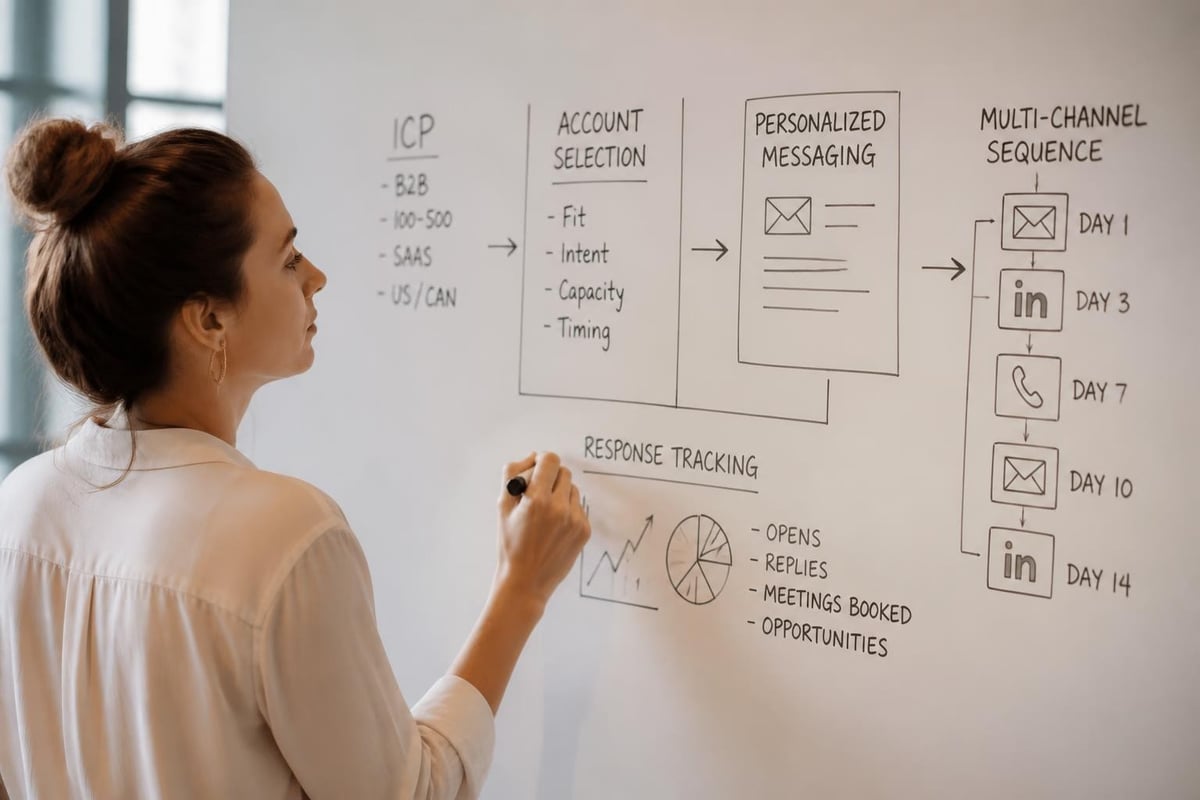
The transition to proactive outreach starts with defining your ideal customer profile with precision. For businesses offering AI-powered sales systems, this means identifying companies by size, industry, current technology stack, and specific pain points your solution addresses.
Your outbound motion should include:
- Targeted account lists based on specific qualifying criteria
- Personalized messaging that references company-specific context
- Multi-channel outreach combining email, LinkedIn, and phone
- Consistent follow-up sequences that add value with each touch
- Clear calls-to-action that make responding easy
Measuring Success in Founder-Led Sales
Unlike established sales organizations with historical benchmarks, founder-led sales requires different success metrics. You're not just measuring closed revenue but also the quality of your learning and the repeatability of your process.
Key Metrics to Track
| Metric Category | Specific Measures | Why It Matters |
|---|---|---|
| Pipeline Velocity | Days from first contact to close | Indicates process efficiency |
| Conversion Rates | Lead to meeting, meeting to proposal, proposal to close | Reveals where process needs refinement |
| Deal Economics | Average contract value, customer acquisition cost | Ensures sustainable unit economics |
| Product-Market Fit | Customer retention, feature requests, referrals | Validates you're solving real problems |
| Process Documentation | Updated playbooks, recorded objections, refined messaging | Measures readiness to scale |
For B2B email marketing and sales automation solutions, tracking these metrics helps identify which messages resonate and which aspects of your offering create the most value.
Common Founder-Led Sales Mistakes to Avoid
Even experienced founders make predictable mistakes when transitioning into sales. Understanding these pitfalls helps you avoid costly detours.
The most common mistakes include:
- Spending too much time on unqualified prospects who will never buy
- Failing to document your process, making it impossible to delegate later
- Over-customizing solutions to win deals, creating unsustainable complexity
- Neglecting to ask for the sale, assuming interest will convert automatically
- Avoiding difficult pricing conversations, leading to undervalued deals
One particularly damaging mistake is waiting too long to transition beyond founder-led sales. While founders should remain close to customers, recognizing when founder-led sales becomes a limitation is critical for sustainable growth.
Creating Repeatable Sales Assets
As you progress through founder-led sales, your goal is creating assets that enable others to replicate your success. These assets become the foundation for scaling beyond your personal capacity.
Essential Sales Enablement Materials
Start by documenting everything that works. Your first sales hire shouldn't need to reinvent your approach. Instead, they should build on your validated foundation.
Critical assets to develop:
- Customer personas with detailed pain points and motivations
- Value proposition framework that articulates your differentiation
- Sales deck template that tells a compelling story
- Demo script that highlights key capabilities
- Objection handling guide addressing common concerns
- Proposal template with proven pricing structures
- Email sequences for various stages of the buyer journey
These materials serve double duty. They accelerate your own efficiency during the founder-led phase while preparing for eventual team expansion.

When to Transition Beyond Founder-Led Sales
The right time to hire your first sales professional varies by business model, market, and growth trajectory. However, certain indicators suggest you're ready to make this transition.
You should consider moving beyond pure founder-led sales when you've achieved consistent conversion rates across multiple deals, documented a repeatable sales process, validated pricing that supports team economics, and identified the ideal customer profile that converts predictably.
Successful transitions from founder-led sales require having closed at least 10-20 customers through a consistent process. This provides enough data to train someone new while maintaining confidence in your approach.
Hybrid Approaches That Work
Many successful companies maintain founder involvement in sales even after hiring dedicated team members. Founders might continue handling enterprise deals, participate in key customer calls, or focus on strategic accounts while the team handles standard sales motions.
For businesses offering custom AI solutions, founder involvement often remains valuable for complex technical discussions and high-value opportunities. The key is transitioning from doing all the selling to enabling others while staying strategically engaged.
Optimizing Your Sales Technology Stack
During the founder-led sales phase, resist the temptation to invest heavily in sales technology. However, a minimal stack prevents deals from falling through the cracks.
Essential tools for founder-led sales include:
- A basic CRM to track conversations and follow-ups
- Email automation for sequences and templates
- Calendar scheduling to eliminate back-and-forth
- Proposal software for professional, trackable quotes
- Video conferencing with recording capabilities
As you scale, AI-powered sales systems can automate repetitive tasks while you focus on high-value activities. But in the early days, simplicity beats sophistication.
Building Strategic Partnerships Through Direct Sales
Founder-led sales creates unique opportunities for strategic partnerships that hired salespeople rarely discover. When founders engage directly with early customers, they often uncover collaboration opportunities that extend beyond simple vendor relationships.
Pay attention to prospects who might become integration partners, referral sources, or co-marketing collaborators. These relationships, forged during your founder-led sales phase, often become significant growth drivers as your company matures.
Leveraging Customer Success Stories
Your early customers, won through founder-led sales, represent invaluable social proof. As you close each deal, think strategically about how that relationship can support future sales.
Maximize the value of early customers by:
- Documenting their results with specific metrics
- Requesting video testimonials while enthusiasm is high
- Creating detailed case studies that address common objections
- Asking for introductions to similar companies
- Inviting participation in product development
These assets accelerate your sales velocity while building the credibility that makes marketing automation and AI implementation more effective across all channels.
Pricing Strategy in Founder-Led Sales
Pricing represents one of the most challenging aspects of founder-led sales. Without market comparables or historical data, founders often struggle to value their solutions appropriately.
Start with value-based pricing that ties your fee to the measurable impact you create. For AI sales systems that improve conversion rates or reduce sales cycle length, calculate the financial value of those improvements and price accordingly.
| Pricing Approach | Best For | Potential Pitfall |
|---|---|---|
| Value-Based | Solutions with measurable ROI | Requires proof of results |
| Competitive | Crowded markets | Race to the bottom |
| Cost-Plus | Standardized services | Leaves money on the table |
| Tiered Packaging | Diverse customer segments | Complexity in early stages |
Don't be afraid to test different pricing models during your founder-led sales phase. The flexibility to experiment represents another advantage of keeping sales in-house initially.
Maintaining Momentum During Long Sales Cycles
Complex B2B sales, particularly for custom AI implementations, often involve extended decision cycles. Maintaining momentum during these periods challenges even experienced founders.
Strategies to keep deals moving forward:
- Schedule the next step before ending each conversation
- Provide value between formal meetings through relevant insights
- Involve multiple stakeholders to build consensus
- Create mutual action plans with shared accountability
- Use trial periods or pilot projects to reduce perceived risk
The key is staying present without becoming annoying. Each touchpoint should add genuine value rather than simply checking in.
Mastering founder-led sales provides the foundation for sustainable business growth, especially when offering sophisticated solutions like AI-powered sales and marketing systems. The insights you gain, the processes you build, and the customer relationships you forge during this phase become invaluable assets as you scale. If you're ready to enhance your sales effectiveness with custom AI solutions that support your entire revenue operation, Ryan Cook specializes in building intelligent systems that amplify your sales, marketing, and onboarding capabilities. Schedule a consultation to explore how AI can accelerate your growth while you focus on what you do best.