July 9, 2026 · Bizware
Onboarding Best Practices: Complete Guide for 2026
Discover proven onboarding best practices that boost retention and productivity. Learn how to create exceptional employee experiences from day one.

The first 90 days of an employee's tenure can determine whether they become a long-term asset or another turnover statistic. Organizations that implement effective onboarding best practices see 82% higher new hire retention and 70% greater productivity compared to companies with weak onboarding programs. In today's competitive talent landscape, particularly within marketing services and AI implementation, the stakes have never been higher. A strategic approach to welcoming and integrating new team members creates lasting impact on both individual performance and organizational culture.
Understanding the Strategic Value of Effective Onboarding
Onboarding extends far beyond paperwork and orientation videos. It represents the critical bridge between recruitment success and employee performance. Companies investing in structured onboarding programs experience measurable returns across multiple dimensions.
The Business Case for Structured Onboarding
Financial impact drives onboarding investment decisions. Organizations with strong onboarding processes improve new hire retention by 82% and productivity by more than 70%. The cost savings alone justify the effort when considering that replacing an employee typically costs 50% to 200% of their annual salary.
Beyond retention metrics, properly onboarded employees reach full productivity faster. Research indicates that comprehensive onboarding programs reduce time-to-productivity by up to 60%. For roles involving custom AI solutions or complex marketing systems, this acceleration proves invaluable.
Cultural integration matters equally. New hires who feel connected to company culture demonstrate higher engagement scores and become brand ambassadors more quickly. They understand organizational values, communication norms, and decision-making processes that define workplace effectiveness.
| Onboarding Metric | Strong Program | Weak Program | Difference |
|---|---|---|---|
| 1-Year Retention | 91% | 50% | +82% |
| Time to Productivity | 6 weeks | 15 weeks | -60% |
| Employee Engagement | 87% | 52% | +67% |
| Manager Satisfaction | 89% | 54% | +65% |
Pre-Boarding: The Foundation of Success
The onboarding journey begins before day one. Pre-boarding activities set the tone for the entire employee experience and demonstrate organizational preparedness.
Send welcome packages containing company swag, team introductions, and essential information at least one week before the start date. Include technology setup instructions, parking details, and first-week schedules to eliminate anxiety.
Documentation preparation streamlines administrative tasks:
- Employment paperwork sent electronically for advance completion
- Benefits enrollment materials with clear deadlines
- Technology access requests submitted to IT departments
- Workspace setup completed including equipment and supplies
Assign a buddy or mentor before the start date. This person serves as the new hire's go-to resource for questions ranging from lunch spots to project context. The relationship establishes immediate social connection and reduces the isolation many new employees experience.
Create personalized learning paths based on role requirements. For positions involving sales AI systems, design training modules that progressively build competency in tools, processes, and methodologies specific to that function.

First Day Excellence: Creating Memorable Beginnings
Day one shapes lasting impressions. Onboarding best practices emphasize warmth, organization, and purpose during initial interactions.
Welcoming New Team Members
Arrive before the new hire and ensure everything is ready. A prepared workspace with functioning technology, supplies, and welcome notes communicates respect and professionalism. Nothing undermines confidence faster than technical difficulties or missing basic equipment.
Schedule structure for the first day should include:
- Welcome meeting with direct manager covering expectations and goals
- Team introduction session (virtual or in-person)
- Office or platform tour highlighting key resources
- Lunch with team members for informal connection
- Initial training sessions on core systems
- End-of-day check-in to address questions
Avoid information overload. The first day should balance essential knowledge with relationship building. Save detailed training for subsequent weeks when cognitive capacity increases.
Introduce company culture through stories and examples rather than abstract values statements. Share customer success stories, team achievements, or founder anecdotes that illustrate what makes the organization unique.
The 30-60-90 Day Framework
Structured onboarding spans months, not days. The 30-60-90 day approach provides clear milestones while allowing flexibility for individual learning curves.
Days 1-30: Foundation Building
The first month focuses on learning, observing, and establishing basic competency. New hires absorb company culture, understand team dynamics, and master fundamental tools.
Key objectives include:
- Complete all compliance and mandatory training
- Understand organizational structure and key stakeholders
- Achieve proficiency in primary software systems
- Shadow experienced team members across functions
- Contribute to small, low-risk projects or tasks
Schedule weekly check-ins with managers to discuss progress, address challenges, and adjust plans as needed. These conversations build trust and identify support gaps before they become problems.
For marketing services roles, this period should include comprehensive training on AI content marketing tools and methodologies that drive client success.
Days 31-60: Skill Development
Month two shifts toward independent contribution and skill refinement. New hires take ownership of projects while continuing to seek guidance on complex situations.
Assign meaningful work that stretches capabilities without overwhelming. The goal is building confidence through successful completion of increasingly challenging tasks. Include collaborative projects that strengthen relationships with cross-functional partners.
Development priorities:
- Master advanced features of core technologies
- Complete role-specific certification or training programs
- Lead portions of client or internal meetings
- Receive and incorporate feedback on work quality
- Begin mentoring newer employees in basic processes
Introduce performance expectations clearly. Share success criteria, quality standards, and examples of excellent work. Transparency about evaluation processes reduces anxiety and focuses effort on priority outcomes.
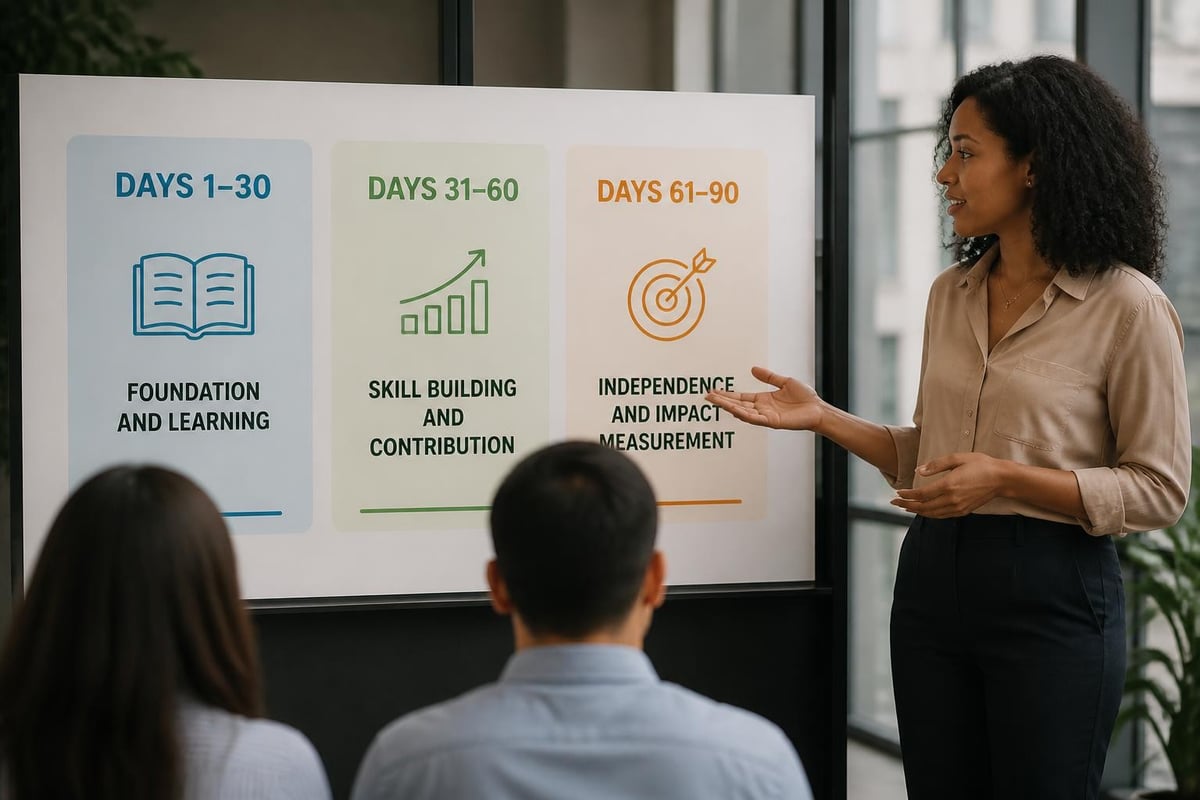
Days 61-90: Integration and Impact
The final month of intensive onboarding emphasizes autonomy, strategic thinking, and measurable contribution. New hires should function independently while knowing when to request support.
Conduct a formal 90-day review covering achievements, growth areas, and future development plans. This conversation sets the tone for ongoing performance management and career progression.
| Onboarding Phase | Primary Focus | Success Indicators | Support Level |
|---|---|---|---|
| Days 1-30 | Learning & Observation | Completes training, asks questions | High guidance |
| Days 31-60 | Contribution & Development | Delivers projects, builds relationships | Moderate guidance |
| Days 61-90 | Autonomy & Impact | Works independently, achieves goals | Low guidance |
| Days 91+ | Optimization & Growth | Exceeds expectations, mentors others | As-needed support |
Essential Onboarding Components
Beyond timeline structure, certain elements prove critical across all successful onboarding programs. These components work together to create comprehensive integration experiences.
The Five Cs Framework
Research-backed approaches identify five critical dimensions that effective onboarding must address:
Compliance covers legal and policy requirements. This includes employment documentation, safety training, confidentiality agreements, and regulatory certifications. While often perceived as tedious, compliance establishes necessary boundaries and protections.
Clarification ensures role understanding. New hires need crystal-clear expectations about responsibilities, performance standards, decision-making authority, and success metrics. Ambiguity creates stress and reduces effectiveness.
Confidence develops through early wins and supportive feedback. Structure experiences that allow new employees to demonstrate competence quickly. Celebrate accomplishments publicly and provide constructive guidance privately.
Connection builds relationships across the organization. Facilitate introductions to colleagues beyond immediate teams. For remote employees, create virtual coffee chats or online community spaces that foster informal interaction.
Culture transmits organizational values and norms. Share decision-making philosophies, communication preferences, conflict resolution approaches, and celebration traditions that define "how we work here."
Buddy Systems and Mentorship
Peer support accelerates integration and reduces manager burden. Onboarding best practices consistently highlight buddy systems as high-impact, low-cost interventions.
Select buddies who exemplify company culture, possess strong communication skills, and volunteer for the role. Avoid assigning this responsibility without genuine interest. Provide buddies with clear guidance about their role, time commitment, and support resources.
Effective buddy programs include:
- Structured check-in schedule (daily in week one, weekly through month three)
- Specific topics to cover (from lunch spots to unwritten rules)
- Access to manager for escalation of concerns
- Recognition for mentors who excel in this role
The relationship should complement rather than replace manager interactions. Buddies answer quick questions and provide peer perspective while managers focus on performance development and strategic guidance.
Technology-Enabled Onboarding
Digital tools transform onboarding from administrative burden to strategic advantage. Learning management systems, collaboration platforms, and automation capabilities enhance consistency and scalability.
Digital Onboarding Platforms
Centralized onboarding platforms streamline workflows and improve experiences. These systems manage document collection, training delivery, task tracking, and progress monitoring from a single interface.
Key capabilities to prioritize:
- Automated task assignment based on role and department
- Mobile-responsive design for flexibility
- Integration with HRIS and other core systems
- Analytics dashboards tracking completion and engagement
- Customizable content libraries for role-specific paths
For organizations implementing AI systems for sales and marketing, onboarding platforms should include interactive simulations allowing new hires to practice with AI tools in risk-free environments.
Video content enhances engagement and knowledge retention. Create welcome messages from leadership, process demonstrations, and customer testimonials that bring concepts to life. Short, focused videos outperform lengthy presentations consistently.
Remote and Hybrid Onboarding Considerations
Virtual onboarding requires intentional relationship-building and communication. The absence of casual office interactions demands structured connection opportunities.
Ship technology and supplies before day one to ensure readiness. Test equipment setup through pre-calls that troubleshoot potential issues. Nothing derails virtual onboarding faster than technical failures during first impressions.
- Schedule daily video check-ins during the first week
- Create virtual team-building activities (online games, shared meals)
- Over-communicate expectations and deadlines
- Record training sessions for on-demand access
- Establish clear communication protocols and response expectations
Leverage collaboration tools that simulate office presence. Platforms enabling quick questions, screen sharing, and casual conversation reduce remote isolation while maintaining productivity.
Measuring Onboarding Effectiveness
Best practices in onboarding include systematic evaluation of program impact. Measurement drives continuous improvement and demonstrates ROI.
Critical Metrics to Track
Retention rates at 90 days, six months, and one year reveal onboarding impact on stability. Compare retention across departments, managers, and time periods to identify patterns and improvement opportunities.
Time-to-productivity measures how quickly new hires reach full performance. Define clear productivity benchmarks for each role, then track how long onboarding cohorts require to achieve them.
Employee satisfaction scores collected at multiple onboarding milestones provide real-time feedback. Use brief surveys after week one, month one, and quarter one asking about clarity, support, and confidence.
Manager satisfaction indicates whether onboarding prepares employees for success. Query managers about new hire readiness, knowledge gaps, and program improvement suggestions.
| Success Metric | Measurement Method | Target Benchmark | Review Frequency |
|---|---|---|---|
| 90-Day Retention | HRIS tracking | >90% | Quarterly |
| Time to Productivity | Manager assessment | <60 days | Monthly |
| New Hire Satisfaction | Survey (1-10 scale) | >8.5 | Per cohort |
| Training Completion | LMS analytics | 100% by day 30 | Weekly |
Gathering and Acting on Feedback
Create multiple feedback channels throughout onboarding. Exit interviews with departing employees who left during onboarding reveal critical weaknesses. Stay interviews with successful new hires identify strengths to amplify.
Conduct 30-60-90 day surveys asking specific questions about each onboarding component. Which elements proved most valuable? What information was missing? When did they feel most supported or confused?
Sample feedback questions:
- How prepared did you feel on day one? (1-10 scale)
- Which onboarding activities contributed most to your success?
- What additional support would have been helpful?
- How well does daily work match what you learned during onboarding?
- Would you recommend this company to others based on your onboarding experience?
Analyze feedback quarterly and implement improvements. Share changes with current employees to demonstrate responsiveness and continuous enhancement. This transparency builds trust and encourages ongoing input.

Specialized Onboarding for Different Roles
Generic onboarding fails to address role-specific needs. Customize experiences based on function, seniority, and complexity while maintaining consistent cultural elements.
Sales and Marketing Onboarding
Revenue-generating roles require product knowledge, competitive intelligence, and customer understanding alongside standard onboarding. Successful programs include job shadowing experienced performers, mock presentations, and gradual responsibility increases.
For marketing services organizations, comprehensive training on client industries, service delivery methodologies, and technology platforms forms the foundation. New marketers should understand both the "what" and "why" behind strategies.
Sales-specific onboarding elements:
- Product demonstrations and hands-on practice
- Customer persona development and journey mapping
- CRM system training with realistic scenarios
- Sales process walkthroughs from prospect to close
- Shadowing customer calls and meetings
- Competitive positioning and objection handling
Consider implementing B2B email marketing training modules that demonstrate how your organization generates and nurtures leads. This knowledge helps sales professionals understand where their opportunities originate.
Technical and Specialized Positions
Complex technical roles demand extended onboarding periods focused on systems, methodologies, and quality standards. Rushed technical onboarding creates knowledge gaps that persist for months.
Pair new technical hires with experienced team members for structured knowledge transfer. Document institutional knowledge about system architecture, code standards, and troubleshooting approaches that rarely exist in formal documentation.
Provide sandbox environments where new technical employees experiment without production risk. Hands-on learning accelerates competency development more effectively than passive training consumption.
Continuous Onboarding Beyond 90 Days
Onboarding extends throughout the first year and beyond. Progressive organizations view employee development as continuous rather than event-based.
Implement check-ins at six months and one year focusing on growth, challenges, and future aspirations. These conversations identify development opportunities and demonstrate ongoing investment in employee success.
Update onboarding materials regularly based on product changes, process improvements, and organizational evolution. Stale content undermines credibility and confuses new hires encountering discrepancies between training and reality.
Year-one development milestones:
- Quarter 2: Advanced skill training and stretch assignments
- Quarter 3: Cross-functional project participation
- Quarter 4: Performance review and career planning conversation
- Month 13+: Mentorship of newer employees
Create alumni networks for onboarding cohorts that maintain connections and facilitate peer learning. These communities provide support systems extending beyond formal programs.
Implementing comprehensive onboarding best practices transforms new hire experiences from administrative necessities into strategic advantages that drive retention, productivity, and engagement. Organizations that invest in structured, measurable, and personalized onboarding programs build stronger teams and more resilient cultures. If you're looking to enhance your onboarding processes with intelligent automation and personalized employee experiences, Ryan Cook specializes in custom AI solutions that streamline sales, marketing, and onboarding workflows. Our systems help you deliver consistent excellence while freeing your team to focus on human connection and strategic relationship building.