June 27, 2026 · Bizware
AI Sales Automation: Complete Guide for 2026
Discover how AI sales automation transforms sales processes, boosts efficiency, and drives revenue. Expert strategies for implementation in 2026.
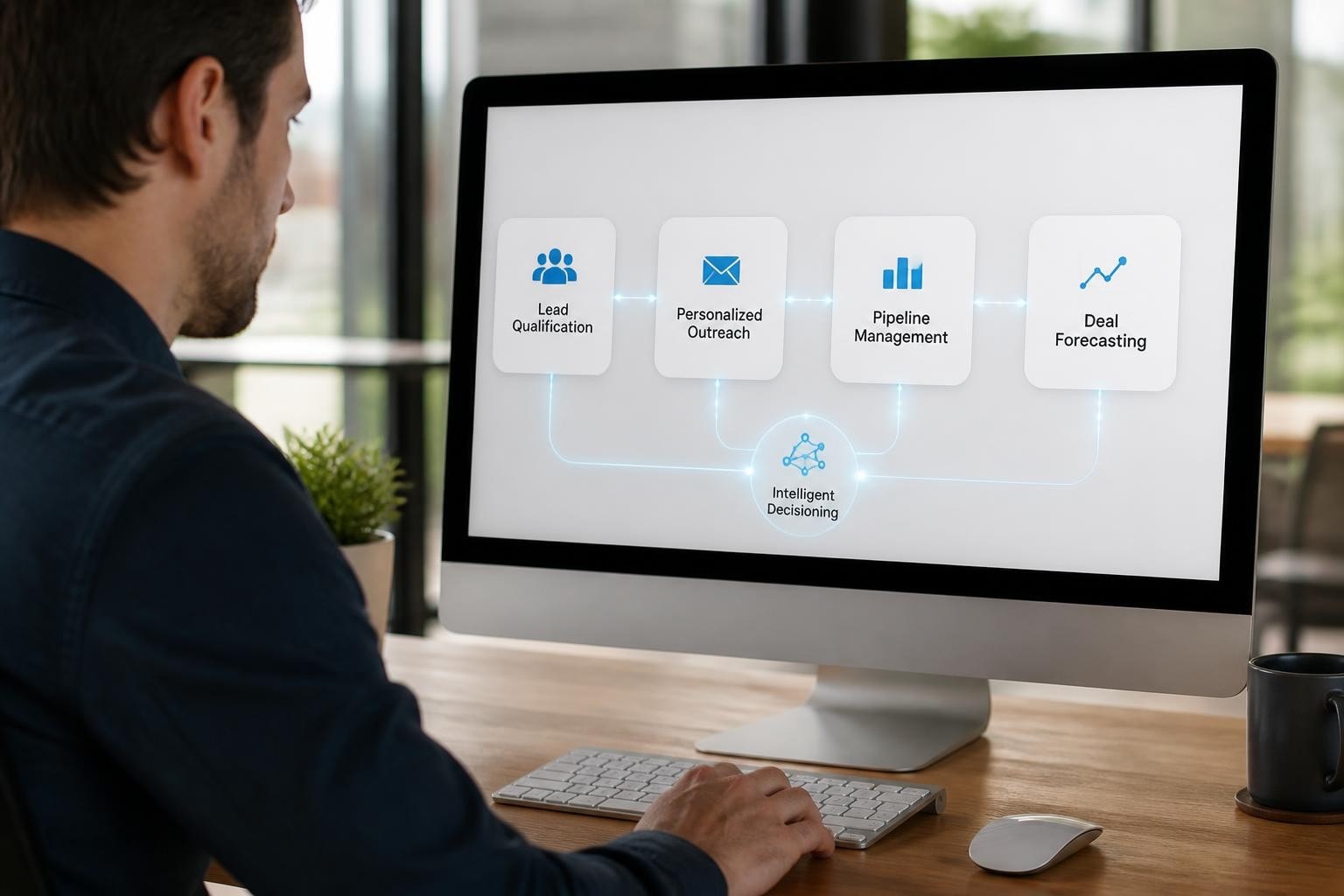
Sales teams face mounting pressure to close more deals while managing increasingly complex buyer journeys. Traditional manual processes can't keep pace with modern market demands, leading organizations to embrace artificial intelligence as a strategic advantage. AI sales automation represents a fundamental shift in how businesses identify prospects, nurture relationships, and convert opportunities into revenue. By integrating intelligent systems throughout the sales cycle, companies are achieving unprecedented efficiency gains while maintaining the personal touch that drives meaningful customer connections.
Understanding AI Sales Automation in Modern Business
AI sales automation combines machine learning algorithms, natural language processing, and predictive analytics to streamline repetitive sales tasks and enhance decision-making. These systems analyze vast datasets to identify patterns, predict outcomes, and recommend actions that human sales representatives can execute with greater precision.
The technology operates across multiple dimensions of the sales process. Lead scoring algorithms evaluate prospect behavior and demographic data to prioritize high-value opportunities. Conversational AI handles initial customer inquiries through chatbots and virtual assistants. Predictive forecasting models analyze historical performance to project future revenue with remarkable accuracy.
Modern AI business solutions have evolved beyond simple task automation to become strategic partners in revenue generation. The shift represents a departure from rules-based workflows toward adaptive systems that learn from every interaction and continuously improve their performance.
Key Components of AI Sales Systems
- Intelligent lead qualification that ranks prospects based on conversion probability
- Automated email sequencing with personalized messaging at scale
- Real-time conversation analysis providing guidance during sales calls
- Dynamic pricing optimization adjusting offers based on market conditions
- Predictive pipeline management forecasting deal closure with statistical confidence

Implementation Strategies for Sales Organizations
Successful ai sales automation deployment requires careful planning and phased execution. Organizations that rush implementation without proper foundation often face adoption challenges and suboptimal results. A structured approach ensures technology aligns with sales methodology and business objectives.
Phase One: Process Assessment and Data Preparation
Begin by mapping current sales workflows to identify automation opportunities. Document each stage of your sales cycle, noting time-consuming manual tasks and decision points where AI could provide valuable insights.
Data quality determines AI effectiveness. Clean, standardized customer records form the foundation for accurate predictions and meaningful automation. Audit your CRM data for completeness, remove duplicates, and establish governance policies to maintain integrity going forward.
Critical preparation steps include:
- Conducting workflow analysis to pinpoint automation candidates
- Evaluating data quality across all customer touchpoints
- Defining success metrics and performance benchmarks
- Securing executive sponsorship and budget allocation
- Assembling cross-functional implementation teams
Phase Two: Technology Selection and Integration
The market offers numerous platforms with varying capabilities. Salesmate CRM's robust automation features demonstrate how modern systems combine customizable pipelines with intelligent workflows. Evaluate solutions based on your specific requirements rather than feature checklists.
Integration complexity varies significantly across platforms. Prioritize solutions with native connectors to your existing technology stack. API accessibility enables custom integrations when standard connections don't meet specialized needs.
| Evaluation Criteria | What to Assess | Why It Matters |
|---|---|---|
| Scalability | System capacity for user and data growth | Prevents costly platform migrations |
| Ease of Use | Interface intuitiveness and learning curve | Drives adoption rates |
| Customization | Workflow and rule configuration flexibility | Matches unique sales processes |
| Analytics | Reporting depth and visualization options | Enables data-driven decisions |
| Support | Training resources and technical assistance | Reduces implementation time |
Ryan Cook specializes in deploying marketing services that integrate AI sales automation with broader go-to-market strategies, ensuring technology investments deliver measurable returns.
Optimizing Lead Generation and Qualification
AI sales automation revolutionizes how organizations identify and prioritize sales opportunities. Traditional lead qualification relies on demographic criteria and basic engagement tracking. Intelligent systems analyze hundreds of behavioral signals to predict conversion likelihood with statistical precision.
Predictive Lead Scoring Models
Machine learning algorithms evaluate prospect attributes across multiple dimensions. Website behavior patterns reveal purchase intent. Email engagement metrics indicate information needs. Social media activity demonstrates professional challenges and business priorities.
The most sophisticated systems incorporate firmographic data (company size, industry, revenue), technographic data (technology stack and adoption patterns), and intent signals (content consumption and search behavior) into unified scoring frameworks.
These models adapt continuously as new data becomes available. A prospect who initially scored low might surge in priority after attending a webinar or downloading specific content. Real-time score updates ensure sales representatives always focus on the highest-probability opportunities.
Organizations using AI tools for financial advisors have reported qualification accuracy improvements exceeding 40% compared to manual methods, translating directly to higher conversion rates and reduced sales cycle length.
Automated Lead Enrichment
AI systems automatically supplement prospect records with publicly available information. Company news, funding announcements, leadership changes, and competitive intelligence populate CRM fields without manual research. Sales representatives enter conversations armed with comprehensive context.
- Contact discovery identifies decision-makers and influencers within target accounts
- Trigger event monitoring alerts teams to moments when prospects are receptive to outreach
- Competitive analysis surfaces opportunities where prospects evaluate alternatives
- Relationship mapping reveals existing connections that can facilitate introductions

Personalizing Outreach at Scale
Generic mass emails generate poor response rates and damage brand reputation. AI sales automation enables genuine personalization across thousands of prospect interactions simultaneously. Advanced natural language generation creates customized messaging that reflects individual prospect contexts.
Dynamic Email Sequencing
Intelligent email systems adapt message content, timing, and frequency based on recipient behavior. If a prospect opens an email but doesn't click, the next message addresses potential objections. If they engage with specific content, follow-up communications expand on related topics.
The technology analyzes subject line performance, optimal send times, and content preferences across your prospect database. Each campaign generates insights that improve subsequent outreach. How AI is reshaping selling through vibe coding concepts shows this evolution from generic automation to contextually intelligent communication.
Personalization variables extend beyond basic merge fields:
- Industry-specific pain points and use cases
- Company size and growth stage considerations
- Technology stack compatibility and integration requirements
- Regulatory compliance and security concerns
- Competitive positioning and differentiation factors
Conversation Intelligence and Real-Time Guidance
Modern ai sales automation extends into live customer interactions. SalesCopilot and similar AI assistants provide real-time support during sales calls by automatically retrieving relevant information, suggesting talking points, and flagging important discussion moments.
These systems transcribe conversations, identify key topics, analyze sentiment, and surface objections for later coaching. Post-call analytics reveal which messaging resonates and where representatives need additional training.
Managing Pipelines and Forecasting Revenue
Accurate pipeline visibility separates high-performing sales organizations from those struggling to meet targets. AI sales automation transforms forecasting from guesswork into data-driven prediction.
Predictive Deal Scoring
Similar to lead scoring, deal scoring algorithms evaluate opportunity health throughout the sales cycle. The systems consider engagement frequency, stakeholder involvement, competitive dynamics, and historical win patterns for similar opportunities.
Risk indicators trigger alerts when deals show warning signs. Perhaps champion engagement has dropped, or the prospect hasn't responded to recent outreach. Early intervention prevents deals from stalling or slipping to competitors.
| Deal Health Indicator | Green Signal | Yellow Warning | Red Alert |
|---|---|---|---|
| Champion Engagement | Daily interaction | Weekly contact only | No response 14+ days |
| Stakeholder Breadth | Multiple departments | Single department | One contact only |
| Timeline Clarity | Specific decision date | General timeframe | Vague or none |
| Budget Confirmation | Allocated and approved | Under review | Not discussed |
| Competitive Position | Preferred vendor | In consideration | Unknown standing |
Dynamic Forecasting Models
Traditional forecasting multiplies deal values by subjective probability percentages. AI approaches analyze historical conversion patterns, current pipeline composition, and market conditions to project revenue with statistical confidence intervals.
These models account for seasonality, economic indicators, and sales representative performance trends. Forecast accuracy typically improves 25-35% over manual methods, enabling better resource allocation and strategic planning.
Businesses implementing comprehensive B2B email marketing strategies integrated with AI pipeline management report more predictable revenue growth and improved quota attainment across sales teams.
Balancing Automation with Human Judgment
While ai sales automation delivers remarkable efficiency gains, over-reliance creates risks. The hidden costs of excessive automation include diminished customer relationships and missed opportunities requiring human intuition.
Defining Automation Boundaries
Certain sales activities benefit from AI assistance without full automation. Complex negotiations, relationship building with executive buyers, and handling sensitive objections require human empathy and creative problem-solving.
Optimal automation candidates share these characteristics:
- High volume and repetitive nature
- Clear decision rules and criteria
- Minimal need for creative thinking
- Low risk if errors occur
- Easily measured outcomes
Reserve human attention for strategic activities where experience, emotional intelligence, and relationship skills create competitive differentiation. Let AI handle data processing, administrative tasks, and initial screening while sales professionals focus on value creation.
Continuous Learning and Optimization
AI sales automation systems require ongoing refinement. Monitor performance metrics to identify improvement opportunities. A/B test messaging variations, scoring model adjustments, and workflow modifications to optimize results.
Gather feedback from sales representatives using the technology daily. Their insights reveal friction points and enhancement possibilities that data alone might miss. Create feedback loops connecting field observations with system configuration.

Measuring Return on Investment
Justifying ai sales automation investments requires demonstrating tangible business impact. Establish baseline metrics before implementation to enable accurate before-and-after comparisons.
Quantitative Performance Indicators
Track metrics across multiple dimensions to capture comprehensive value. Revenue impact remains paramount, but efficiency gains and quality improvements also contribute significantly to ROI.
- Conversion rate improvements at each sales funnel stage
- Sales cycle reduction from initial contact to closed deal
- Average deal size increases through better targeting and positioning
- Sales representative productivity measured by activities and outcomes
- Customer acquisition cost comparing investment to revenue generated
Organizations leveraging CRM solutions for financial advisors with integrated AI capabilities typically see payback periods between six and eighteen months, with ongoing benefits accumulating over time.
Qualitative Value Assessment
Numbers tell part of the story. Qualitative benefits include improved sales representative satisfaction, enhanced customer experiences, and better competitive positioning.
Survey sales teams about time saved on administrative tasks and their ability to focus on high-value activities. Measure customer satisfaction scores and Net Promoter Scores to gauge relationship quality. Monitor competitive win rates to assess market positioning improvements.
| ROI Category | Measurement Approach | Typical Impact Range |
|---|---|---|
| Revenue Growth | Year-over-year comparison | 15-40% increase |
| Efficiency Gains | Time saved per representative | 8-15 hours weekly |
| Conversion Rates | Stage-by-stage improvement | 20-50% lift |
| Forecast Accuracy | Prediction vs. actual variance | 25-35% improvement |
| Representative Retention | Turnover rate comparison | 10-25% reduction |
Future Trends in Sales Automation
The ai sales automation landscape continues evolving rapidly. Emerging capabilities promise even greater impact on sales performance and customer engagement.
Agentic AI and Autonomous Sales Workflows
Next-generation systems move beyond task automation toward autonomous decision-making. These AI agents orchestrate complex workflows spanning multiple applications and data sources. Research on automation benchmarks explores how AI handles sophisticated cross-application processes with minimal human intervention.
Imagine an AI agent that identifies a high-value prospect, researches their business challenges, crafts personalized outreach, schedules meetings based on calendar availability, prepares briefing materials, and updates the CRM automatically. This level of autonomy frees sales professionals to focus exclusively on relationship building and strategic thinking.
Emotional Intelligence and Sentiment Analysis
Advanced natural language processing enables AI to detect emotional nuances in written and spoken communication. Systems analyze tone, word choice, and conversation patterns to assess prospect sentiment and engagement level.
This capability helps sales representatives adapt their approach in real-time. If a prospect seems frustrated, the AI might suggest addressing concerns before proceeding with the pitch. If enthusiasm is high, it might recommend advancing to next steps more quickly.
Workbooks' integration of AI tools demonstrates how CRM platforms are embedding emotional intelligence capabilities directly into daily workflows, making sophisticated analysis accessible to every sales representative.
Predictive Market Intelligence
AI systems increasingly incorporate external data sources to provide comprehensive market context. Economic indicators, industry trends, regulatory changes, and competitive movements inform sales strategies and messaging.
These intelligence capabilities help organizations anticipate market shifts and adjust tactics proactively. Rather than reacting to changes after they impact pipeline, sales teams position themselves ahead of trends.
Training Teams for AI-Augmented Selling
Technology implementation succeeds or fails based on user adoption. Comprehensive training programs ensure sales representatives embrace ai sales automation as an enabler rather than viewing it as a threat.
Skill Development Priorities
Modern sales professionals need new competencies to maximize AI capabilities. Data literacy enables interpretation of AI-generated insights. Prompt engineering skills help extract maximum value from generative AI tools. Strategic thinking becomes more important as tactical execution becomes automated.
Essential training topics include:
- Understanding AI capabilities and limitations
- Interpreting predictive scores and recommendations
- Customizing automation workflows for specific situations
- Balancing automated outreach with personal communication
- Using conversation intelligence to improve performance
Organizations investing in prospecting tools for financial advisors recognize that technology alone doesn't guarantee results. Combining powerful tools with skilled users creates sustainable competitive advantages.
Change Management and Cultural Adaptation
Introducing ai sales automation often requires cultural shifts. Some sales representatives fear replacement by technology. Others resist changing familiar processes even when new approaches deliver better results.
Address concerns transparently by demonstrating how AI enhances rather than replaces human capabilities. Share success stories from early adopters within the organization. Celebrate wins that result from effective human-AI collaboration.
Create champions who evangelize benefits and help colleagues overcome adoption challenges. Provide ongoing support through the learning curve, recognizing that proficiency develops gradually.
Selecting the Right Implementation Partner
Many organizations lack internal expertise to deploy ai sales automation effectively. Choosing the right implementation partner accelerates time-to-value and reduces risk.
Evaluation Criteria for Service Providers
Look for partners with deep experience in both sales processes and AI technology. The best providers understand sales methodology and can map technology capabilities to business objectives rather than simply implementing software.
Review case studies and client references from similar organizations. Ask specific questions about challenges encountered during previous implementations and how the partner addressed them.
Key partner capabilities include:
- Technical expertise across relevant platforms and integrations
- Sales process knowledge and methodology understanding
- Change management and training capabilities
- Ongoing support and optimization services
- Clear communication and project management
Custom Solutions vs. Platform Implementation
Standard platforms work well for many organizations, but unique requirements sometimes demand custom development. Custom AI solutions that support sales, marketing, and onboarding address specialized workflows that off-the-shelf products can't accommodate.
Evaluate whether your sales process truly requires customization or if you can adapt to proven platform capabilities. Custom development costs more upfront but may deliver superior long-term value for organizations with distinctive competitive advantages tied to proprietary processes.
The economic impact of AI automation suggests significant growth potential for organizations that successfully integrate these technologies into core business processes, making strategic implementation decisions increasingly important.
AI sales automation transforms how organizations identify prospects, nurture relationships, and close deals by combining intelligent technology with human expertise. The systems deliver measurable improvements in conversion rates, sales cycle efficiency, and forecast accuracy while freeing sales professionals to focus on strategic relationship building. If you're ready to implement AI solutions that streamline your sales, marketing, and onboarding processes, Ryan Cook specializes in custom AI systems designed specifically for your business requirements.