June 23, 2026 · Bizware
Marketing Services: Custom AI Solutions for 2026 Growth
Discover how modern marketing services leverage AI to transform sales, onboarding, and client engagement for sustainable business growth in 2026.

The landscape of marketing services has undergone a dramatic transformation over the past few years, with artificial intelligence emerging as the central force driving innovation and results. As businesses face mounting pressure to deliver measurable outcomes while managing tighter budgets, the integration of custom AI solutions has shifted from experimental to essential. Organizations now recognize that traditional marketing approaches alone cannot meet the sophisticated demands of modern buyers, making AI-powered systems a critical component of competitive sales, marketing, and onboarding processes.
The Current State of Marketing Services in 2026
Marketing services providers face unprecedented challenges in 2026. Research reveals that marketing agencies are struggling with shrinking budgets, elevated client expectations, and the disruptive impact of AI on traditional service delivery models. Client churn rates have reached concerning levels, with many businesses switching providers in search of agencies that can demonstrate tangible value.
The shift toward digital platforms continues to accelerate, fundamentally altering how marketing services are delivered and measured. Companies increasingly demand real-time analytics, personalized customer experiences, and seamless integration across sales and marketing systems. This evolution has created both challenges and opportunities for providers who embrace technological innovation.
Key market dynamics shaping marketing services include:
- Rising operational costs coupled with pressure to reduce client fees
- Demand for transparent, data-driven reporting and attribution
- Integration requirements across multiple platforms and tools
- Expectation of immediate response times and 24/7 availability
- Need for specialized expertise in emerging channels and technologies
The marketing services sector has seen significant consolidation as firms seek scale and capabilities to meet these evolving demands. This consolidation trend reflects the reality that delivering comprehensive, AI-enhanced services requires substantial technology investment and specialized talent.

AI-Powered Sales Systems: The New Competitive Advantage
Custom AI solutions have emerged as the differentiating factor in modern marketing services. Sales AI systems process vast amounts of customer data, identify patterns invisible to human analysis, and generate insights that drive revenue growth. These systems transform how businesses identify prospects, engage leads, and convert opportunities into customers.
Intelligent Lead Qualification and Scoring
Traditional lead scoring relies on simple demographic data and basic behavioral triggers. AI-powered systems analyze hundreds of variables simultaneously, including engagement patterns, content consumption, digital body language, and external signals. This sophisticated analysis enables sales teams to prioritize efforts on prospects most likely to convert, dramatically improving efficiency and close rates.
The implementation of AI tools for financial advisors demonstrates how specialized industries benefit from customized AI solutions that understand sector-specific buying behaviors and compliance requirements.
Benefits of AI-driven lead qualification:
- Predictive accuracy rates exceeding 85% compared to 60-65% with traditional scoring
- Real-time scoring updates that reflect changing buyer intent signals
- Automatic lead routing to the most appropriate sales representative
- Integration with CRM systems for seamless workflow management
- Continuous learning that improves accuracy over time
Personalized Outreach at Scale
Generic mass marketing campaigns generate diminishing returns as buyers demand relevance and personalization. AI systems analyze individual prospect behaviors, preferences, and pain points to generate customized messaging that resonates. This personalization extends across email campaigns, social media engagement, content recommendations, and sales conversations.
Modern marketing services leverage natural language processing to craft messages that match each prospect's communication style and preferences. The system learns which subject lines, content formats, and call-to-action phrases generate optimal response rates for different audience segments.
For specialized sectors requiring sophisticated relationship management, prospecting tools for financial advisors showcase how AI personalizes outreach while maintaining compliance and professional standards.
Transforming Marketing Operations Through Automation
Marketing services providers increasingly rely on AI-powered automation to deliver consistent results while controlling costs. These systems handle repetitive tasks, optimize campaign performance in real-time, and free human experts to focus on strategy and creative development.
| Traditional Marketing | AI-Enhanced Marketing Services |
|---|---|
| Manual campaign setup and management | Automated campaign orchestration across channels |
| Weekly or monthly performance reviews | Real-time optimization and adjustment |
| Generalized audience targeting | Dynamic micro-segmentation |
| Static content delivery | Personalized content adaptation |
| Reactive problem solving | Predictive issue identification |
The automation capabilities extend far beyond simple email scheduling. Modern AI systems manage multi-channel campaigns, adjusting messaging, timing, and channel mix based on real-time performance data. When one channel underperforms, the system automatically reallocates budget and focus to higher-performing alternatives.
Content Intelligence and Optimization
AI analyzes which content types, topics, and formats drive engagement for specific audience segments. This intelligence guides content creation priorities and distribution strategies. The system identifies content gaps, suggests topics likely to resonate with target audiences, and recommends optimal publishing schedules.
Natural language generation capabilities enable AI systems to draft initial content variations, subject lines, and social media posts. While human oversight remains essential for quality control and brand voice consistency, this automation dramatically accelerates content production cycles.
Organizations exploring B2B email marketing benefit from AI systems that optimize send times, subject lines, and content variations to maximize engagement rates across different industry segments and company sizes.

Revolutionizing Customer Onboarding with AI
Customer onboarding represents a critical but often neglected phase of the customer lifecycle. Poor onboarding experiences lead to early churn, reduced lifetime value, and negative word-of-mouth. AI-powered onboarding systems create personalized experiences that accelerate time-to-value and strengthen customer relationships.
Adaptive Learning Paths
AI systems assess each customer's technical proficiency, goals, and usage patterns to create customized onboarding journeys. Rather than forcing all customers through identical processes, the system adapts content difficulty, pacing, and support levels based on individual needs.
Components of intelligent onboarding include:
- Skill assessment algorithms that identify knowledge gaps
- Dynamic content delivery matching learning preferences
- Proactive support triggered by frustration signals
- Progress tracking with predictive completion timelines
- Automated check-ins at critical milestone points
The system monitors engagement signals to identify customers at risk of abandoning the onboarding process. When it detects confusion or disengagement, it automatically triggers interventions such as additional resources, simplified explanations, or human support escalation.
Predictive Success Metrics
AI analyzes onboarding behavior patterns to predict long-term customer success and lifetime value. Early identification of high-value customers enables marketing services teams to allocate white-glove support resources strategically. Conversely, early warning signals for at-risk accounts trigger retention interventions before problems escalate.
These predictive capabilities transform onboarding from a standardized checklist into a strategic customer success function that drives retention and expansion revenue.
Integration Strategies for Maximum Impact
The power of AI-enhanced marketing services multiplies when systems integrate seamlessly across the technology stack. Isolated point solutions create data silos and workflow friction. Integrated platforms enable unified customer views, automated data synchronization, and coordinated actions across sales, marketing, and customer success functions.
CRM and Marketing Automation Alignment
Customer relationship management systems serve as the central repository for customer data and interactions. AI-enhanced marketing services require bidirectional data flow between CRM platforms and marketing automation tools. This integration ensures sales teams access complete behavioral data while marketing systems leverage sales insights to refine targeting and messaging.
Organizations comparing CRM solutions for financial advisors recognize that AI capabilities vary significantly across platforms. The most effective solutions offer native AI features rather than requiring complex third-party integrations that create maintenance burdens and potential failure points.
- Data synchronization occurs in real-time, not batch processes
- Field mapping aligns automatically based on semantic understanding
- Workflow triggers activate across systems without manual configuration
- Reporting consolidation provides unified performance dashboards
- Permission management maintains security across integrated platforms
Multi-Channel Orchestration
Modern buyers engage across multiple channels throughout their journey. Email, social media, website interactions, chat conversations, and phone calls all generate valuable behavioral data. AI systems aggregate these signals to create comprehensive customer profiles that inform engagement strategies.
The orchestration layer ensures consistent messaging and appropriate timing across channels. When a prospect engages via LinkedIn, the AI system may suppress an email scheduled for later that day to avoid overwhelming the contact. Conversely, strong engagement signals might trigger immediate follow-up through the prospect's preferred channel.
For businesses seeking comprehensive solutions, exploring AI business solutions reveals how integrated platforms deliver superior results compared to fragmented tool collections.
Measuring Success in AI-Enhanced Marketing Services
Traditional marketing metrics focus on activity volume and basic engagement rates. AI-powered marketing services demand more sophisticated measurement frameworks that connect marketing activities to revenue outcomes and customer lifetime value.
| Metric Category | Traditional Measures | AI-Enhanced Measures |
|---|---|---|
| Lead Generation | Volume of leads | Predicted conversion probability |
| Engagement | Open rates, click rates | Intent signal strength, buying stage |
| Sales Impact | Leads created | Revenue influenced, pipeline velocity |
| Customer Success | Onboarding completion | Time-to-value, predicted LTV |
| ROI Calculation | Marketing spend vs. revenue | Attribution across touchpoints, predicted ROI |
Attribution and Revenue Impact
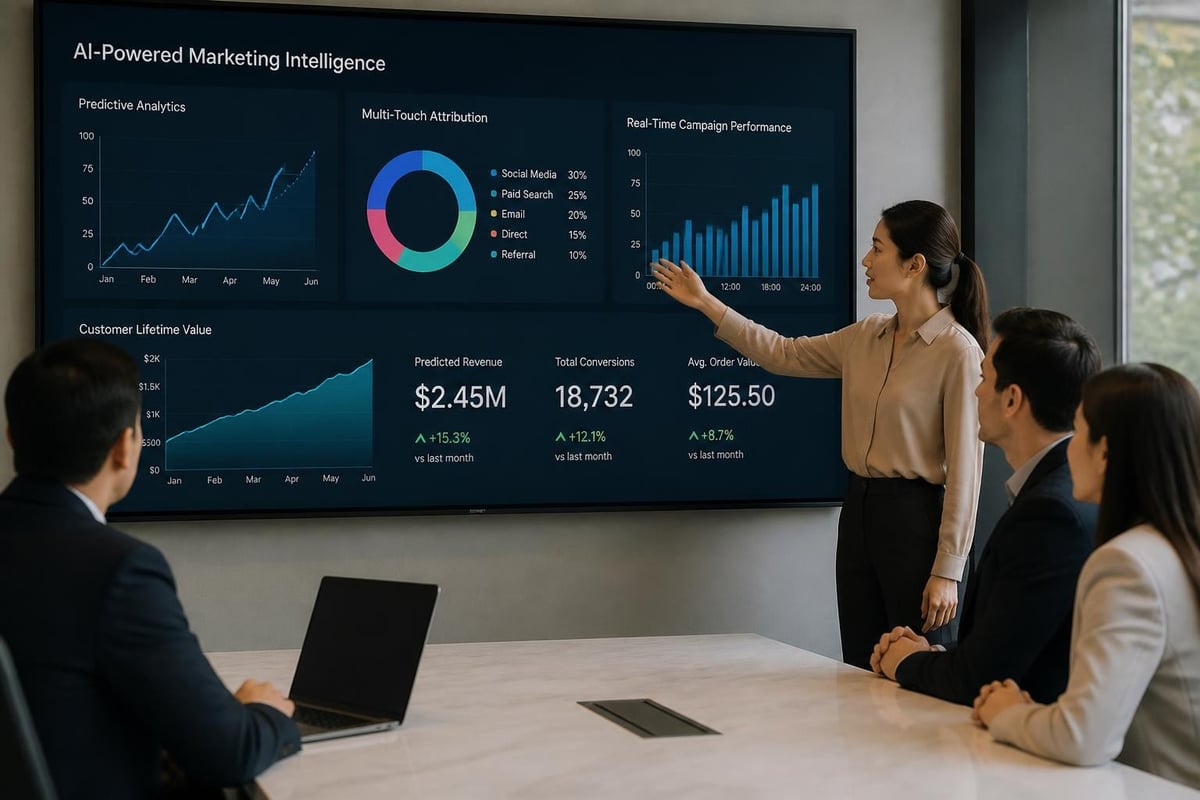
Multi-touch attribution powered by AI provides accurate understanding of which marketing activities drive revenue. Rather than crediting only the last touchpoint before conversion, AI systems assign appropriate value to each interaction throughout the customer journey. This granular attribution enables data-driven budget allocation and channel optimization.
The marketing services outlook for 2025 emphasizes that demonstrating clear ROI has become non-negotiable for agency retention. AI-powered attribution systems provide the transparency clients demand.
Predictive Performance Forecasting
Historical performance reporting tells what happened but offers limited guidance for future planning. AI systems analyze current campaign performance, market conditions, and seasonal patterns to forecast future results with increasing accuracy. These predictions enable proactive adjustments before underperformance impacts quarterly targets.
Key forecasting capabilities include:
- Campaign performance projections based on early indicators
- Budget requirement estimates for achieving specific targets
- Channel mix recommendations for optimal ROI
- Resource allocation guidance for capacity planning
- Risk identification for campaigns unlikely to meet objectives
The Human Element in AI-Powered Marketing Services
Despite automation's growing role, human expertise remains central to effective marketing services. AI systems excel at data processing, pattern recognition, and repetitive task execution but lack the creativity, emotional intelligence, and strategic thinking that drive breakthrough marketing results.
The most successful marketing services providers position AI as an amplifier of human capabilities rather than a replacement. AI handles data-heavy analytical work and routine execution, freeing marketing professionals to focus on strategy development, creative concepting, relationship building, and complex problem-solving.
Strategic Oversight and Creative Direction
AI systems generate recommendations based on data patterns, but humans must evaluate these suggestions within broader business context. Market conditions, competitive dynamics, brand positioning, and long-term strategic goals all influence which AI recommendations to implement.
Creative development requires human insight into emotional triggers, cultural nuances, and storytelling approaches that resonate with target audiences. While AI can generate content variations and suggest messaging angles, breakthrough creative concepts emerge from human imagination informed by AI insights.
Relationship Management and Trust Building
B2B marketing services depend heavily on trust relationships between clients and agency teams. These relationships develop through consistent communication, demonstrated expertise, and collaborative problem-solving. Marketing agency churn research highlights that clients value responsiveness and partnership as much as technical capabilities.
AI systems support relationship management by providing customer success managers with complete interaction histories, predictive alerts about account health, and suggested action items. However, the actual relationship nurturing requires human empathy and communication skills.
Implementation Considerations for AI Marketing Solutions
Organizations seeking to enhance their marketing services with AI capabilities face several implementation decisions. The approach varies based on existing technology infrastructure, internal technical capabilities, budget constraints, and timeline requirements.
Build vs. Buy Analysis
Some organizations develop custom AI solutions tailored precisely to their unique requirements. This approach offers maximum flexibility and competitive differentiation but requires significant development resources, ongoing maintenance, and specialized AI expertise.
Alternatively, purchasing established AI-powered marketing platforms provides faster implementation, proven capabilities, and vendor support. However, these solutions may lack the precise customization some businesses require.
For many organizations, particularly those serving specialized sectors, platforms like FreelanceDEV offer access to development talent capable of building custom integrations that connect best-of-breed AI tools into cohesive marketing systems.
Critical evaluation factors include:
- Total cost of ownership over 3-5 year periods, not just initial investment
- Integration complexity with existing CRM, marketing automation, and analytics platforms
- Scalability to accommodate business growth and evolving requirements
- Vendor stability and product development roadmaps
- Data privacy and security compliance with industry regulations
Change Management and Team Enablement
Technology implementation succeeds or fails based on user adoption. Marketing teams accustomed to traditional processes may resist AI-powered tools that change familiar workflows. Successful implementation requires comprehensive training, clear documentation, ongoing support, and leadership commitment.
The transition should emphasize how AI systems eliminate frustrating manual work rather than threatening job security. Teams that understand AI as a productivity multiplier embrace the technology more readily than those who perceive it as replacement automation.
Future Trends Shaping Marketing Services
The evolution of marketing services continues accelerating as AI capabilities advance. Industry analysis of 2025 trends identifies several developments that will define competitive advantage in coming years.
Conversational AI and Voice Interactions
Natural language interfaces enable prospects and customers to interact with marketing systems through text or voice conversations. These AI-powered conversations qualify leads, answer questions, schedule meetings, and provide product recommendations without human intervention. The technology has matured to the point where most users cannot distinguish AI conversations from human interactions.
Voice search optimization becomes increasingly important as smart speakers and voice assistants handle growing percentages of information queries. Marketing services must adapt content strategies to align with conversational search patterns rather than traditional keyword-focused approaches.
Hyper-Personalization Through Behavioral Prediction
AI systems increasingly predict individual preferences and needs before explicit signals emerge. By analyzing subtle behavioral patterns and comparing them to millions of similar customer journeys, these systems anticipate what content, offers, and engagement approaches will resonate with each prospect.
This predictive personalization extends beyond content recommendations to include optimal communication timing, preferred channels, ideal message length, and appropriate tone. The result approaches true one-to-one marketing at scale.
Autonomous Campaign Management
Current AI systems optimize campaign performance within parameters set by human marketers. Emerging autonomous systems will soon manage entire campaigns from strategy development through execution and optimization with minimal human oversight. Marketers will shift from campaign managers to strategic directors who set business objectives while AI handles tactical implementation.
As growth becomes harder for service providers, autonomous AI systems provide the efficiency and scalability necessary to serve more clients without proportional staff increases.
Data Privacy and Ethical Considerations
AI-powered marketing services raise important questions about data usage, privacy protection, and ethical boundaries. Regulations like GDPR and CCPA establish legal requirements, but organizations must also consider ethical standards that build customer trust.
Transparency about data collection and AI usage strengthens customer relationships rather than undermining them. Clear privacy policies, opt-in consent mechanisms, and user control over personal data demonstrate respect for customer autonomy.
Ethical AI marketing practices include:
- Explicit disclosure when customers interact with AI systems rather than humans
- Respect for communication preferences and frequency limits
- Secure data storage with encryption and access controls
- Prohibition of discriminatory targeting or pricing algorithms
- Regular audits of AI decision-making for bias and fairness
Organizations that prioritize ethical AI implementation differentiate themselves in markets where consumers increasingly value privacy and corporate responsibility. The short-term revenue gains from aggressive data exploitation rarely justify the long-term reputation damage and regulatory risk.
The integration of artificial intelligence into marketing services represents a fundamental shift in how businesses attract, convert, and retain customers. Organizations that embrace AI-powered solutions for sales automation, marketing optimization, and customer onboarding position themselves for sustainable growth in an increasingly competitive landscape. If you're ready to transform your marketing operations with custom AI systems designed specifically for your sales, marketing, and onboarding needs, Ryan Cook delivers tailored solutions that drive measurable results. Contact us today to discover how AI can accelerate your business growth.