June 19, 2026 · Bizware
AI Solutions for Business: Strategic Implementation Guide
Discover how AI solutions for business transform sales, marketing, and onboarding processes with custom implementations that deliver measurable ROI.

The landscape of business technology has shifted dramatically over the past few years, with artificial intelligence emerging as a fundamental driver of competitive advantage. Organizations across industries are discovering that ai solutions for business aren't just experimental tools anymore-they're essential systems that automate workflows, enhance decision-making, and accelerate revenue growth. For companies focused on sales, marketing, and customer onboarding, the right AI implementation can mean the difference between reactive operations and proactive market leadership.
Understanding the Strategic Value of AI in Modern Business
AI solutions for business have evolved far beyond basic automation. Today's systems leverage machine learning, natural language processing, and predictive analytics to deliver outcomes that were impossible just a few years ago. These technologies fundamentally change how companies interact with prospects, nurture leads, and convert customers.
The shift toward agentic AI systems that deliver measurable business value represents a particularly significant development. These autonomous systems can make decisions, execute tasks, and optimize processes without constant human intervention. For sales and marketing teams, this means AI can qualify leads, personalize outreach, schedule follow-ups, and even predict which prospects are most likely to convert.
The ROI Framework for AI Implementation
When evaluating ai solutions for business, organizations need clear metrics to measure success. Traditional technology investments often focus on cost savings, but AI delivers value across multiple dimensions:
Primary Value Drivers:
- Revenue acceleration through improved lead conversion
- Time savings from automated repetitive tasks
- Enhanced customer experience through personalization
- Data-driven insights that inform strategic decisions
- Scalability without proportional headcount increases

The challenge isn't whether to adopt AI-it's determining which solutions align with your specific business objectives. Companies that avoid common mistakes when choosing AI tools focus on business outcomes first and technology features second.
Sales AI Systems: Transforming Revenue Operations
Sales teams face constant pressure to do more with less. Territory coverage expands, quotas increase, yet the hours in a day remain fixed. This is where ai solutions for business demonstrate immediate impact.
Modern sales AI systems handle tasks across the entire customer journey. Lead scoring algorithms analyze behavioral data, demographic information, and engagement patterns to identify high-value prospects. Natural language processing tools scan email conversations and call transcripts to surface buying signals that human reps might miss. Predictive analytics forecast which opportunities are likely to close and which need additional nurturing.
Intelligent Lead Qualification and Routing
One of the most transformative applications involves automating the qualification process. Traditional methods rely on manual review of form submissions and basic demographic filters. AI-powered systems examine dozens of variables simultaneously:
| Traditional Qualification | AI-Enhanced Qualification |
|---|---|
| Basic demographic matching | Behavioral pattern analysis |
| Manual lead scoring | Real-time predictive scoring |
| Static routing rules | Dynamic assignment optimization |
| One-time assessment | Continuous re-evaluation |
| Limited data points | Multi-source data integration |
When integrated with CRM solutions designed for client relationship management, these AI systems create a seamless flow from initial contact through closed deal. The AI continuously learns from outcomes, refining its predictions based on which leads actually convert.
Conversation Intelligence and Sales Enablement
AI-powered conversation analysis has emerged as a game-changer for sales coaching and performance improvement. These systems transcribe calls, identify key moments, and provide actionable feedback to both reps and managers.
Key Capabilities:
- Automatic objection detection and suggested responses
- Competitor mention tracking and competitive intelligence
- Talk-to-listen ratio analysis for conversation balance
- Sentiment analysis to gauge prospect engagement
- Automated follow-up task creation based on conversation commitments
The impact extends beyond individual rep performance. Aggregated conversation data reveals patterns across your entire sales organization, highlighting what messaging resonates and which approaches consistently drive results.
Marketing Automation Enhanced by Artificial Intelligence
Marketing teams juggle countless responsibilities: content creation, campaign management, audience segmentation, performance analysis, and continuous optimization. AI solutions for business address each of these challenges with increasing sophistication.
The evolution of B2B email marketing strategies illustrates this transformation perfectly. Where marketers once sent batch-and-blast campaigns to entire databases, AI now enables hyper-personalized messaging at scale. Machine learning algorithms determine optimal send times for individual recipients, predict subject line performance, and automatically segment audiences based on engagement likelihood.
Predictive Content Optimization
Content performance used to be measured retrospectively-you'd publish something, wait for results, then adjust your approach. AI flips this model by predicting performance before publication.
These systems analyze historical content data alongside current market trends to forecast how different formats, topics, and messaging angles will perform with specific audience segments. The technology examines:
- Historical engagement patterns across content types
- Semantic analysis of high-performing versus low-performing pieces
- Competitive content performance in your industry
- Seasonal trends and topical relevance
- Channel-specific optimization factors

Dynamic Audience Segmentation and Personalization
Static audience segments based on basic demographics represent outdated marketing. Modern ai solutions for business create dynamic microsegments that evolve as customer behavior changes.
Machine learning models continuously analyze engagement signals, purchase history, content consumption patterns, and behavioral indicators to group customers with similar characteristics and needs. When someone's behavior suggests they're moving toward a purchase decision, they're automatically added to higher-intent segments and receive appropriately targeted messaging.
This approach proves particularly valuable for prospecting and lead generation, where identifying the right timing and message can dramatically impact conversion rates.
Streamlining Customer Onboarding with AI Automation
Customer onboarding represents a critical juncture where experience directly impacts retention and lifetime value. Yet many organizations still rely on manual processes that create friction, delays, and inconsistent experiences. AI solutions for business transform onboarding into a competitive advantage.
Intelligent Process Orchestration
Modern onboarding involves coordinating multiple systems, stakeholders, and touchpoints. AI orchestration platforms manage this complexity automatically:
Automated Onboarding Workflow Elements:
- Document collection and verification
- System provisioning and access setup
- Personalized training content delivery
- Progress tracking and intervention triggers
- Success milestone identification
- Automated check-in scheduling
The AI monitors each customer's progress, identifying those who are advancing smoothly versus those showing signs of struggle. When patterns indicate potential churn risk-such as low login frequency or incomplete setup steps-the system automatically triggers appropriate interventions.
Personalized Learning Paths and Success Planning
Not all customers need the same onboarding experience. Some arrive with extensive knowledge and want to move quickly, while others require more guidance. AI-powered systems adapt the onboarding journey based on individual customer characteristics and behavior.
Natural language processing analyzes support tickets, chat conversations, and email communications to identify knowledge gaps. The system then delivers targeted educational content, schedules relevant training sessions, and connects customers with appropriate resources. This personalization accelerates time-to-value while reducing support burden.
Integration Architecture for AI Business Solutions
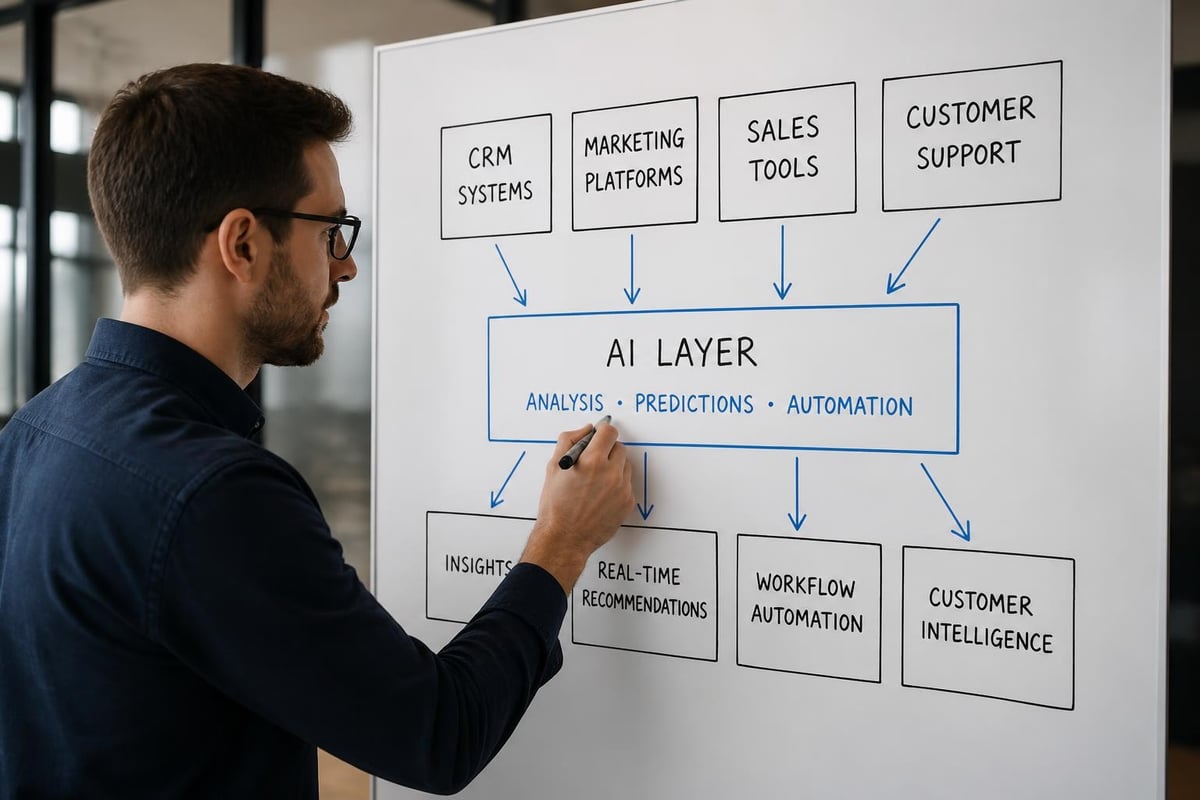
The technical foundation underlying ai solutions for business determines their ultimate effectiveness. Systems that operate in isolation deliver limited value compared to those that integrate seamlessly across your technology stack.
Building Connected AI Ecosystems
Successful AI implementations connect to existing business systems rather than replacing them. This requires careful architectural planning:
| Integration Layer | Function | Impact |
|---|---|---|
| Data aggregation | Combines information from CRM, marketing automation, support systems | Creates comprehensive customer view |
| Real-time sync | Ensures AI models work with current data | Improves prediction accuracy |
| Bidirectional communication | Allows AI insights to flow back to source systems | Enables automated action |
| API management | Standardizes connections between systems | Reduces integration complexity |
| Security and governance | Controls data access and usage | Maintains compliance |
Organizations should consider whether building versus buying AI tools aligns with their core competencies and strategic objectives. The reality is that most effective implementations combine off-the-shelf platforms with custom components tailored to specific business processes.
Data Quality and AI Performance
AI systems are only as good as the data they're trained on. Poor data quality produces unreliable predictions, erodes user trust, and ultimately leads to abandonment of AI initiatives.
Critical Data Quality Factors:
- Completeness: All required fields populated consistently
- Accuracy: Information reflects actual customer attributes
- Consistency: Data standardized across systems
- Timeliness: Information updated to reflect current state
- Relevance: Data collected aligns with AI use cases
Many organizations discover that implementing ai solutions for business requires parallel data hygiene initiatives. The good news is that AI can help clean data through anomaly detection, duplicate identification, and automated enrichment from external sources.
Measuring Success and Optimizing AI Performance
Deploying AI solutions for business is not a one-time project but an ongoing optimization process. The most successful implementations establish clear measurement frameworks from day one and commit to continuous improvement.
Establishing Baseline Metrics
Before implementing AI, document current performance across key metrics. This baseline provides the reference point for measuring AI impact:
Sales Metrics:
- Lead-to-opportunity conversion rate
- Average deal size
- Sales cycle length
- Win rate by lead source
- Rep productivity (activities per day, deals closed per quarter)
Marketing Metrics:
- Cost per lead
- Marketing qualified lead (MQL) to sales qualified lead (SQL) conversion
- Campaign ROI
- Content engagement rates
- Attribution accuracy
Onboarding Metrics:
- Time to first value
- Completion rates for onboarding milestones
- Early-stage churn rate
- Support ticket volume during onboarding
- Customer satisfaction scores
Track these metrics monthly to identify trends and attribute changes to AI implementation. Remember that some AI benefits, like improved data quality or better customer insights, may impact these metrics indirectly.
Continuous Learning and Model Refinement
AI models degrade over time as business conditions change, customer behavior evolves, and market dynamics shift. This phenomenon, called model drift, requires active management.
Establish processes for regular model retraining using updated data. Monitor prediction accuracy and compare AI recommendations against actual outcomes. When accuracy drops below acceptable thresholds, investigate whether the model needs retraining, the underlying data has quality issues, or business conditions have fundamentally changed.
Organizations leveraging AI tools for strategic business functions typically assign dedicated resources to monitor AI performance and coordinate optimization efforts across teams.
Implementation Roadmap for AI Adoption
Successful ai solutions for business deployments follow a structured implementation approach that balances quick wins with long-term strategic objectives.
Phase 1: Assessment and Planning (Weeks 1-4)
Begin by identifying high-impact use cases where AI can deliver measurable value quickly. Prioritize processes that are data-rich, repetitive, and currently consuming significant human resources.
Conduct a data inventory to understand what information is available, where it resides, and what quality issues need addressing. Map your current technology stack and identify integration requirements. Define success metrics and establish baseline measurements.
Phase 2: Pilot Implementation (Weeks 5-12)
Select one or two high-priority use cases for initial implementation. Start with narrow scope to minimize complexity and accelerate time-to-value. Common pilot projects include:
- Lead scoring and prioritization for sales teams
- Email send-time optimization for marketing campaigns
- Chatbot implementation for initial customer inquiries
- Automated data entry and enrichment
- Predictive churn identification
Run the pilot alongside existing processes to compare results and build confidence. Collect feedback from users and document lessons learned.
Phase 3: Scaling and Optimization (Weeks 13-26)
Based on pilot results, expand successful implementations and refine underperforming ones. Integrate AI capabilities more deeply into daily workflows. Provide training to ensure users understand how to leverage AI insights effectively.
This phased approach, similar to strategies employed when implementing comprehensive technology solutions, reduces risk while building organizational capability and confidence.
Overcoming Common Implementation Challenges
Even well-planned AI initiatives encounter obstacles. Understanding common challenges helps organizations prepare appropriate mitigation strategies.
Change Management and User Adoption
Technology succeeds or fails based on user adoption. Sales reps may resist AI-powered lead scoring if they believe it will reduce their autonomy. Marketing teams might distrust automated campaign optimization if they don't understand how the AI makes decisions.
Address adoption challenges through transparency, education, and inclusive implementation processes. Explain how AI works, involve users in defining requirements, and demonstrate value through pilot results. Position AI as augmenting human capabilities rather than replacing jobs.
Data Privacy and Ethical Considerations
AI solutions for business must navigate increasingly complex privacy regulations and ethical considerations. Systems that process customer data need appropriate consent mechanisms, security controls, and data governance policies.
Establish clear guidelines for AI usage, particularly around customer interactions. Ensure transparency about when customers are interacting with AI versus humans. Implement oversight mechanisms to catch and correct biased or inappropriate AI outputs.
Technical Debt and Legacy System Constraints
Organizations with legacy technology infrastructure may struggle to implement modern AI solutions. Old systems often lack APIs, store data in incompatible formats, or run on outdated platforms.
Rather than attempting complete infrastructure overhauls, identify strategic integration points and implement data bridges. Consider cloud-based AI platforms that can connect to legacy systems through standardized protocols. Plan incremental modernization aligned with AI roadmap priorities.
The Future of AI Solutions for Business Operations
The trajectory of AI development suggests even more profound changes ahead. Understanding emerging trends helps organizations prepare for the next wave of capability.
Agentic AI systems that operate with increasing autonomy will handle more complex workflows. These systems won't just execute predefined tasks-they'll make contextual decisions, coordinate with other AI agents, and adapt to changing conditions without human intervention.
The integration of large language models into business applications will enable more natural interactions between users and systems. Instead of navigating complex interfaces, users will describe what they want in plain language and let AI orchestrate the necessary actions across multiple systems.
Edge AI will bring processing closer to data sources, enabling real-time analysis and response even when internet connectivity is limited. This proves particularly valuable for field sales teams and distributed operations.
Organizations investing in ai solutions for business today are building the foundation for these future capabilities. The data infrastructure, integration architecture, and organizational capabilities developed now will determine how quickly companies can adopt next-generation AI tools.
The transformation enabled by AI solutions for business extends far beyond automation-it fundamentally changes how organizations compete, deliver value, and scale operations. Success requires strategic planning, thoughtful implementation, and continuous optimization based on measurable outcomes. If you're ready to explore how custom AI systems can transform your sales, marketing, and onboarding processes, Ryan Cook specializes in building tailored solutions that deliver measurable results. Our team develops AI implementations designed specifically for your business context, ensuring technology serves your strategic objectives rather than dictating them.