June 21, 2026 · Bizware
AI Strategy Consulting for Sales and Marketing Growth
Discover how AI strategy consulting transforms sales and marketing operations. Learn frameworks, implementation steps, and ROI strategies.

Organizations investing in artificial intelligence without a cohesive strategy often find themselves with disconnected tools, frustrated teams, and minimal return on investment. The difference between successful AI adoption and costly missteps lies in strategic planning that aligns technology capabilities with business objectives. This is where ai strategy consulting becomes essential for companies looking to transform their sales, marketing, and customer onboarding operations through intelligent automation.
Understanding the Scope of AI Strategy Consulting
AI strategy consulting encompasses far more than selecting software platforms or implementing chatbots. It represents a comprehensive approach to identifying where artificial intelligence can create measurable business value, then building the roadmap to achieve those outcomes.
Professional consultants begin by assessing your current operational landscape. They examine existing workflows, data infrastructure, team capabilities, and customer touchpoints. This diagnostic phase reveals opportunities where AI can eliminate friction, accelerate processes, or unlock insights previously hidden in your data.
The core components of effective ai strategy consulting include:
- Business objective alignment and value identification
- Data readiness assessment and architecture planning
- Technology selection and vendor evaluation
- Implementation roadmap development with clear milestones
- Change management and team training strategies
- Performance measurement frameworks

Why Generic AI Approaches Fail
Many organizations approach AI adoption by purchasing popular tools and hoping for transformation. This technology-first mindset frequently leads to disappointment. As experts note, treating AI as the strategy itself rather than integrating it within broader business transformation initiatives prevents meaningful outcomes.
Sales and marketing teams particularly struggle with this approach. A CRM with AI features doesn't automatically improve conversion rates. An email platform with predictive analytics won't boost engagement without proper strategy. The technology alone cannot solve problems it wasn't specifically configured to address.
Strategic consulting flips this equation. It starts with business challenges: How do we shorten our sales cycle? What content resonates with high-value prospects? Which leads deserve immediate attention? Only after defining these questions does the consultant recommend AI solutions tailored to answer them.
Key Implementation Phases
Implementing AI across sales and marketing operations requires structured progression through distinct phases. AI strategy consulting follows a proven roadmap that moves organizations from assessment through full-scale deployment.
Phase One: Discovery and Assessment
The discovery phase typically spans 2-4 weeks and establishes the foundation for everything that follows. Consultants conduct stakeholder interviews, analyze current processes, and evaluate data quality. They identify quick wins that can build momentum while mapping longer-term opportunities.
During assessment, consultants examine:
- Current sales conversion rates and pipeline velocity
- Marketing campaign performance and attribution models
- Customer onboarding completion rates and time-to-value
- Data collection practices and integration points
- Team skills and resistance to change factors
This phase concludes with a comprehensive report that prioritizes AI opportunities based on potential impact and implementation feasibility.
Phase Two: Strategy Development
With assessment complete, consultants develop your customized AI strategy. This document becomes your organization's blueprint for the next 12-24 months. It specifies which processes will receive AI augmentation, what success looks like, and how you'll measure progress.
| Strategic Element | Questions Addressed | Deliverables |
|---|---|---|
| Vision & Goals | What will AI enable us to achieve? | 3-year AI vision statement, annual objectives |
| Use Case Portfolio | Which processes get AI first? | Prioritized use case matrix with ROI projections |
| Technology Stack | What platforms and tools do we need? | Vendor shortlist, architecture diagrams |
| Implementation Plan | What happens when? | Phased rollout timeline, resource requirements |
| Governance Model | Who makes AI decisions? | AI council structure, approval workflows |
The strategy phase ensures everyone understands not just what you're building, but why it matters for the business.
Phase Three: Pilot Program Launch
Rather than enterprise-wide deployment, effective ai strategy consulting recommends starting with focused pilots. These controlled experiments prove value before significant investment.
A sales-focused pilot might implement AI-powered lead scoring for one product line or territory. The system learns from historical data to predict which prospects most likely convert, allowing representatives to prioritize effectively. Meanwhile, marketing might pilot AI content personalization for a specific customer segment.
Pilot programs should include:
- Clear success metrics established before launch
- Control groups for comparison
- Regular check-ins to address challenges
- Documentation of lessons learned
- Stakeholder communication updates
Successful pilots generate internal champions who advocate for broader AI adoption.

Sales and Marketing AI Applications
For organizations focused on revenue generation, ai strategy consulting delivers the greatest value when applied to sales and marketing operations. These functions generate abundant data while directly impacting business growth.
Transforming Sales Processes
AI revolutionizes sales teams by automating research, prioritizing activities, and personalizing outreach. Strategic implementation creates systems that enhance human capabilities rather than replacing salespeople.
Lead scoring algorithms analyze behavioral signals, demographic data, and engagement patterns to identify prospects most likely to convert. This allows sales representatives to focus energy where it matters most. AI tools for financial advisors demonstrate how specialized AI applications can transform prospecting and client acquisition in professional services.
Conversation intelligence platforms record sales calls, extract insights, and identify coaching opportunities. They surface which objections frequently arise, what messaging resonates, and when deals stall. Sales managers gain objective data to improve team performance.
Automated outreach sequences use AI to determine optimal contact timing, channel selection, and message personalization. Instead of generic email blasts, systems craft communications tailored to individual prospect behaviors and preferences.
Enhancing Marketing Operations
Marketing teams leverage AI for content creation, campaign optimization, and customer journey orchestration. Strategic consulting ensures these capabilities integrate cohesively rather than creating isolated tools.
AI-powered marketing applications include:
- Predictive analytics that forecast campaign performance before launch
- Dynamic content personalization based on visitor behavior and profile
- Automated A/B testing that continuously optimizes messaging
- Customer segmentation that identifies micro-audiences for targeted campaigns
- Attribution modeling that reveals which touchpoints drive conversions
Understanding B2B email marketing strategies becomes more sophisticated when AI analyzes send times, subject lines, and content elements that correlate with engagement. Marketing teams shift from intuition-based decisions to data-driven optimization.
Building Effective Data Foundations
Artificial intelligence quality depends entirely on data quality. The most sophisticated algorithms cannot overcome incomplete, inconsistent, or inaccessible information. This is why enterprise AI strategy consulting emphasizes data architecture as a prerequisite for successful implementation.
Data Collection and Integration
Sales and marketing teams often work with fragmented data scattered across multiple systems. Customer information lives in the CRM, engagement data sits in the marketing platform, support tickets exist in separate software, and financial details remain in accounting systems.
AI strategy consulting addresses this fragmentation by designing integration architectures that create unified customer views. When systems share data seamlessly, AI models can analyze the complete customer journey rather than isolated touchpoints.
For organizations exploring CRM solutions for financial advisors, integration becomes particularly critical. Client relationship management requires connecting prospecting activities, communication history, service delivery, and compliance documentation.
Data Governance and Quality
Establishing data governance ensures consistency, accuracy, and compliance. Consultants help organizations define:
- Data ownership and stewardship roles
- Quality standards and validation rules
- Privacy policies and security protocols
- Retention schedules and archival procedures
- Access controls and usage policies
Poor data governance undermines AI initiatives. Models trained on inaccurate data produce unreliable predictions. Systems accessing incomplete information miss critical patterns. Investment in governance pays dividends throughout the AI lifecycle.
Measuring ROI and Business Impact
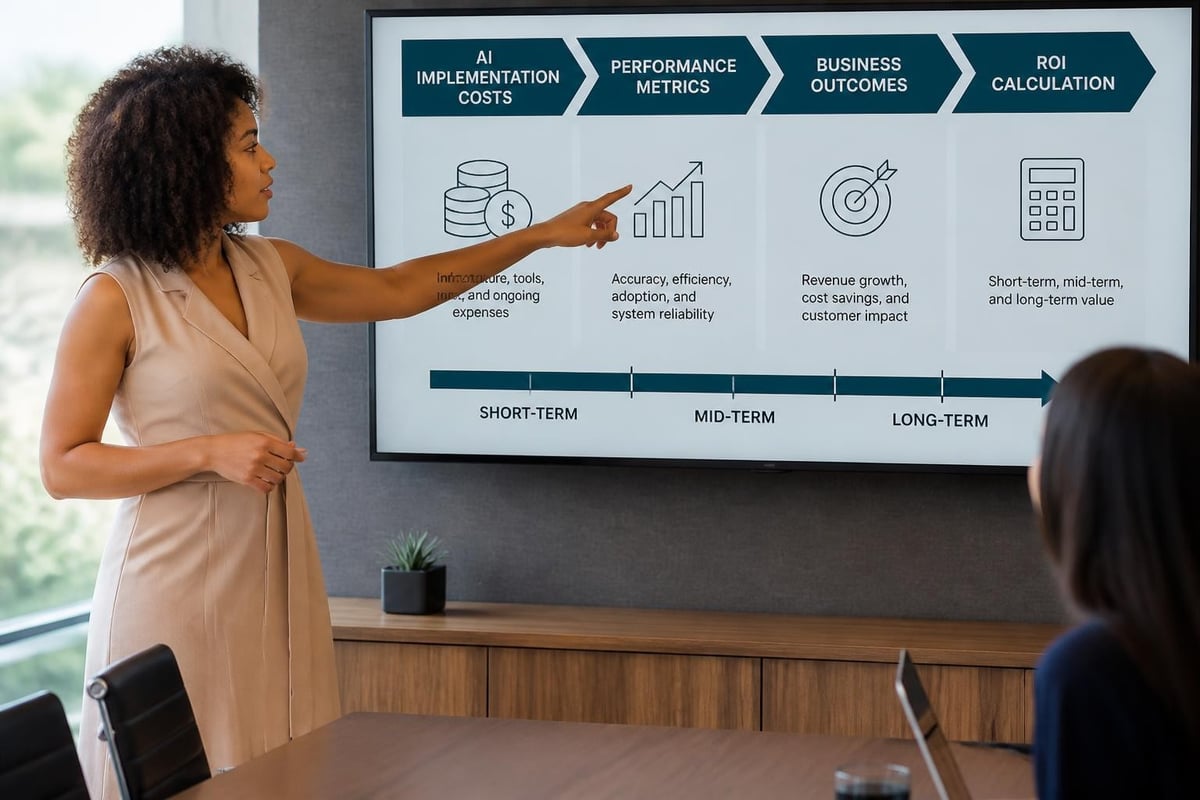
Organizations demand measurable returns from AI investments. Effective ai strategy consulting establishes clear metrics before implementation begins, then tracks progress against defined benchmarks.
Defining Success Metrics
Different AI applications require different measurement approaches. Sales AI might track metrics like conversion rate improvement, pipeline velocity increase, or deal size growth. Marketing AI focuses on customer acquisition cost reduction, campaign ROI enhancement, or engagement rate improvement.
| Application Area | Key Performance Indicators | Target Improvement |
|---|---|---|
| Lead Qualification | Conversion rate from MQL to SQL | 25-40% increase |
| Sales Forecasting | Forecast accuracy | 15-25% improvement |
| Email Marketing | Open and click-through rates | 30-50% increase |
| Customer Onboarding | Time to first value, completion rate | 20-35% improvement |
| Content Personalization | Engagement duration, conversion rate | 40-60% increase |
These metrics provide objective evidence of AI value, justifying continued investment and expansion.
Calculating Total Cost of Ownership
Understanding true AI costs requires looking beyond software licensing fees. Comprehensive analysis includes implementation costs, ongoing maintenance, training expenses, and opportunity costs during deployment.
Consultants help organizations build realistic budgets that account for:
- Platform and tool licensing
- Integration and customization development
- Data infrastructure upgrades
- Team training and change management
- Consultant or specialist fees
- Ongoing optimization and refinement
This complete picture enables accurate ROI calculations and prevents budget surprises.
Overcoming Common Implementation Challenges
Even well-planned AI initiatives encounter obstacles. Experienced ai strategy consulting anticipates these challenges and builds mitigation strategies into the roadmap.
Addressing Team Resistance
Sales and marketing professionals sometimes view AI as a threat to their roles. They worry about automation replacing human judgment or technology exposing performance gaps. Research shows that 70% of AI value comes from rethinking how people work, making change management critical.
Effective consultants frame AI as augmentation rather than replacement. They demonstrate how automation handles repetitive tasks, freeing professionals for high-value activities. A salesperson spending less time on data entry can invest more in relationship building. A marketer liberated from manual reporting can focus on creative strategy.
Involving team members in AI design and testing builds buy-in. When people help shape solutions, they become stakeholders in success rather than passive recipients of change.
Managing Technical Complexity
AI implementation involves complex technical decisions about platforms, integrations, and architectures. Organizations without deep technical expertise benefit from consultant guidance through vendor selection, contract negotiation, and system design.
Consultants evaluate options based on your specific requirements rather than generic recommendations. They consider factors like existing technology investments, team capabilities, scalability needs, and budget constraints. This tailored approach prevents costly mismatches between solutions and requirements.
Selecting the Right Consulting Partner
Not all ai strategy consulting delivers equal value. Organizations should evaluate potential partners based on relevant experience, methodology, and cultural fit.
Essential qualifications include:
- Proven track record in your industry or function
- Deep technical knowledge combined with business acumen
- Collaborative approach that builds internal capabilities
- Transparent pricing and scope definition
- References from similar organizations
- Commitment to measurable outcomes
The best consultants view engagements as partnerships rather than transactions. They invest in understanding your unique context, challenge assumptions when appropriate, and transfer knowledge to build lasting organizational capability.
Future-Proofing Your AI Strategy
AI technology evolves rapidly. What seems cutting-edge today may become standard practice within months. Strategic consulting helps organizations build adaptable frameworks that accommodate future developments without constant reinvention.
This requires focusing on foundational capabilities rather than specific tools. Strong data infrastructure, skilled teams, and clear governance enable smooth adoption of new AI capabilities as they emerge. Organizations can upgrade components without rebuilding entire systems.
Consultants also help establish innovation processes for continuous AI evolution. Regular reviews assess performance, identify new opportunities, and adjust priorities based on changing business needs. AI strategy becomes an ongoing practice rather than a one-time project.
Ethical and Responsible AI Practices
As AI capabilities expand, organizations must address ethical considerations and potential risks. Best practices in AI governance emphasize transparency, fairness, and accountability.
Strategic consulting incorporates responsible AI principles from the beginning:
- Ensuring algorithms avoid discriminatory bias
- Maintaining transparency about AI use with customers
- Protecting privacy and data security
- Establishing human oversight for critical decisions
- Planning for potential failure modes and mitigation
These practices protect brand reputation while building customer trust in AI-enhanced experiences.
Industry-Specific Considerations
While AI principles apply broadly, implementation details vary by industry. Marketing services organizations face different challenges than healthcare providers or manufacturers.
For professional services firms, ai strategy consulting often emphasizes client relationship management, personalized communication, and knowledge management. Financial advisors benefit from AI that enhances prospecting tools for financial advisors and streamlines compliance workflows.
Consultants with industry expertise understand regulatory requirements, competitive dynamics, and customer expectations specific to your sector. This knowledge accelerates implementation and reduces compliance risk.
Building Long-Term AI Capabilities
The ultimate goal of ai strategy consulting extends beyond implementing specific solutions. Successful engagements build organizational capabilities that sustain AI innovation after consultants depart.
This means developing internal expertise through training and knowledge transfer. Team members learn to identify AI opportunities, evaluate solutions, and manage implementations. Organizations reduce dependence on external resources while maintaining innovation momentum.
Consultants should document decisions, create playbooks, and establish communities of practice that preserve knowledge. These resources enable teams to solve future challenges independently.
Strategic AI implementation transforms how sales and marketing teams operate, delivering measurable improvements in efficiency, effectiveness, and customer experience. Success requires careful planning, focused execution, and commitment to building lasting capabilities. Ryan Cook specializes in developing custom AI solutions that support sales, marketing, and onboarding processes, helping organizations navigate the complexities of AI adoption with proven frameworks and hands-on implementation support.