
Email marketing is the practice of sending commercial messages to people who have given you permission to contact them, with the goal of building relationships, generating leads, and driving sales. It works by collecting subscribers, grouping them by interest or stage, sending relevant messages through an email platform, and measuring how recipients respond. For small B2B teams, it remains one of the few channels you fully own, because no algorithm decides whether your audience sees the message.
This guide explains the mechanics, the main email types, the compliance rules that now govern delivery, and how to measure whether your program earns its place.
How Email Marketing Works
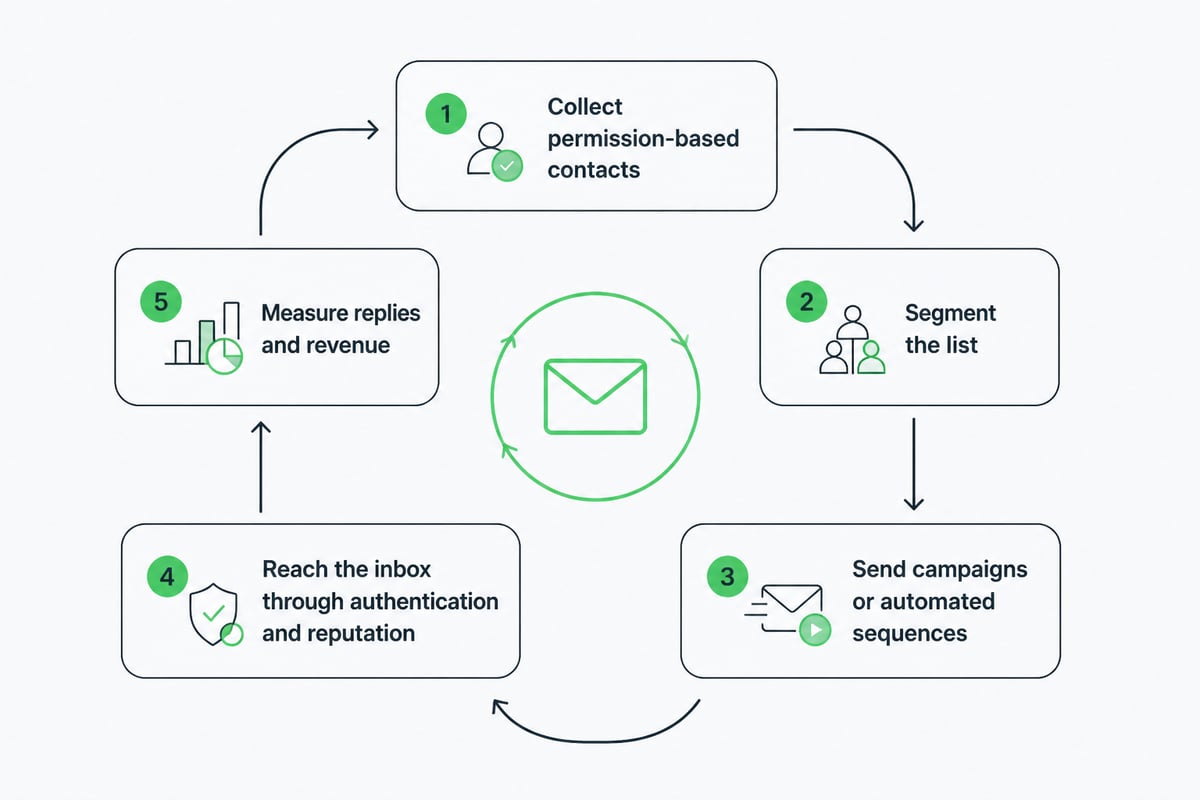
Email marketing works as a loop of five stages: collect permission-based contacts, organize them, send messages, deliver them to the inbox, and measure the results.
- Collect contacts. Subscribers join through a website form, a gated resource, an event sign-up, or a sales conversation where the prospect agrees to receive updates.
- Organize the list. Contacts are tagged and grouped by industry, role, source, or buying stage. This is called segmentation.
- Create and send. You write a message, choose a segment, and send it through an email service provider (ESP) or CRM. Messages go out as one-time campaigns or as automated sequences triggered by behavior.
- Reach the inbox. Mailbox providers check authentication, sender reputation, and recipient engagement before deciding between the inbox, a promotions tab, or spam.
- Measure and adjust. Open rates, click rates, replies, meetings booked, and revenue tell you which messages deserve repetition.
An ESP handles the technical work: storing contacts, managing unsubscribes, scheduling sends, and reporting. Many CRMs bundle these functions, and teams already working inside one should read about email marketing in Salesforce before adding another tool.
Why Email Marketing Matters for Small B2B Teams
Email marketing matters because it delivers a measurable return, gives you direct access to buyers, and supports long sales cycles in a way that one-off ads cannot.
Return on investment is the usual headline. In Litmus's 2025 survey of nearly 500 marketing professionals, a large share of respondents reported earning $10 to $36 for every $1 spent on email, and a smaller group reported returns above $36 per dollar spent (Litmus). These are self-reported figures from marketers, so treat them as directional rather than guaranteed. Still, the pattern holds across most surveys: email costs little to run compared with paid media.
Three reasons stand out for owner-led B2B teams:
- You own the audience. A subscriber list belongs to you, unlike social followers or search rankings.
- Sales cycles are long. B2B buyers rarely purchase on first contact. Regular, useful messages keep your company in view until the buyer is ready.
- It connects marketing to selling. Replies, forwarded messages, and booked meetings give sales managers direct signals about who is interested.
Email also pairs well with other channels. Paid campaigns and content bring in new contacts, and email converts them. If you are mapping the wider picture, the guide on marketing your business shows where each channel fits.
Types of Marketing Emails With Examples
The main types of marketing emails are welcome emails, newsletters, lead nurturing sequences, promotional offers, re-engagement emails, and transactional messages, each tied to a different stage of the relationship.
| Email type | Purpose | B2B example |
|---|---|---|
| Welcome | Set expectations, deliver the promised resource | A three-email series after a prospect downloads a pricing checklist |
| Newsletter | Stay visible with useful content | A monthly note with one customer story and one practical tip |
| Lead nurturing | Move a contact toward a conversation | A five-email sequence addressing common objections |
| Promotional | Drive a specific action | An invitation to a webinar or a limited-time audit |
| Re-engagement | Revive inactive contacts | A "still interested?" message after 90 days of silence |
| Transactional | Confirm or inform | A meeting confirmation with an agenda |
Welcome and onboarding emails
Welcome emails receive the highest attention of any message you send, because the subscriber has just opted in. Deliver the promised resource immediately, state how often you will write, and ask one simple question to start a conversation.
Lead nurturing sequences
A nurturing sequence is a short series of automated emails triggered by an action, such as a form fill. Each message answers one question the buyer is likely asking at that stage. Automation tools make this practical for a small team, and the overview of AI marketing automation covers how triggers and sequences are built.
Re-engagement emails
Inactive contacts drag down engagement and can hurt deliverability. A brief re-engagement series with a clear option to stay or leave cleans the list and often recovers a handful of real opportunities.
How to Do Email Marketing Step by Step
Email marketing is done by setting one goal, building a consented list, choosing a platform, writing for a single reader, and testing before you send.
- Set one measurable goal. Examples: 20 booked discovery calls per quarter, or a 15% reply rate on a nurturing sequence.
- Build the list with consent. Offer something specific in exchange for an address, such as a template or benchmark report. Never buy lists.
- Choose a platform. Pick one that supports segmentation, automation, authentication setup, and one-click unsubscribe.
- Segment before you write. A message to "owners of five-person sales teams" outperforms a message to "everyone."
- Write for one reader. Use a clear subject line, one idea per email, and one call to action.
- Test and send. Send a proof to yourself, check mobile display, and test links.
- Review results weekly. Compare against your goal, then change one variable at a time.
Teams that want help turning the plan into execution can look at the AI marketing campaigns overview, or at Hummingbird Agency for outside strategy and creative support.
The Five C's of Email
The five C's of email are clarity, conciseness, courtesy, correctness, and consideration of the reader, and they apply to every marketing message you write.
- Clarity: State the point in the first two sentences. A reader should know why the email exists before scrolling.
- Conciseness: Cut every sentence that does not move the reader toward the one action you want.
- Courtesy: Respect the recipient's time and inbox. Make unsubscribing easy.
- Correctness: Check names, links, and facts. A wrong first name undermines trust faster than a weak offer.
- Consideration: Write about the reader's problem, not your product. Ask what the person gains from opening.
These principles also work as a quick review checklist before any send.
Deliverability and Compliance Rules
Deliverability is the share of your emails that reach the inbox, and it now depends on technical authentication and low complaint rates, particularly for senders reaching Gmail users.
Google defines a bulk sender as one sending close to 5,000 or more messages to personal Gmail accounts within 24 hours, and messages from the same primary domain count toward that threshold. Most small B2B teams stay well below that volume, but the standards are worth following regardless, since they reflect what mailbox providers reward.
Google's requirements for bulk senders include:
- Authentication: SPF, DKIM, and DMARC must be in place.
- Easy unsubscribe: Marketing and subscribed messages must support one-click unsubscribe and show a clearly visible unsubscribe link.
- Low spam complaints: Google advises keeping the reported spam rate low and well away from the higher thresholds it warns about.
Even a small complaint rate adds up across a large send, so list quality matters more than list size. A small, engaged list of 1,000 qualified contacts will outperform a purchased list of 10,000.
How to Measure Email Marketing Results
You measure email marketing by tracking engagement, conversions, and revenue, and by tying each metric back to the goal you set at the start.
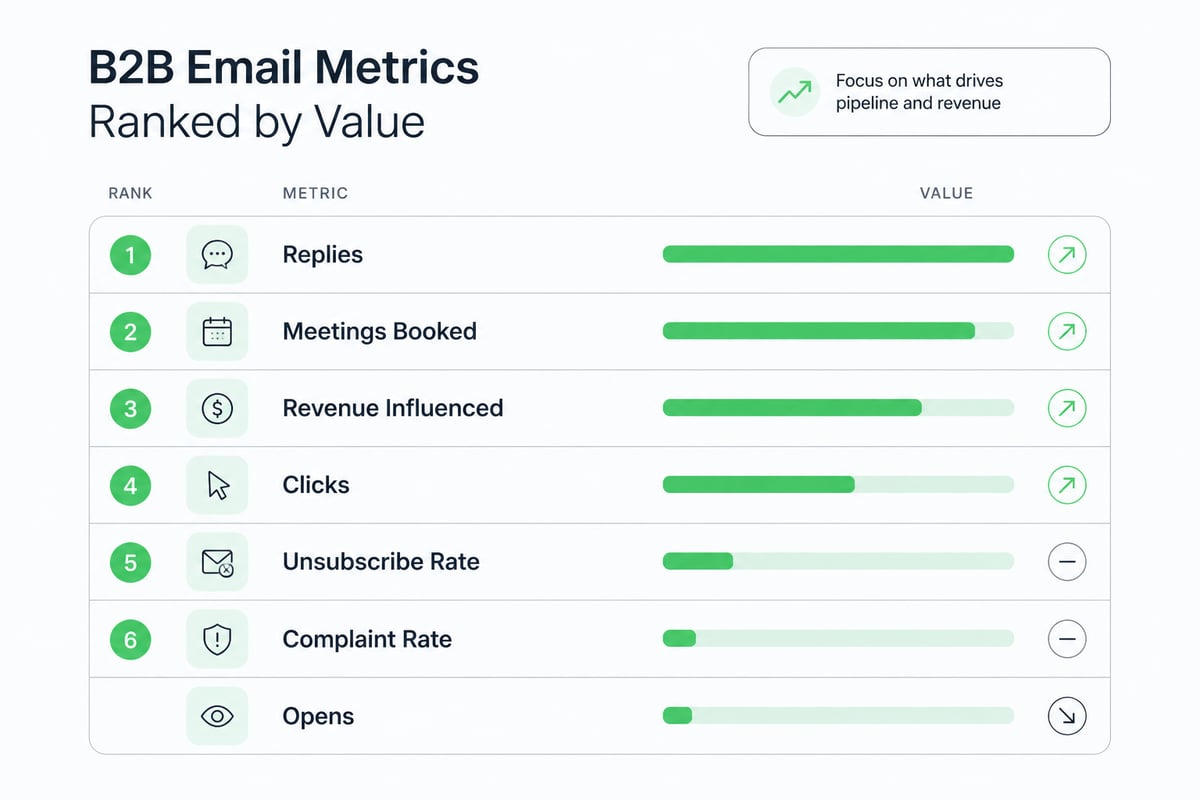
In the Litmus survey cited earlier, most marketers used customer-engagement metrics to assess email, and many tracked marketing-qualified leads or conversions or attributed revenue directly to email campaigns (Litmus). For a small B2B team, a practical scorecard looks like this:
- Reply rate: The strongest signal in B2B, because it shows real interest.
- Click-through rate: Shows whether the content and call to action match.
- Meetings booked: Connects email to pipeline.
- Unsubscribe and complaint rates: Early warnings about relevance.
- Revenue influenced: Closed deals where email touched the buyer's path.
Open rates have become less reliable because mail privacy features inflate them, so weight clicks and replies more heavily.
Connecting Email to Sales Conversations
Email results only improve when what you write matches what buyers actually say on calls, which makes sales conversations an underused source of email material.
Objections raised on discovery calls become the subjects of nurturing emails. Phrases prospects use to describe their problems become better subject lines than anything brainstormed in a meeting. The practical challenge for an owner who cannot listen to every call is capturing those patterns consistently.
This is where call analysis helps. Ryan Cook captures virtual and in-person sales conversations in one place and scores each call against your own sales playbook, so you can see which objections and questions recur across reps. Those findings feed directly into email copy, and the same data shows which reps need coaching on follow-up. For background on this approach, see the guides on sales call analysis software and how to coach sales reps.
Consultants and coaches advising B2B teams can use the same method: review call patterns with a client, then build a short email sequence around the top three objections. It gives the client an ongoing asset rather than a one-time workshop.
Personalization, AI, and What Is Changing
Personalization in email means adjusting content to the recipient's role, behavior, or stage, and AI is increasingly used to produce and analyze it faster.
In Litmus's State of Email 2025 survey of nearly 500 email marketers, many said advanced AI-driven content generation and analytics would be the biggest change that year. The same survey found the obstacles are practical, with developing content efficiently, collecting and analyzing data, and measuring personalization's impact all cited as personalization challenges.
For a small team, the sensible approach is modest. Personalize by segment and trigger first, then use AI to draft variations that a human edits. The overview of AI in marketing and the guide to AI content marketing describe where drafting help is useful and where human judgment should stay in control.
FAQ
How much is a 1,000 email list worth?
The value depends on who is on the list and how engaged they are. A simple estimate multiplies list size by conversion rate and average deal value: if 1% of 1,000 qualified contacts become customers worth $5,000 each, the list is worth about $50,000. A list of 1,000 purchased or unengaged addresses may be worth close to nothing and can damage your sender reputation.
Do Gen Z buyers like email marketing?
Younger professionals use email heavily for work, so B2B email reaches them in a channel they already check. They respond better to short, specific, mobile-friendly messages with a clear reason to read. Generic mass mailings tend to be ignored regardless of age.
How often should a small B2B team send marketing emails?
Most small teams do well with one newsletter or campaign every two to four weeks, plus an automated welcome and nurturing sequence. Consistency matters more than volume. Watch unsubscribe and complaint rates, and reduce frequency if either rises.

Start this week by pulling the three objections that came up most often on your last ten sales conversations and drafting one short email that answers each. If you want those patterns surfaced from every call without listening to each recording yourself, Ryan Cook scores calls against your playbook and gives each rep private coaching, and you can start a 30-day free trial of Ryan Cook to see what your calls reveal.