
To measure sales rep performance with call data, track a small set of outcome metrics (win rate, quota attainment, sales cycle length) alongside call behaviors you score against your own playbook (discovery depth, objection handling, next-step commitment). Outcomes tell you who is winning, and call data tells you why. Owners and managers who cannot listen to every conversation need both, because results alone arrive too late to coach and activity counts alone say nothing about quality.
Most performance frameworks stop at pipeline and revenue figures, such as those covered in Salesforce's overview of sales KPIs. Those numbers matter. The gap is that they describe what happened after the conversation ended. This article covers the metrics worth tracking, how to turn raw calls into scores, how to set a ramp-up standard, and the tools that make call-based measurement practical for a small team.
The two layers of sales rep performance
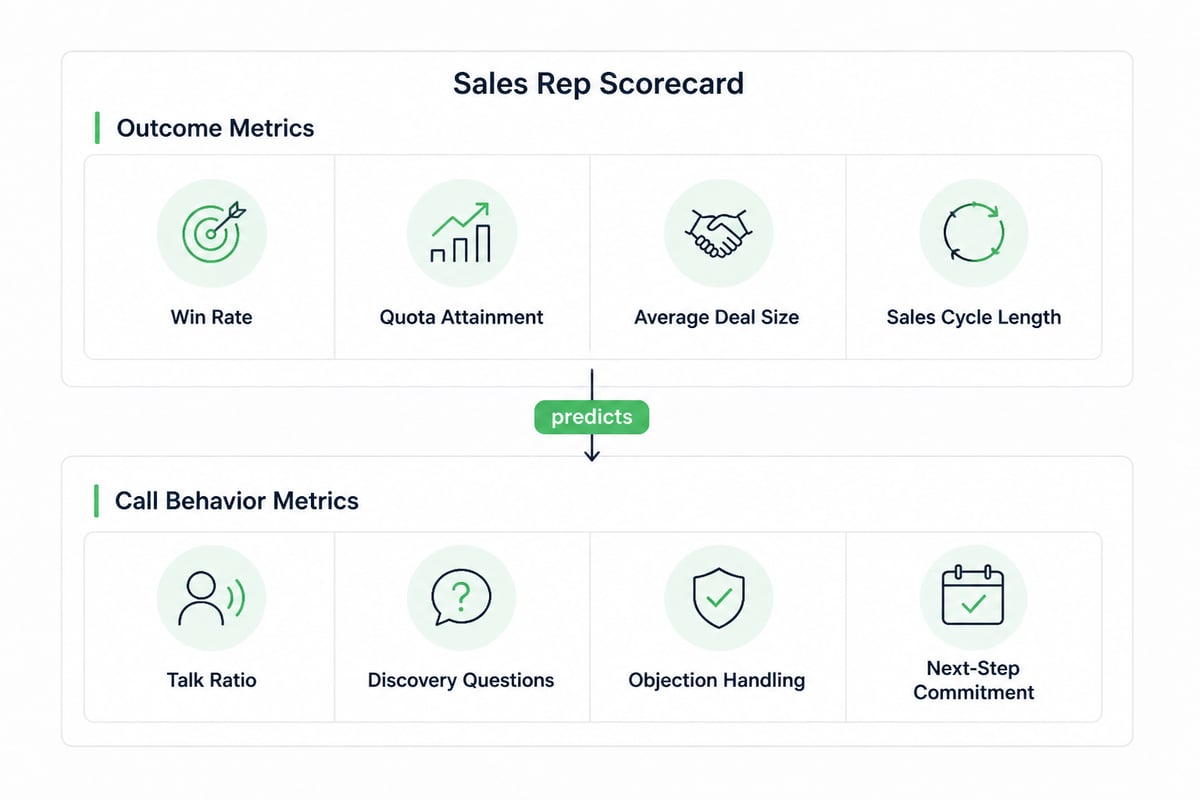
Sales rep performance is best measured in two layers: lagging outcomes that show results, and leading call behaviors that predict them.
Lagging metrics are the familiar ones. As summarized in CaptivateIQ's breakdown of sales performance metrics, they include quota attainment, win rate, average deal size, and sales cycle length. They are reliable, but they move slowly, so a rep can miss quota for a long stretch before the pattern is obvious.
Leading metrics come from the conversations themselves. They show up days after a call, not months. For a team of three to ten reps, this is where coaching decisions should start.
A simple way to hold both layers together:
- Outcome layer: win rate, quota attainment, average deal size, sales cycle length
- Behavior layer: talk-to-listen ratio, discovery questions asked, objections handled, next step secured
- Consistency layer: how closely each call follows the team's agreed playbook
What are the key performance indicators in sales?
The five sales KPIs most worth tracking for individual reps are win rate, quota attainment, average deal size, sales cycle length, and lead response time. Together they cover conversion, volume, value, speed, and responsiveness.
- Win rate: opportunities won divided by opportunities worked. It is the clearest single signal of call and closing quality.
- Quota attainment: revenue closed against target. Useful, but heavily influenced by territory and lead quality.
- Average deal size: shows whether a rep is selling value or discounting to close.
- Sales cycle length: days from first conversation to close. Long cycles often point to weak early qualification.
- Lead response time: how quickly a rep follows up. Fast response correlates with better early engagement.
A useful way to avoid mixing team-level numbers with individual rep numbers is to separate performance, growth, and operations metrics, as IBM's guide to sales metrics does. Keep rep scorecards limited to what a rep can actually control.
Which call metrics reveal rep skill?
The call metrics that best reveal rep skill are talk-to-listen ratio, discovery question count, objection handling, and next-step commitment. Each one maps to a behavior a manager can coach.
Talk-to-listen ratio
Reps who dominate the conversation tend to under-discover. A reasonable working goal is for the rep to speak well under half of the call during discovery. Treat any benchmark as a starting point and adjust it against your own best performers' calls.
Discovery depth
Count how many open questions a rep asks about the buyer's problem, timeline, budget, and decision process before presenting. A rep who pitches in the first five minutes is usually skipping qualification, which later shows up as a stretched sales cycle.
Objection handling
Note which objections come up (price, timing, incumbent vendor, authority) and whether the rep acknowledged, explored, and responded or simply defended the offer. Patterns across calls matter more than any single call.
Next-step commitment
A call that ends with a dated, specific next step (a scheduled demo, a stakeholder invite, a proposal review) keeps deals moving. Calls that end with "I'll follow up" stall. This is one of the simplest behaviors to score and one of the most predictive.
Playbook adherence
Score each call against your team's own sales playbook, not a generic framework. If your playbook says every first call confirms budget range and decision-maker, adherence is whether that happened. This turns subjective impressions into a repeatable number.
How to measure sales rep performance with a call scorecard
The most reliable way to measure sales rep performance from calls is a weighted scorecard with four to six criteria, applied to the same number of calls per rep each month. Consistency matters more than sophistication.
Build it in five steps:
- Define the playbook behaviors. Pick the four to six moments that most often separate won deals from lost ones on your team.
- Write a pass or fail standard for each. "Asked about budget" is scorable. "Built rapport well" is not.
- Weight the criteria. Next-step commitment and discovery usually deserve more weight than opening pleasantries.
- Sample evenly. Score the same number of calls per rep so one rep's best call does not stand in for their average.
- Review monthly and compare to outcomes. If a high-scoring behavior does not correlate with wins, revise the scorecard.
Manual scoring works for a handful of calls, but it breaks down once a manager is running their own pipeline too. That is the practical reason small teams adopt call capture and automated scoring.
How to use the 30-60-90 rule to judge new reps
The 30-60-90 rule is a ramp-up framework that sets a distinct performance expectation for a new rep at day 30, day 60, and day 90. Call data makes each checkpoint measurable instead of a gut call.
- Days 1 to 30, learn: The rep should be running calls that follow the playbook structure. Measure playbook adherence and discovery question count, not revenue.
- Days 31 to 60, apply: The rep should be holding full conversations independently. Measure next-step commitment rate and objection handling quality.
- Days 61 to 90, produce: The rep should be generating pipeline. Now measure opportunity-to-win rate and early cycle length.
The benefit is that a struggling new hire shows up at day 30 on adherence scores, not at day 90 on missed numbers. Your thresholds should come from how your own tenured reps performed at the same stage.
Common mistakes when measuring rep performance
A few patterns produce misleading conclusions:
- Tracking activity as if it were quality. Call counts and email volume reward motion. A rep making 80 weak calls is not outperforming one making 40 strong ones.
- Using too many metrics. Reference lists of sales performance metrics are useful, but a rep scorecard with dozens of numbers will not change behavior. Choose five to eight.
- Coaching on averages. A rep's average score hides the specific moment that costs them deals. Review individual calls for the behavior gap.
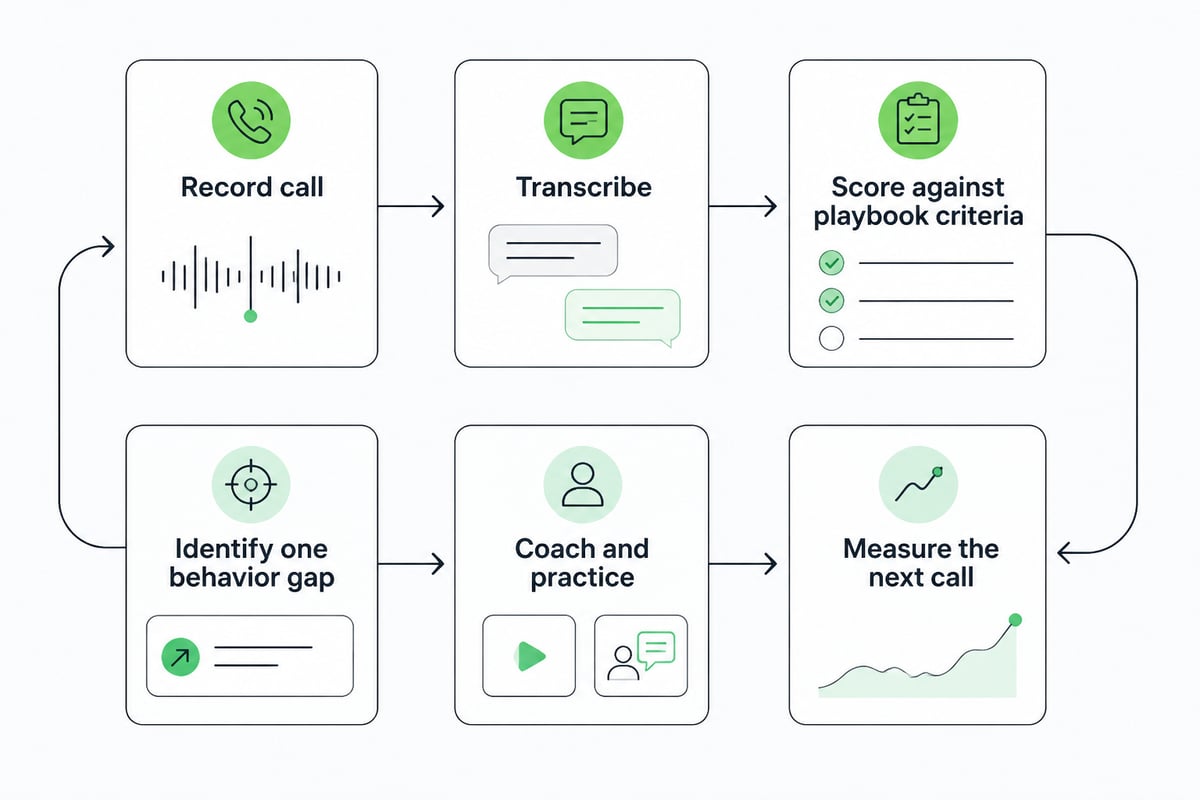
- Skipping the follow-through. Scoring without a defined next call to measure improvement produces reports, not growth. Each coaching step should target one behavior and be checked on the next call.
- Comparing reps across different lead sources. Inbound and outbound reps face different conversations. Compare like with like.

Tools that capture and score call data
Call-based measurement needs three things: reliable recording and transcription, scoring against criteria you define, and a way to turn findings into coaching. The tools below cover those needs at different depths. Prices are approximate and change often, so check each vendor's current pricing.
1. Fireflies.ai
Fireflies.ai records and transcribes calls into searchable text, with AI notes, summaries, and action-item extraction. It offers a free plan, and paid tiers are priced per seat.
- Key specs: searchable call transcripts, AI summaries, action-item extraction
- Suits: small teams that need a low-cost way to search and review conversations manually, such as spot-checking how discovery questions were asked
- Verdict: an economical capture layer, but scoring and coaching structure are yours to build.
2. Avoma
Avoma combines meeting recordings, real-time transcription, and summaries with AI call scoring and coaching. Recorder seats and the conversation-intelligence add-on are priced separately, so total cost depends on which add-ons you choose.
- Key specs: meeting recordings, real-time transcription, AI call scoring and coaching, modular add-ons
- Suits: meeting-heavy teams that want to add call analysis and coaching in stages rather than buy everything at once
- Verdict: a flexible modular option; total cost depends on which add-ons you stack.
3. Jiminny
Jiminny provides searchable voice and video recordings with conversation analytics and coaching insights, and it covers email, phone, and video. Pricing is by custom quote, so budgeting is less predictable.
- Key specs: voice and video recordings, conversation analytics, coaching insights, email, phone, and video coverage
- Suits: mid-market teams that want coaching signals across calls, meetings, and email in one view
- Verdict: broad channel coverage, though custom pricing makes budgeting less predictable.
4. Claap
Claap scores calls against team-defined criteria, includes coaching features, and completes CRM data from conversations. A free plan exists, with paid plans priced per license per month.
- Key specs: call scoring against team criteria, coaching features, CRM data completion
- Suits: teams that want a structured scorecard applied to calls and tidier CRM records without extra admin work
- Verdict: a good match for scorecard-driven measurement at a mid-range price.
5. Bizware AI Sales Coach
Bizware AI Sales Coach captures virtual and in-person sales conversations in one place and scores every call against the team's own sales playbook. Each rep receives private coaching plus voice or text role-play built on moments from their real calls, and a manager dashboard shows progress. The Starter plan is priced at $77 per user per month billed annually.
- Key specs: call capture across virtual and in-person conversations, playbook-based scoring, private rep coaching, voice and text role-play, manager dashboard
- Suits: small owner-led B2B teams where the owner or manager cannot listen to every call and wants one behavior gap addressed at a time, with a measurable next call
- Verdict: the strongest fit when the goal is closing the loop from score to coaching to the next call, not only recording conversations. Teams that only want meeting notes or a standalone practice tool without call capture will find it more than they need.
Comparison of call measurement tools
| Tool | Approximate starting price | Core strength | Best use |
|---|---|---|---|
| Fireflies.ai | Free plan; paid tiers per seat | Searchable transcripts and summaries | Low-cost manual call review |
| Avoma | Recorder seats plus separately priced add-on | Modular scoring and coaching | Meeting-heavy teams adding analysis in stages |
| Jiminny | Custom quote | Calls, meetings, and email coverage | Mid-market multichannel coaching |
| Claap | Free plan; paid plans per license | Scoring against team criteria | Scorecard-driven measurement and CRM cleanup |
| Bizware AI Sales Coach | From $77/user/month billed annually | Playbook scoring plus private coaching and role-play | Small owner-led teams coaching one behavior gap at a time |
FAQ
What are some important performance metrics for sales reps?
Win rate, quota attainment, average deal size, and sales cycle length cover outcomes. Add call-level measures such as talk-to-listen ratio, discovery questions asked, and next-step commitment to see why those outcomes move.
How many calls should I score per rep?
Score the same number for each rep every period, enough to see patterns rather than one-off performances. For small teams, a consistent monthly sample per rep is more useful than an occasional deep dive into one call.
Should call scores affect compensation?
Use them for coaching first. Tying scores directly to pay too early can lead reps to perform for the scorecard rather than the buyer, so confirm that scored behaviors correlate with wins before linking them to incentives.
Pick one behavior from your last ten lost deals, such as missing next-step commitments, and write a pass or fail standard for it this week. Then score your next five calls against that single standard to see where each rep stands. If you want that scoring, private coaching, and role-play handled automatically across every rep's calls, Bizware AI Sales Coach is built for small B2B teams, and you can schedule a free demo with Ryan Cook to see how it would score your own playbook.