July 1, 2026 · Bizware
AI Marketing Strategy: Build Revenue with Smart Automation
Transform your marketing with an AI marketing strategy. Learn to automate sales, personalize campaigns, and optimize onboarding in 2026.
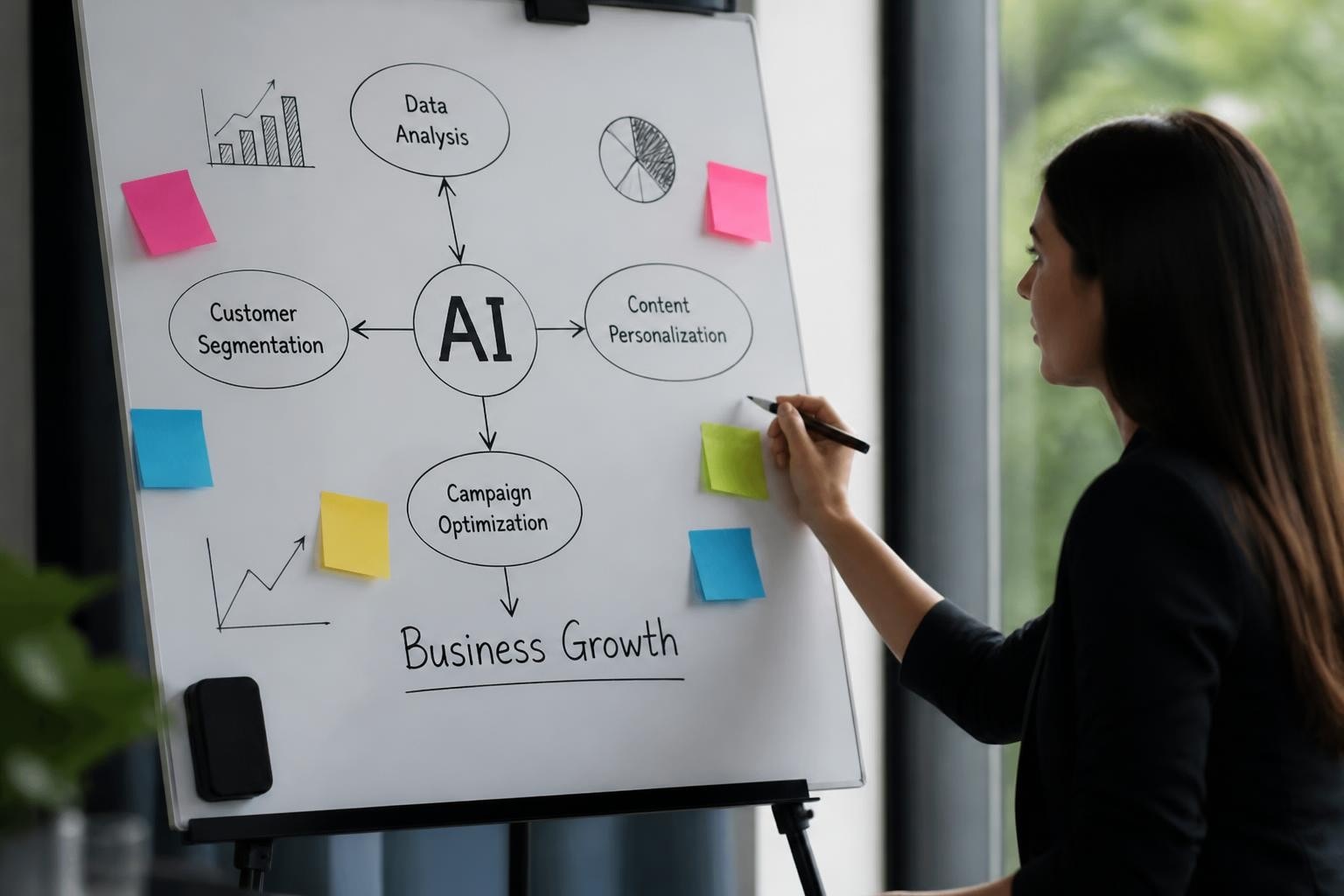
Building a successful ai marketing strategy has become essential for businesses looking to scale their marketing operations while maintaining personalized customer experiences. The integration of artificial intelligence into marketing processes creates opportunities to automate repetitive tasks, generate insights from customer data, and deliver targeted messages at precisely the right moments. Companies implementing AI-driven marketing systems are seeing measurable improvements in conversion rates, customer lifetime value, and operational efficiency. This comprehensive approach to marketing automation enables teams to focus on strategic initiatives while AI handles data processing, pattern recognition, and personalization at scale.
Understanding the AI Marketing Strategy Framework
A well-structured ai marketing strategy begins with clear objectives aligned to business outcomes. Rather than implementing AI tools randomly, successful organizations start by identifying specific marketing challenges that automation can solve. These typically include lead scoring inefficiencies, manual campaign management, inconsistent follow-up processes, and difficulty personalizing content for diverse audience segments.
The foundation of any effective strategy involves mapping your customer journey from initial awareness through conversion and retention. AI systems excel at identifying patterns across these touchpoints, revealing opportunities for optimization that human analysis might miss. By analyzing behavioral data, engagement metrics, and conversion signals, AI can predict which prospects are most likely to convert and recommend specific actions to move them through the funnel.
Data Collection and Integration Systems
Before deploying AI marketing tools, you need robust data infrastructure. This includes:
- Customer relationship management (CRM) integration that centralizes all prospect and customer interactions
- Website analytics platforms tracking visitor behavior, page performance, and conversion paths
- Email marketing systems capturing engagement metrics and response patterns
- Sales automation tools documenting outreach activities and results
- Social media monitoring gathering audience insights and sentiment data
The quality of your AI marketing strategy depends entirely on data quality. Incomplete records, duplicate entries, and inconsistent formatting undermine AI model accuracy. Establishing data governance protocols ensures your systems can generate reliable insights and recommendations.

Many businesses discover that AI business solutions require upfront investment in data cleanup and system integration before AI tools deliver their full value. This preparation phase typically takes 30-60 days but creates the foundation for long-term success.
Implementing AI for Sales and Lead Generation
Sales teams benefit significantly from AI-powered lead scoring and qualification systems. Traditional lead scoring assigns points based on static criteria like job title or company size. AI marketing strategy approaches analyze hundreds of behavioral signals to predict conversion probability with remarkable accuracy.
Predictive Lead Scoring Models
Modern AI systems evaluate prospect engagement across multiple dimensions:
| Scoring Factor | Traditional Approach | AI-Driven Analysis |
|---|---|---|
| Email engagement | Open rate only | Time to open, reading duration, link clicks, forwarding behavior |
| Website activity | Page views | Navigation patterns, content consumption depth, return frequency |
| Content interaction | Download count | Specific topics viewed, reading sequence, time investment |
| Social signals | Follower status | Engagement type, sharing behavior, network influence |
These predictive models continuously improve as they process more data, identifying subtle patterns that correlate with successful conversions. Sales teams receive prioritized lead lists with context about each prospect's interests and readiness to buy.
Automated outreach sequences represent another powerful application. Based on prospect behavior, AI systems can trigger personalized email sequences, schedule follow-up reminders, and suggest optimal contact timing. According to recent research on AI marketing strategies, businesses using predictive analytics see 20-30% improvements in conversion rates.
Conversational AI and Chatbots
Website visitors expect immediate responses. AI-powered chatbots handle initial qualification conversations, answer common questions, and schedule meetings with sales representatives. Unlike scripted chatbots from earlier years, modern conversational AI understands context and intent, providing helpful responses that feel natural.
These systems learn from every interaction, expanding their knowledge base and improving response quality. When conversations require human expertise, the AI seamlessly transfers to a team member along with complete conversation history and context.
Content Personalization at Scale
Generic marketing messages no longer resonate with sophisticated buyers who expect relevant, timely content. An effective ai marketing strategy leverages AI to deliver personalization across email campaigns, website experiences, and advertising.
Dynamic content systems analyze individual behavior patterns to determine which messages, offers, and formats will likely generate the strongest response. Someone who consistently reads detailed technical content receives different messaging than a prospect who prefers case studies and ROI calculators.
Email Campaign Optimization
AI transforms email marketing from batch-and-blast to precision targeting:
- Subject line testing that goes beyond simple A/B tests to generate and evaluate dozens of variations
- Send time optimization identifying when each recipient is most likely to engage based on historical patterns
- Content variation adapting message length, tone, and focus based on recipient preferences
- Automated segmentation creating micro-audiences based on behavioral clusters
- Performance prediction forecasting campaign results before sending
This level of sophistication enables marketing services teams to achieve open rates and click-through rates significantly above industry benchmarks. The AI continuously monitors results and adjusts strategies based on performance data.

However, businesses must balance AI automation with authentic human connection. Research shows that 60% of Americans consider AI in marketing a turnoff when it feels impersonal or manipulative. The key is using AI to enhance personalization while maintaining genuine communication.
Automating the Customer Onboarding Journey
After converting a prospect to a customer, the onboarding experience determines long-term satisfaction and retention. AI marketing strategy extends beyond acquisition to optimize these critical early interactions.
Automated onboarding workflows guide new customers through setup processes, deliver educational content at appropriate intervals, and identify potential friction points before they cause frustration. AI monitors engagement signals to detect customers who might be struggling and triggers proactive support interventions.
Progressive Profiling and Adaptive Learning Paths
Rather than overwhelming new customers with lengthy forms or generic training content, AI-driven onboarding uses progressive profiling. The system asks a few essential questions initially, then gradually learns more about the customer through behavioral observation.
Based on this growing understanding, the AI recommends specific features, resources, or use cases aligned with each customer's goals. Someone using your product for specific use case A receives different guidance than someone focused on use case B.
| Onboarding Element | Static Approach | AI-Optimized Approach |
|---|---|---|
| Welcome sequence | Same 5 emails for everyone | Personalized based on signup source and initial behavior |
| Product tutorials | Complete library dump | Curated sequence matching user's role and goals |
| Feature adoption | Announce everything | Highlight features relevant to user's workflow |
| Support resources | Generic FAQ | Predictive help based on usage patterns |
This adaptive approach accelerates time-to-value and improves product adoption rates. Customers feel understood rather than processed through a one-size-fits-all system.
Measuring and Optimizing AI Marketing Performance
Implementing AI tools without measuring their impact leads to wasted investment. Your ai marketing strategy must include clear metrics and regular performance reviews. Start by establishing baseline measurements before AI implementation, then track improvements across key dimensions.
Essential Performance Metrics
- Lead quality scores comparing AI-scored leads against actual conversion rates
- Time savings quantifying hours recovered from automation
- Conversion rate improvements at each funnel stage
- Customer acquisition cost (CAC) reductions
- Lifetime value (LTV) increases from better targeting and retention
- Campaign ROI improvements from optimization
Advanced analytics platforms integrate these metrics, providing dashboards that reveal which AI initiatives deliver the strongest returns. This data-driven approach enables continuous refinement of your strategy.
Testing and iteration are fundamental. The framework for AI marketing in 2026 emphasizes experimentation cycles where teams test hypotheses, measure results, and scale successful approaches while abandoning underperformers.
Addressing Common AI Marketing Challenges
Despite its potential, AI marketing implementation faces obstacles. Understanding these challenges helps organizations prepare appropriate solutions.
Data privacy and compliance concerns require careful attention. AI systems processing customer data must comply with regulations like GDPR, CCPA, and industry-specific requirements. Transparency about data usage builds trust while protecting against legal exposure.
Integration complexity creates technical hurdles when connecting AI tools with existing marketing technology stacks. Many businesses benefit from AI content marketing platforms that offer pre-built integrations with popular CRM and marketing automation systems.
Team resistance emerges when employees worry AI will replace their roles. Successful implementations emphasize how AI handles repetitive tasks, freeing teams for creative and strategic work that requires human judgment.
Avoiding Generic AI-Generated Content
The rise of generative AI creates efficiency but risks producing bland, indistinguishable marketing. As noted in analyses of why AI-generated ads often fail, content lacking authentic brand voice and genuine insights fails to connect with audiences.
Your ai marketing strategy should use AI as a starting point, not a finished product. Human marketers review, refine, and inject personality into AI-generated drafts. This hybrid approach combines AI efficiency with human creativity and brand expertise.

Building Sustainable AI Marketing Systems
Long-term success with AI marketing requires organizational commitment beyond initial implementation. Companies that treat AI as a one-time project rather than ongoing capability development fail to capture its full potential.
Continuous Learning and Model Updates
AI models degrade over time as market conditions, customer preferences, and competitive landscapes evolve. Establish processes for:
- Regular model retraining with fresh data
- Performance monitoring to detect accuracy drift
- Feedback loops incorporating sales team insights
- Testing new AI capabilities as they become available
- Benchmarking against industry performance standards
This maintenance ensures your AI marketing strategy remains effective rather than becoming obsolete. Organizations investing in AI tools for specialized applications often achieve better results than those pursuing generic solutions.
Team Training and Skill Development
Marketing teams need new capabilities to work effectively with AI systems. Provide training on:
- Interpreting AI-generated insights and translating them into action
- Prompt engineering for generative AI content tools
- Data analysis fundamentals to evaluate model outputs
- AI ethics and bias awareness to maintain responsible practices
- Integration management for connecting various AI tools
Companies that invest in team development alongside technology implementation achieve significantly better outcomes. The human expertise to guide, question, and refine AI recommendations separates successful ai marketing strategy from failed experiments.
Future-Proofing Your Marketing Approach
The AI marketing landscape continues evolving rapidly. Capabilities that seemed futuristic two years ago are now standard features in marketing platforms. Staying current requires attention to emerging trends while maintaining focus on proven fundamentals.
Multimodal AI that understands and generates text, images, audio, and video simultaneously will enable entirely new creative possibilities. According to industry projections, nearly 90% of advertisers will use generative AI for video creation by late 2026.
Explainable AI frameworks like those described in recent research will make it easier to understand why AI systems make specific recommendations, building trust and enabling better human oversight.
Agentic AI systems that can execute complex marketing workflows autonomously will handle increasingly sophisticated tasks. Google's launch of marketing AI tools designed to assist small and medium-sized businesses signals this direction.
Building a flexible ai marketing strategy means adopting tools and processes that can incorporate these advances without requiring complete system overhauls. Choose platforms with active development roadmaps and robust integration capabilities.
Developing an effective ai marketing strategy transforms how businesses attract, convert, and retain customers while significantly reducing the manual effort required to execute sophisticated campaigns. The combination of intelligent automation, predictive analytics, and personalized customer experiences creates competitive advantages that compound over time. If you're ready to implement custom AI solutions for your sales, marketing, and onboarding processes, Ryan Cook specializes in building systems tailored to your specific business requirements and objectives.