
July 19, 2026 · Bizware
Facebook Ads for Financial Advisors: 2026 Guide
Learn how financial advisors can leverage Facebook Ads to generate qualified leads, build trust, and grow their AUM with compliant strategies.

Facebook advertising has become an essential channel for financial advisors looking to scale their practices in 2026. With over 2.9 billion active users, the platform offers unparalleled reach and sophisticated targeting capabilities that enable advisors to connect with high-net-worth individuals, business owners, and pre-retirees. However, running successful facebook ads for financial advisors requires more than just boosting posts or promoting services. It demands a strategic approach that balances regulatory compliance, audience targeting precision, and compelling creative that builds trust with prospects who may be skeptical about financial advertising.
Understanding the Unique Landscape of Financial Advisor Advertising
Financial services advertising operates under strict regulatory oversight. The Securities and Exchange Commission (SEC) and Financial Industry Regulatory Authority (FINRA) impose specific requirements on how advisors can market their services. Every ad must be clear, not misleading, and properly substantiated. This regulatory framework creates challenges but also opportunities for advisors who invest in compliant and scalable lead generation strategies.
Key compliance considerations include:
- Avoiding guarantees or promises of specific returns
- Including necessary disclosures about advisory services
- Maintaining records of all advertising materials
- Ensuring testimonials meet regulatory requirements
- Clearly distinguishing between different types of services
The financial services industry also faces unique trust barriers. Potential clients are entrusting advisors with their life savings, retirement plans, and family's financial future. This means facebook ads for financial advisors must prioritize credibility and education over aggressive sales tactics.
Building Trust Through Educational Content
Modern financial advisor advertising succeeds when it provides genuine value before asking for commitment. Educational content positions advisors as knowledgeable experts rather than salespeople. Video ads explaining complex financial concepts, carousel ads comparing investment strategies, and lead magnet offers like retirement planning guides all serve this educational purpose.
Consider creating content that addresses specific pain points:
- Tax optimization strategies for high earners
- Estate planning mistakes to avoid
- Retirement income planning for business owners
- College funding strategies that preserve wealth
- Market volatility management techniques
This approach aligns with how sophisticated AI tools for financial advisors can personalize messaging at scale while maintaining the human touch that builds confidence.
Targeting Strategies That Connect With Ideal Clients

Facebook's targeting capabilities allow financial advisors to reach prospects with surgical precision. Rather than broadcasting messages to a general audience, advisors can identify and engage specific demographic, behavioral, and interest-based segments.
Primary targeting dimensions include:
| Targeting Type | Examples | Best Use Case |
|---|---|---|
| Demographics | Age 50-65, Income $150K+, Homeowners | Pre-retirees with assets |
| Interests | Investment topics, Business ownership, Estate planning | Topic-aware prospects |
| Behaviors | Frequent travelers, Charitable donors, Recent movers | Life event triggers |
| Life Events | Engagement, New job, Business milestones | Immediate financial needs |
The most effective facebook ads for financial advisors combine multiple targeting layers. For example, targeting business owners aged 55-65 with household incomes above $200,000 who have recently shown interest in retirement planning creates a highly qualified audience segment.
Lookalike Audiences and Customer Match
Once you've generated initial leads or clients through Facebook, leverage that data to find similar prospects. Upload your existing client list as a Custom Audience (ensuring compliance with privacy regulations), then create Lookalike Audiences that mirror those characteristics. According to this comprehensive playbook, advisors often see their best cost-per-lead results from 1-3% lookalike audiences based on high-value clients.
Geographic targeting also matters. Local financial advisors should focus their budget on specific zip codes or radius targeting around their office locations. Virtual advisors serving clients nationwide can broaden their geographic scope while potentially targeting states with favorable tax environments or high concentrations of their ideal demographic.
Creating Compelling Ad Creative That Converts
The creative elements of your facebook ads for financial advisors determine whether prospects stop scrolling and engage with your message. In 2026's crowded digital landscape, generic stock photos and vague value propositions don't cut through the noise.
Winning creative elements include:
- Authentic imagery: Photos of real advisors, actual clients (with permission), or genuine office settings build credibility far better than stock photography
- Clear value proposition: State exactly what prospects will receive and how it solves their specific problem
- Social proof: Testimonials, client success metrics, or professional credentials that establish authority
- Compelling hooks: Questions that resonate with target pain points grab attention in the first three seconds
Video content consistently outperforms static images for financial advisor campaigns. Short educational videos explaining single concepts, advisor introduction videos that humanize your practice, or client testimonial videos all generate higher engagement rates and lower cost per lead.
Ad Copy That Speaks to Prospect Concerns
Your ad copy must acknowledge the emotional aspects of financial decision-making. People don't hire financial advisors because they want asset allocation. They hire advisors because they're worried about running out of money in retirement, stressed about market volatility, or confused about tax strategies.
Effective copy frameworks include:
- Problem-Agitate-Solve: Identify a specific problem, intensify the pain, then present your solution
- Question-Answer: Pose a relevant question that prospects are asking themselves, then provide a valuable answer
- Before-After-Bridge: Show the current state, describe the desired state, then bridge with your service
These approaches integrate naturally with marketing tools for financial advisors that automate follow-up and nurture sequences once leads are captured.
Campaign Structure and Budget Allocation
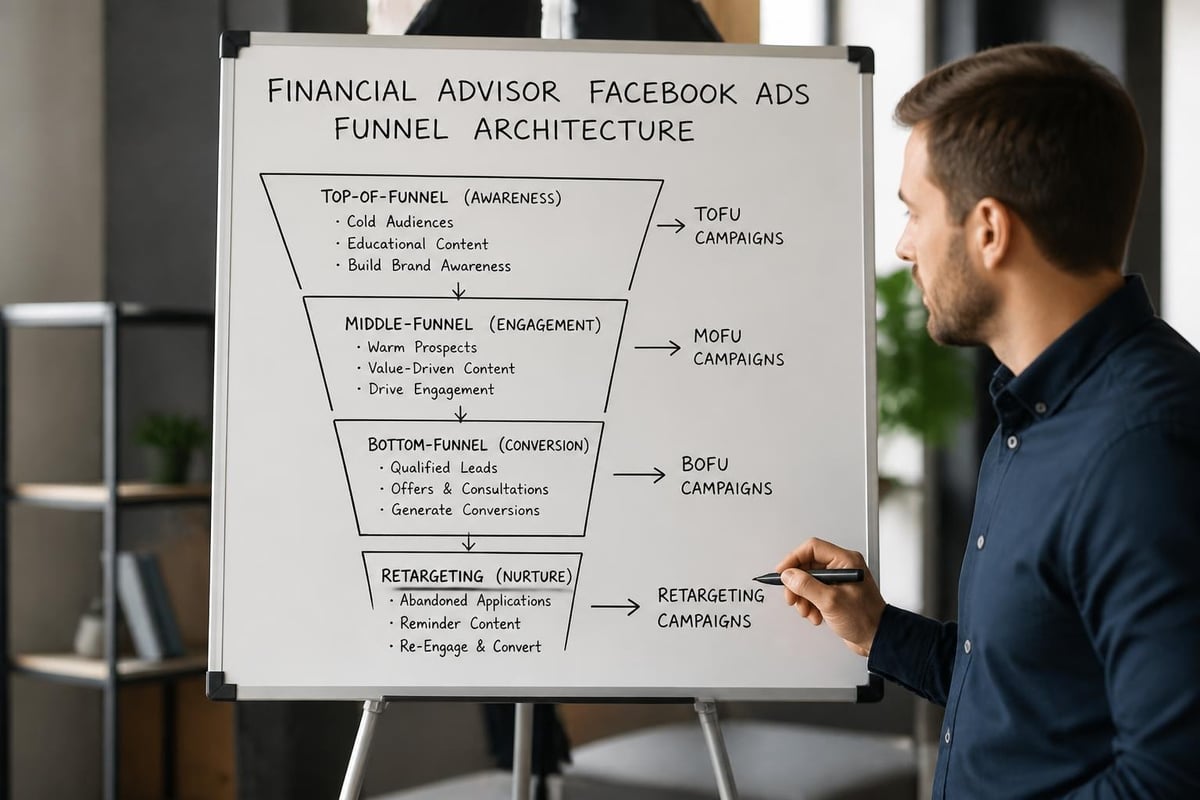
Strategic campaign organization maximizes your advertising investment. Rather than running a single campaign with all your targeting and creative options mixed together, structure campaigns based on funnel stage and audience temperature.
Three-Tier Campaign Framework
Awareness campaigns target cold audiences who don't know your practice. These campaigns prioritize educational content, broad targeting, and cost-effective engagement. Budget allocation: 30-40% of total spend.
Consideration campaigns engage warm audiences who've interacted with your content but haven't converted. These campaigns feature more specific offers, tighter targeting, and retargeting pixels. Budget allocation: 30-40% of total spend.
Conversion campaigns focus on hot prospects ready to schedule consultations. These campaigns use direct response creative, specific offers, and optimized landing pages. Budget allocation: 20-30% of total spend.
According to data from advisors who generated 173 leads in two months, this structured approach significantly improves lead quality while reducing overall cost per acquisition.
Lead Magnets and Offer Development
The offer you promote through your facebook ads for financial advisors determines conversion rates more than any other single factor. Generic "schedule a consultation" offers rarely convert cold traffic effectively. Prospects need lower-commitment entry points that provide immediate value.
High-converting lead magnet options:
- Retirement readiness calculators or assessment tools
- Comprehensive guides on specific topics (tax strategies, estate planning, 401k rollovers)
- Educational webinars covering timely financial topics
- Portfolio analysis or financial health checkup offers
- Exclusive research reports or market insights
The best lead magnets address specific problems for specific audiences. A "Business Owner's Guide to Tax-Efficient Exit Planning" will dramatically outperform a generic "Financial Planning Guide" when targeting business owners approaching retirement age.
Landing Page Optimization
Your ad's destination matters as much as the ad itself. Dedicated landing pages that match ad messaging, remove navigation distractions, and focus on single conversion goals consistently outperform general website pages. Effective prospecting tools for financial advisors often include landing page builders optimized for lead capture and compliance.
Key landing page elements include clear headlines that echo ad promises, benefit-focused copy addressing specific pain points, trust indicators like credentials and testimonials, simple forms requesting only essential information, and prominent calls-to-action with compelling button copy.
Budget Expectations and Performance Metrics
Financial advisors frequently ask about required advertising budgets and expected returns. The answer varies based on market competition, targeting specificity, and offer quality, but 2026 benchmarks provide helpful guidance.
| Budget Level | Monthly Spend | Expected Leads | Cost Per Lead Range |
|---|---|---|---|
| Starter | $1,500-$2,500 | 15-30 | $50-$150 |
| Growth | $3,000-$5,000 | 35-70 | $45-$120 |
| Scale | $5,000-$10,000 | 75-150 | $40-$100 |
| Enterprise | $10,000+ | 150+ | $35-$85 |
These ranges assume optimized campaigns following best practices. Initial campaign phases often show higher cost per lead while Facebook's algorithm learns and optimizes delivery. Typical costs for Facebook Ads depend heavily on target audience competition and geographic market.
Tracking Meaningful Metrics
Vanity metrics like impressions and reach don't drive business growth. Focus on metrics that connect directly to revenue and client acquisition:
- Cost per qualified lead: Not just form submissions, but leads meeting your minimum criteria
- Lead-to-consultation rate: Percentage of leads that schedule meetings
- Consultation-to-client rate: Percentage of meetings that become clients
- Customer acquisition cost (CAC): Total ad spend divided by new clients acquired
- Lifetime client value (LCV): Average revenue per client over their relationship
- Return on ad spend (ROAS): Revenue generated divided by advertising investment
The relationship between these metrics reveals campaign health. If cost per lead is acceptable but lead quality is poor, targeting or offer adjustments are needed. If lead quality is excellent but volume is insufficient, budget increases may be warranted.
Advanced Strategies for Scaling Success
Once foundational campaigns are performing consistently, advanced tactics can amplify results and improve efficiency. These strategies require solid baseline performance before implementation.
Retargeting sequences engage prospects who visited your website or engaged with content but didn't convert. Create custom audiences based on specific behaviors (visited pricing page, watched 75% of video, downloaded lead magnet) and serve tailored ads addressing likely objections or providing additional information. The 15 actionable tips for financial advisors include sophisticated retargeting approaches that significantly improve conversion rates.
Dynamic creative optimization automatically tests different combinations of headlines, images, and copy to identify top performers. Rather than manually creating and testing variations, Facebook's algorithm identifies winning combinations and allocates budget accordingly.
Appointment booking automation integrates your facebook ads for financial advisors with scheduling tools, allowing qualified prospects to immediately book consultations without back-and-forth email coordination. This reduces friction and improves conversion rates substantially.
Integration With Sales and Onboarding Systems
Modern financial advisor marketing extends beyond lead generation into comprehensive client journey management. Custom AI solutions can connect Facebook lead capture directly to CRM systems, trigger automated nurture sequences, qualify prospects based on predefined criteria, and route high-value leads to advisors instantly.
This integration ensures no leads fall through cracks while allowing advisors to focus energy on qualified prospects ready for consultation. The connection between advertising and CRM for financial advisors creates seamless prospect experiences that build trust and accelerate relationship development.
Testing and Optimization Protocols
Continuous testing separates mediocre campaigns from exceptional ones. Systematic testing protocols identify incremental improvements that compound into significant performance gains.
Elements worth testing include:
- Audience segments (different age ranges, income levels, geographic markets)
- Creative formats (video versus static, testimonial versus educational)
- Ad copy angles (fear-based versus aspiration-based messaging)
- Offer types (calculators versus guides versus webinars)
- Landing page variations (long-form versus short-form, different headline treatments)
Implement structured A/B tests that change one variable at a time. Run tests long enough to achieve statistical significance, typically requiring at least 50-100 conversions per variation. Document results systematically to build institutional knowledge about what resonates with your target audience.
Performance analysis should occur weekly at minimum. Review campaign metrics, identify underperforming elements, reallocate budget toward winners, and implement new tests based on learnings. This disciplined approach to optimization compounds improvements over time.
Compliance and Risk Management
Operating within regulatory boundaries protects your practice while building long-term credibility. Every piece of creative, every claim, and every landing page must meet SEC and FINRA requirements for financial advisor advertising.
Compliance best practices include:
- Establishing approval workflows requiring compliance review before launch
- Maintaining comprehensive records of all advertising materials and performance data
- Including necessary disclosures appropriate to your services and client types
- Avoiding superlative claims, guarantees, or misleading statements
- Clearly distinguishing between educational content and service promotion
Partner with compliance professionals familiar with digital advertising nuances. Rules designed for print advertisements don't always translate clearly to social media campaigns, retargeting sequences, and dynamic creative formats. B2B email marketing principles around compliance often apply to paid advertising as well, particularly regarding follow-up communication.
Work with platforms like Facebook to understand their financial services advertising policies, which sometimes impose restrictions beyond regulatory requirements. Pre-submission review of creative can prevent disapproved ads and campaign delays.

Converting Leads Into Lasting Client Relationships
Generating leads through facebook ads for financial advisors represents only the first step toward practice growth. Converting those leads into consultations, then consultations into clients, requires systematic follow-up and relationship development.
Effective lead nurture components:
- Immediate automated response confirming lead magnet delivery or appointment details
- Educational email sequence providing additional value over 7-14 days
- Personal outreach from advisors within 24-48 hours of lead capture
- Retargeting ads reinforcing key messages and addressing common objections
- Phone follow-up for high-intent leads who meet specific qualification criteria
The integration between advertising platforms and sales AI systems ensures consistent follow-up regardless of lead volume fluctuations. Automated systems can score leads based on engagement behaviors, demographic fit, and expressed interests, allowing advisors to prioritize outreach effectively.
Track conversion rates at each funnel stage to identify bottlenecks. If consultation-to-client rates are strong but lead-to-consultation rates are weak, your follow-up process or lead quality needs attention. If lead volume is sufficient but consultation rates are low, targeting or offer refinement may be required.
Building Long-Term Sustainable Growth
Facebook advertising for financial advisors works best as part of comprehensive marketing strategies rather than isolated tactics. Social media marketing for financial advisors encompasses organic content, community building, and paid promotion working together to establish market presence.
Successful advisors view advertising investment as building business assets. Customer lists become retargeting audiences and lookalike sources. Content created for ads serves double duty as website resources and email newsletter content. Testing insights inform broader messaging across all marketing channels.
Diversification across platforms reduces risk. While Facebook remains highly effective for financial advisor marketing in 2026, explore complementary channels like LinkedIn for B2B targeting, Google Ads for search intent capture, and YouTube for long-form educational content. This multi-channel approach builds resilience against platform algorithm changes or policy shifts.
Consider the lifetime value of acquired clients when evaluating advertising returns. A client generating $5,000 annually in advisory fees over a 10-15 year relationship justifies substantially higher acquisition costs than surface-level calculations might suggest. This perspective allows appropriate investment in qualified lead generation that competitors with shorter time horizons might avoid.
Facebook advertising offers financial advisors unprecedented opportunity to connect with ideal clients, build credibility through educational content, and scale practices systematically. Success requires balancing regulatory compliance, strategic targeting, compelling creative, and systematic follow-up processes that convert prospects into long-term client relationships. When you're ready to implement AI-powered systems that connect your advertising efforts directly to your sales and onboarding processes, Ryan Cook specializes in custom solutions that automate lead qualification, nurture sequences, and client journey management, allowing you to focus on what you do best while technology handles the systematic follow-through that turns advertising investment into sustainable growth.