
Sales coaching for small businesses is the practice of reviewing real sales conversations, identifying one specific behavior to improve in each rep, and measuring whether that behavior changes on the next call. In a small owner-led team, it works best when it is short, regular, and based on actual calls rather than general advice or occasional training days.
The difficulty is time. An owner or sales manager at a ten-person company is often still selling, hiring, and handling customers, so listening to every rep's calls is not realistic. This guide explains what coaching involves, why most small teams under-coach, and how to build a repeatable system that fits a small team's capacity.
What Does Sales Coaching Actually Involve?
Sales coaching is an ongoing, individual process in which a manager or coach observes a rep's real selling behavior, gives specific feedback, and tracks the change over time. It differs from training, which delivers the same content to a group, and from deal reviews, which focus on the opportunity rather than the rep's skills.
A coaching cycle has four parts:
- Observe. Review a real call or meeting, not a rep's recollection of it.
- Diagnose. Compare what happened with what your sales playbook says should happen.
- Practice. Rehearse the specific moment that went wrong, ideally through role-play.
- Verify. Check the next call to see whether the behavior changed.
Most coaching programs break at step four. Feedback is delivered, everyone agrees it was useful, and nobody checks whether the next conversation went differently. The HubSpot overview of sales coaching describes coaching models and an eight-step process that begins with identifying each rep's individual needs, which is the same principle applied here.
For a deeper definition, see this explainer on what sales coaching is.
Why Do Small Teams Under-Coach Their Reps?
Small teams under-coach because the people responsible for coaching are also the most overextended people in the company, and because coaching results are slower to appear than deal results.
The data supports this. The 2025 Sales Skills Gap Survey from Salesloft found that most sellers received coaching quarterly or less, and many rarely or never received personalized feedback. The same survey found that many sellers frequently deviated from the sales process. Reps who are not coached tend to drift from the process the business designed.
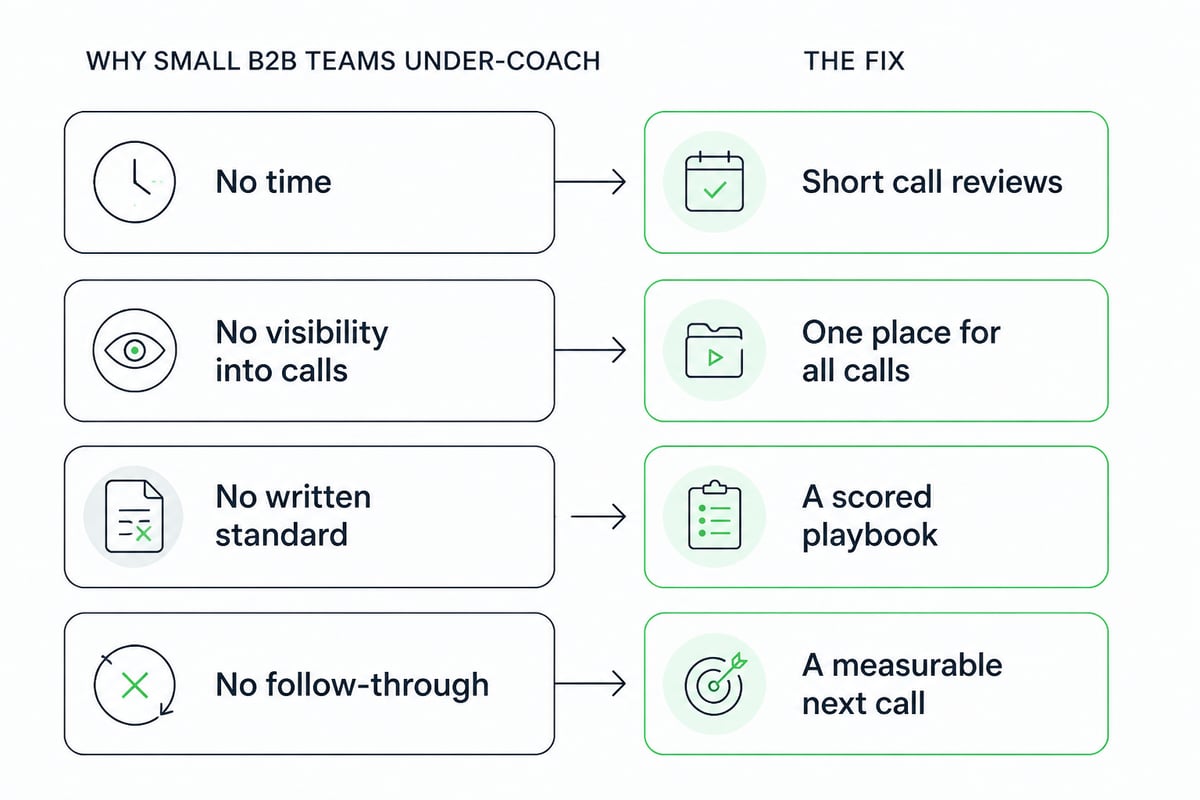
Common reasons small teams skip coaching:
- No time. The owner is closing deals, so call reviews slide to the end of the week and then disappear.
- No visibility. Calls happen on video, by phone, and in person, and nobody has a single place to find them.
- No standard. Without a written playbook, feedback becomes personal opinion, and reps resist it.
- No follow-through. Feedback covers five issues at once, so the rep changes none of them.
The pressure on reps is also real. A 2024 Salesforce survey of 5,500 sales professionals across 27 countries found that most did not expect to meet quota. Consistent coaching is one of the few levers a small team controls directly.
How Do You Build a Sales Playbook You Can Coach Against?
You build a coachable playbook by writing down the five to eight behaviors that separate your best calls from your average ones, in plain language a rep can follow. A playbook that lives in the owner's head cannot be used to score calls or to give consistent feedback.
Start with your own best conversations, not a template. Listen to three or four calls that led to closed deals and note what the rep did in each stage. Then describe those behaviors in observable terms.
Weak: "Build rapport and qualify well."
Usable: "Within the first five minutes, confirm the buyer's reason for the meeting and ask what happens if they do nothing."
A practical playbook covers these stages:
- Opening: how the rep sets the agenda and confirms time.
- Discovery: the questions that surface the problem, its cost, and the timeline.
- Decision process: who else is involved and how the buyer buys.
- Handling objections: the specific responses your team has found effective.
- Next step: how the rep secures a dated commitment before ending the call.
Keep it short. A playbook of twenty pages will not be used in a coaching session. For guidance on structure, this piece on sales coaching best practices is a useful companion.
What Is the One-Behavior-at-a-Time Method?
The one-behavior-at-a-time method means each coaching step targets a single behavior gap, and success is judged by whether that behavior appears on the rep's next call. It prevents the most common coaching failure, which is overwhelming a rep with a long list of corrections.
Here is how a cycle works in practice:
- Review a recent call against the playbook.
- Pick the single gap with the most effect on outcomes, such as never asking about the buyer's timeline.
- Show the rep the exact moment in the recording where it occurred.
- Have the rep practice a better version out loud or in writing.
- Define the measurable next call: "On your next two discovery calls, ask about timeline before minute fifteen."
- Check both calls, then either move on to the next gap or repeat the step.
Hypothetical example: a rep consistently ends calls with "I'll send over a proposal and we can reconnect." The behavior gap is not "closing skills" in general. It is the absence of a dated next step. The coaching target for the following week is to end every call with a booked time on the calendar, and the manager checks that single item.
This approach is gentle on the rep and efficient for the manager. It also produces clear data, because every step has a yes or no result. You can read more about the logic in this guide to sales call scoring by behavior gap.
How Do You Review Calls When You Cannot Listen to All of Them?
You review calls by capturing every conversation in one place, scoring each one against your playbook, and listening only to the moments the scores flag. Manual listening does not scale beyond a few reps, and sampling randomly misses the calls that matter.
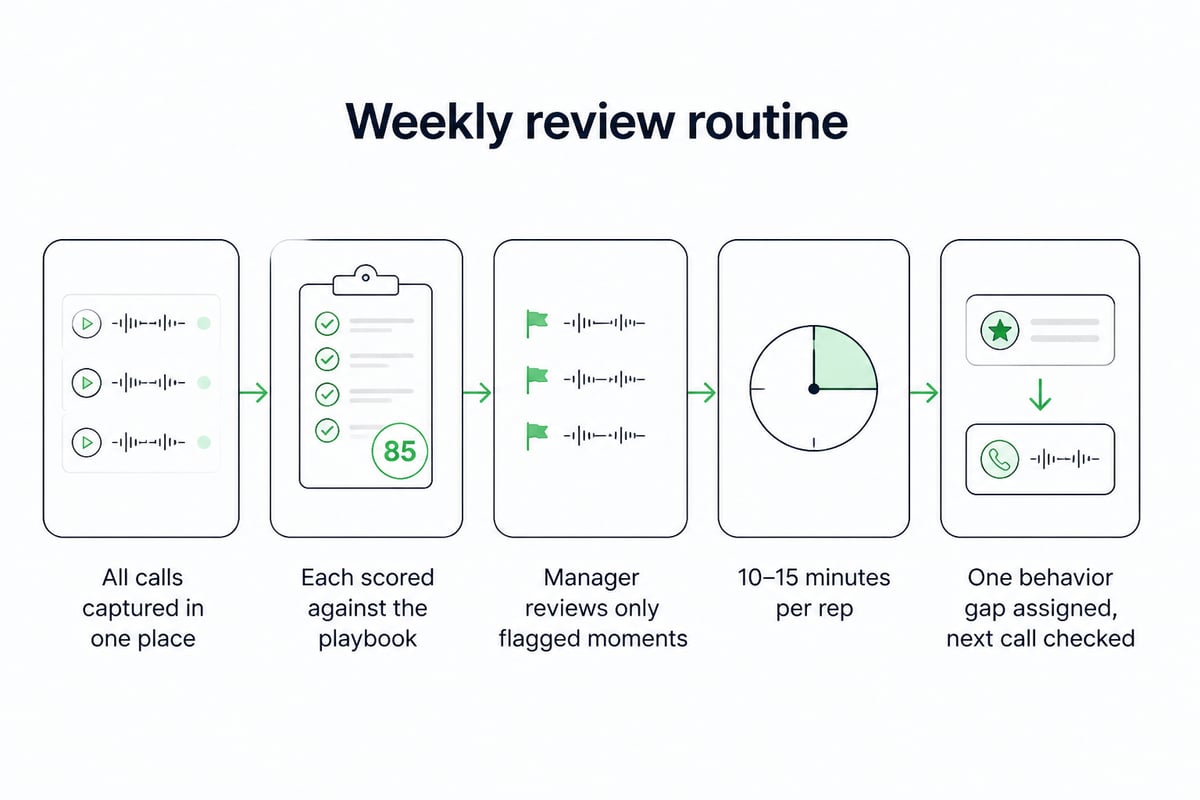
A workable review routine for a small team looks like this:
- Capture everything. Virtual meetings, phone calls, and in-person conversations should land in one searchable location.
- Score against the playbook. Each call receives a result on the same criteria, so reps are measured consistently.
- Review by exception. Spend your time on the lowest-scoring moments and on the best calls worth sharing with the team.
- Cap the session. Ten to fifteen minutes per rep, once a week, is enough when the call has already been scored.
This is where software helps. Bizware AI Sales Coach captures sales calls, scores them against your team's own playbook, and gives each rep private coaching plus voice or text role-play practice before the next call, with a manager dashboard so you can see progress without listening to every recording. It was built for small owner-led B2B teams, and it uses sales frameworks behind $2.3 billion in annual sales growth.
If you are weighing tools, these comparisons of sales call analysis software and sales coaching software cover what to look for.
Why Does Role-Play Matter Between Calls?
Role-play matters because it gives a rep a place to rehearse a corrected behavior before a real buyer is on the line. Feedback alone tells a rep what to change. Practice lets them hear themselves change it.
Many managers avoid role-play because it feels awkward and takes scheduling effort. Reps often dislike it for the same reason. The awkwardness drops considerably when the practice is private, built on the rep's own real call, and available on demand, either by voice or by text.
Effective role-play follows a few rules:
- Use a real moment. Replay the exact objection or question the rep struggled with, not a generic scenario.
- Keep it short. Three to five minutes on one moment beats a thirty-minute mock call.
- Repeat until it is natural. Two or three attempts are usually enough to move a behavior from awkward to usable.
- Tie it to the next call. The rep should leave practice knowing exactly what to try in the real conversation.
New hires benefit most. A rep who practices the discovery sequence against the playbook before taking live calls ramps faster than one who learns by shadowing.

How Do You Measure Whether Coaching Is Working?
You measure coaching by tracking behavior change first and revenue outcomes second. Behavior changes show up within a couple of weeks, while win rates and quota attainment move more slowly and are influenced by many other factors.
Track metrics in three layers:
| Layer | What it tells you | Example measure |
|---|---|---|
| Behavior | Whether coaching is changing what reps do | Percentage of calls where the rep sets a dated next step |
| Call quality | Whether overall conversations are improving | Average playbook score per rep, week over week |
| Outcome | Whether the changes affect results | Stage-to-stage conversion, win rate, sales cycle length |
Read the layers in order. If behavior metrics are flat, coaching is not landing, and you should simplify the target. If behavior improves but outcomes do not, the playbook may be pointing at the wrong behaviors, and it needs revision.
Also watch coaching consistency itself: how many reps received a coaching step this week, and how many next calls were actually checked. A team that coaches every rep every week with modest ambition will outperform a team that runs an intensive session once a quarter.
What Should Consultants Add to Their Client Engagements?
Consultants who advise B2B sales teams can add ongoing call-level coaching to their engagements, which turns a one-time workshop or playbook project into a continuing service with measurable results. The usual weakness of advisory work is the gap between the engagement and the daily behavior of the client's reps.
Three additions close that gap:
- A scored baseline. Before delivering recommendations, review a sample of the client's calls against the playbook you agree on. It gives you a starting point and makes progress visible to the owner.
- A weekly one-gap cadence. Assign each rep one behavior per week and report on whether the next call reflected it. Owners value this because it is concrete and low-effort for them.
- Practice between sessions. Reps who rehearse the target behavior on their own time arrive at your sessions further along.
This positions the consultant as the person who keeps coaching going when the owner is too busy to do it, and it creates a natural basis for retainer work. For a broader view, see this piece on the work of a B2B sales consultant and this overview of fractional sales management.
Which Skills Should a Small Team Coach First?
Coach the behaviors closest to the buyer's decision first: discovery questions, handling objections, and securing a clear next step. These have the most direct effect on whether a deal moves forward.
The Salesloft survey also asked sales managers which soft skill mattered most, and adaptability ranked first, ahead of curiosity, resilience, and empathy. Adaptability is hard to coach as an abstract trait, but easy to coach as a behavior. For example, you can review whether a rep changed their questions when the buyer revealed an unexpected priority, or kept following the script regardless.
A sensible order for most small teams:
- Next step. Every call ends with a dated commitment.
- Discovery depth. The rep uncovers the problem, its cost, and the decision process.
- Objection handling. The rep responds with the team's tested language, not improvisation.
- Adaptation. The rep adjusts to what the buyer says rather than the plan for the call.
Do not try to fix all four at once. Choose the one that shows up most often in your scored calls and stay with it until it stops appearing.
How Do You Keep Coaching Going Past the First Month?
You keep coaching going by fixing a weekly rhythm, limiting each session to one rep-specific target, and making the next-call check automatic rather than dependent on memory. Coaching programs usually fail in weeks three through six, when busy periods push sessions aside.
A few habits protect the routine:
- Calendar it. Block a recurring fifteen-minute slot per rep and treat it like a customer meeting.
- Share the wins. Play a strong call clip in the team meeting so reps see what good looks like in their own market.
- Keep reps' practice private. Role-play results should be visible to the rep first, so they feel safe making mistakes.
- Review the playbook quarterly. Adjust it based on what your best calls are teaching you.
If you are building the program from scratch, this guide to a sales coaching program and this one on sales coaching for growing teams outline stages as headcount increases.
Start this week by choosing one rep, listening to one recent call, and writing down a single behavior to change on their next call. If you want that process to run without you listening to every recording, Bizware AI Sales Coach captures your calls, scores them against your playbook, and coaches each rep on one behavior gap at a time, and you can see how it would fit your team when you schedule a free demo with Ryan Cook.