
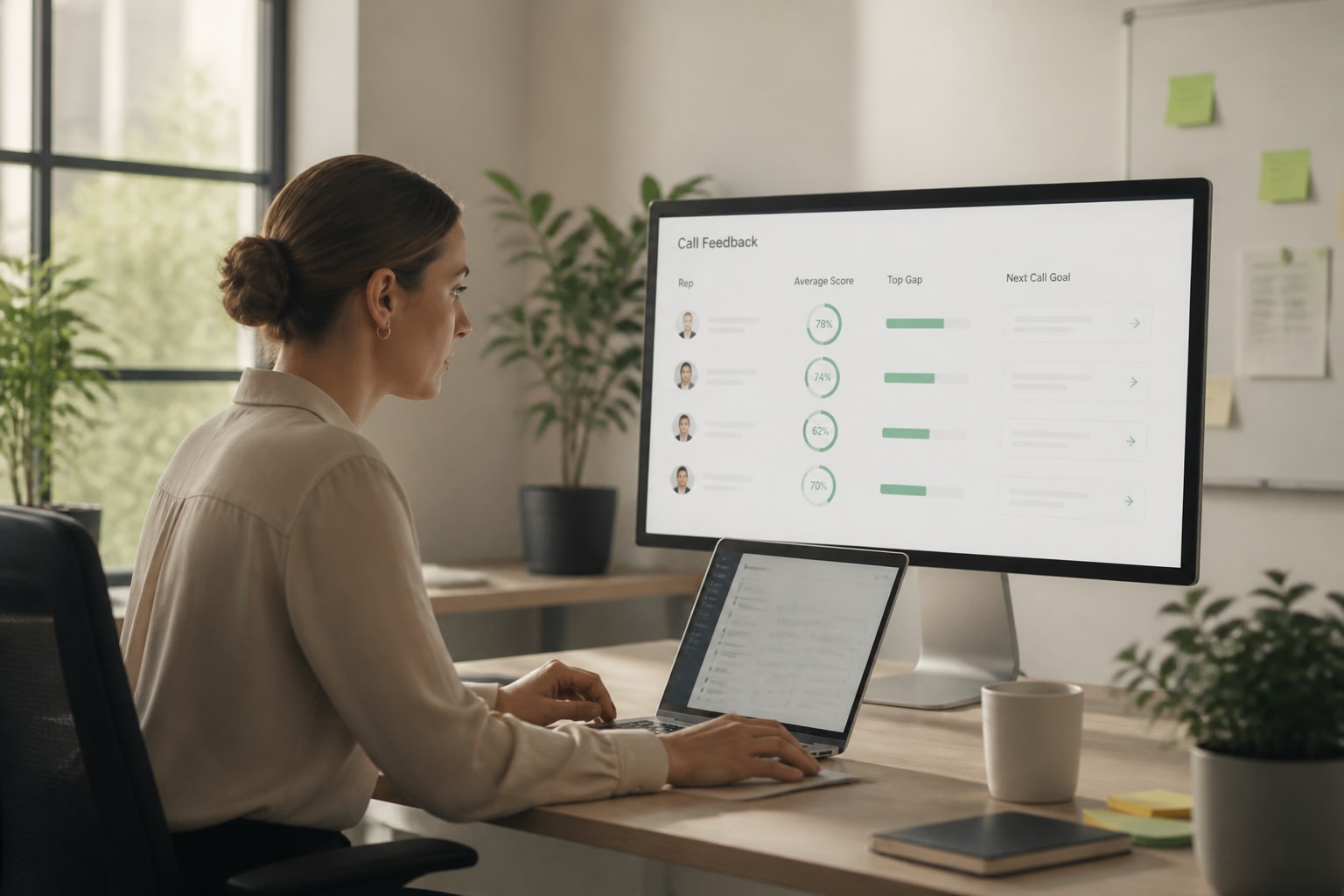
The best sales manager coaching tools capture rep conversations, score them against a standard, and turn the findings into practice a rep can act on before the next call. For a small team, the right choice depends less on feature count and more on whether the tool fits your size, your existing systems and the hours a manager can realistically spend on coaching.
Most owner-led B2B teams share the same constraint. The manager sells, manages and runs the business, so listening to every call is impossible. Tools that automate call review and keep coaching consistent solve that problem. G2's 2026 guide says it evaluated 20+ sales coaching tools, which shows how crowded the category has become. This list narrows it to seven options that are reasonable for small teams, with specs, approximate pricing as of November 2026, and an honest verdict on each.
What to Look for in Sales Manager Coaching Tools
A useful coaching tool does four things: it records or ingests calls, scores them against criteria you set, assigns practice, and shows whether behavior changed. Anything beyond that is optional for a team under 15 reps.
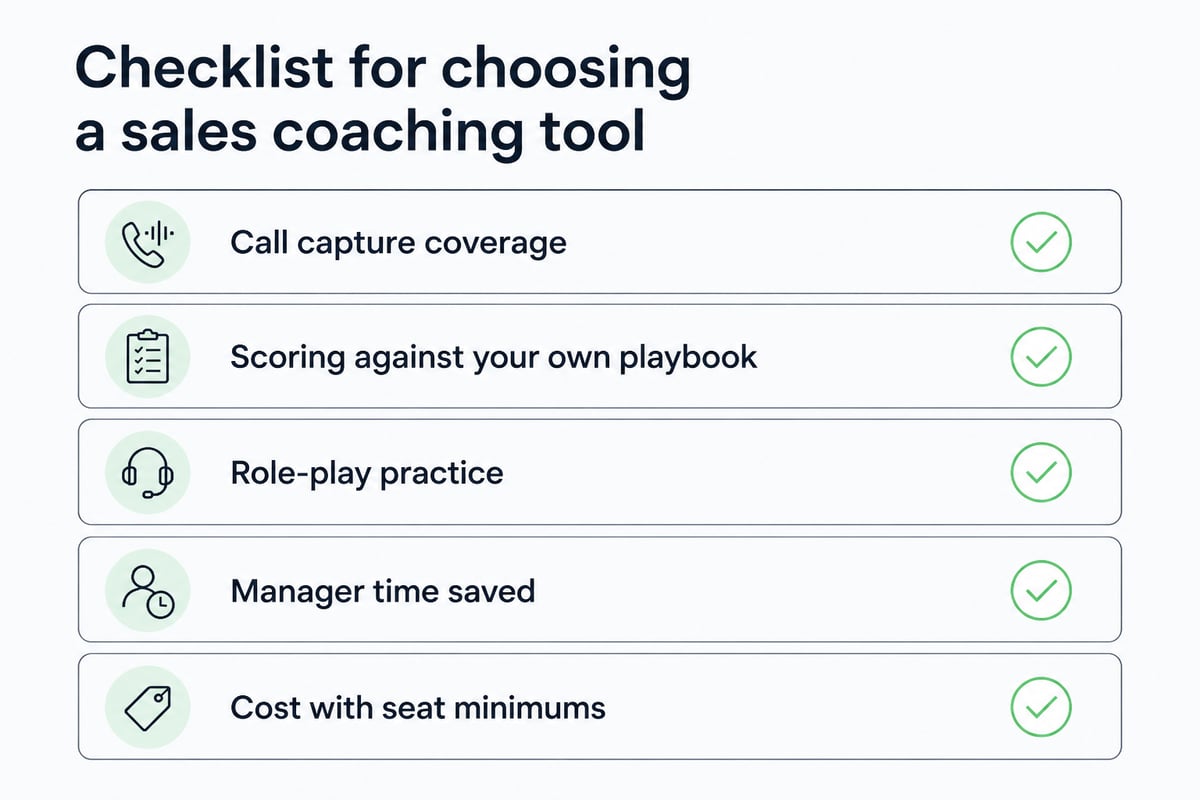
Use these criteria when comparing options:
- Call capture: Does it cover virtual calls only, or in-person conversations too? A team that closes deals at customer sites or trade shows will have blind spots if the tool only records video meetings, and those unrecorded conversations are often the highest-stakes ones.
- Scoring standard: Can you score against your own playbook, or only against generic criteria? A playbook-based score tells a rep whether they asked your qualifying questions in your order, which is more actionable than a generic talk-to-listen ratio.
- Practice: Is there role-play, and is it tied to the rep's real calls? Practicing the exact objection a rep fumbled on Tuesday is more useful than a stock scenario.
- Manager time: Will it reduce the hours you spend reviewing, or add a new dashboard to maintain? Ask how a manager sees one rep's top gap in under five minutes.
- Cost and minimums: Per-seat pricing, seat minimums and contract length matter more for five reps than for fifty. A five-license minimum, annual billing or a credit-based model each change what a small team actually pays.
1. Agentforce Sales (Salesforce)
Agentforce Sales is Salesforce's AI layer for sales workflows, and it suits teams that already run their pipeline inside Salesforce. It offers CRM-driven coaching, AI insights, workflow automation and opportunity management. Pricing is credit-based, at approximately $500 per 100,000 credits as of November 2026.
Best for: Teams already on Salesforce that want coaching signals tied to opportunity data and have an administrator to configure it.
Limits for small teams: Credit-based pricing is harder to forecast than a flat per-seat fee, and setup assumes CRM discipline that many small teams lack.
Verdict: A sensible extension if Salesforce is already your system of record, and a heavy lift if it is not.
2. Substrata
Substrata focuses on relationship intelligence and buyer-signal analysis. It applies AI to customer interactions and surfaces opportunity insights, at approximately $50 per seat per month as of November 2026.
Best for: B2B teams with long sales cycles and multiple stakeholders, where the main coaching question is how engaged a buyer really is.
Limits for small teams: The emphasis is on deal and relationship signals rather than rep behavior practice, so managers would still need a separate method for skill-building.
Verdict: A good fit for deal-focused coaching conversations, less so for structured rep development.
3. Nooks
Nooks is built for outbound teams that live on the phone. Its main features are parallel dialing, virtual sales floors and outbound coaching. Third-party estimates put pricing at roughly $4,000 to $5,000 per user per year, billed annually, as of November 2026, and vendor quotes are available on request.
Best for: SDR and BDR teams where dial volume is the main lever and managers want to coach during live prospecting sessions.
Limits for small teams: The price per seat is high relative to the other tools here, and it is designed around outbound motions rather than consultative, longer-cycle selling.
Verdict: Strong for high-volume outbound, and expensive for a team whose calls are mostly scheduled discovery and demos.
4. Mindtickle
Mindtickle centers on sales readiness. It provides training and certifications, coaching programs and readiness assessments. A starting estimate is approximately $15 per user per month as of November 2026, with quote-based pricing for full packages.
Best for: Teams that need structured onboarding and a repeatable curriculum for new hires, and that have someone to build and maintain the content.
Limits for small teams: Content-heavy platforms need ongoing authoring time. Without that, the library goes stale.
Verdict: A solid onboarding and certification engine when you have the time to feed it.
5. GTM Studio, Powered by ZoomInfo
GTM Studio offers conversation capture and analysis, coaching insights, deal visibility and sales performance analytics. Pricing is available from the vendor on request.
Best for: Teams that want conversation intelligence and performance analytics in one place, and that value deal visibility alongside call review.
Limits for small teams: The analytics breadth can exceed what a five-person team will use, and pricing requires a sales conversation to confirm.
Verdict: Worth a quote if you want analytics depth, and worth skipping if your priority is simple, regular rep coaching.
6. SmartWinnr
SmartWinnr combines AI-powered role-play with coaching, certifications, assessments and gamification. The vendor reports more than 1 million AI coaching sessions. Pricing is not listed here, so request it directly.
Best for: Teams that want reps to practice objections and pitches in a gamified format and that value assessment scores for readiness.
Limits for small teams: Practice scenarios built around generic situations are less effective than practice built from a rep's own calls, so check how closely role-play can be tied to real conversations.
Verdict: A useful practice layer, strongest when paired with a clear view of which behavior each rep should be working on.
7. Bizware AI Sales Coach
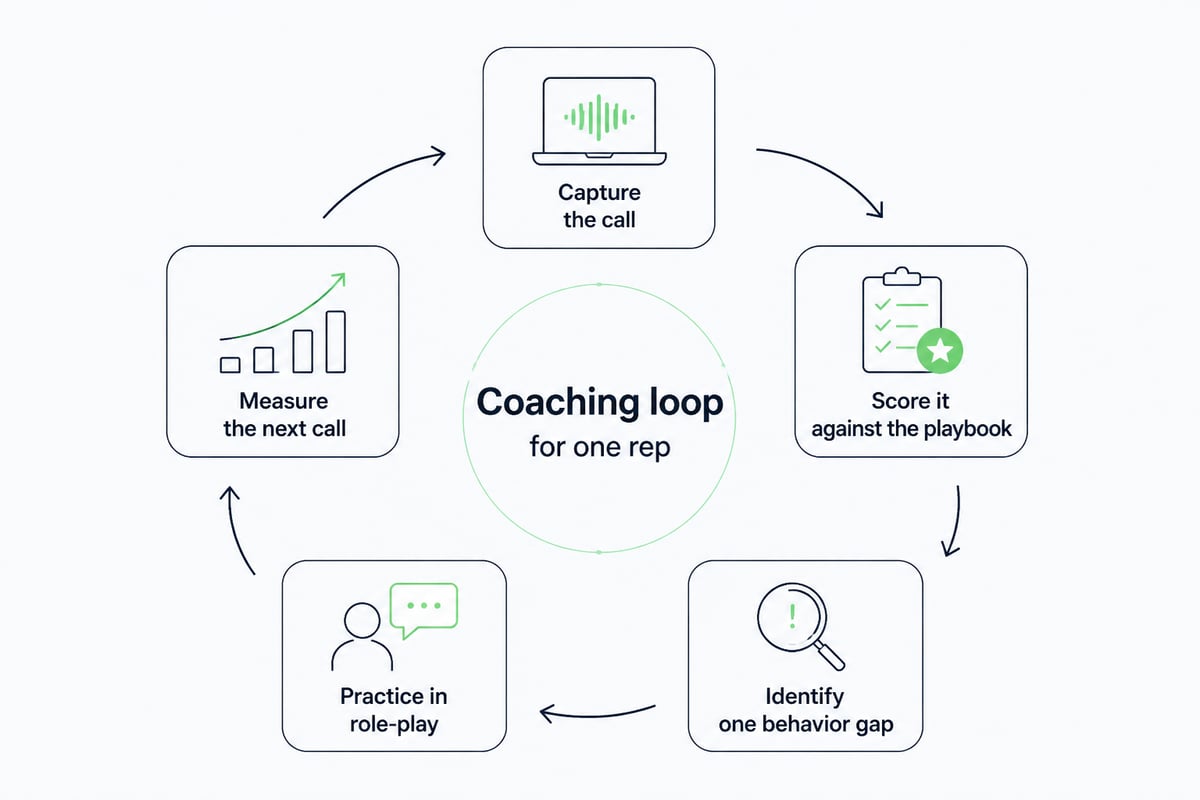
Bizware AI Sales Coach captures sales conversations, scores each call against your own playbook, and gives every rep private coaching and voice or text role-play based on their real calls. It handles both virtual and in-person conversations in one place and includes a manager dashboard. Each coaching step targets one behavior gap, with a measurable next call. The frameworks behind it draw on established sales methods.
According to Bizware's pricing page, the small-team plan is listed at $65 per user per month billed annually, with a five-license minimum. The same page says it includes AI call reviews, text and voice role-play, a performance dashboard and live onboarding. Bizware says its sales coaching system can be live in under 14 days and can be trained on your product, ideal customer profile, objections and winning calls, and the main site advertises a 30-day trial covering any number of licenses, with a card required to start and cancellation available before the trial ends.
Best for: Owner-led B2B teams of roughly 5 to 20 reps where the manager cannot listen to every call and wants consistent, private coaching without building a training library.
Limits: It is a coaching system, not a forecasting or RevOps platform, and teams that only need meeting notes will not use most of it. Confirm current plan details on the Bizware AI Sales Coach page.
Verdict: A practical fit when the goal is more calls reviewed, one clear behavior focus per rep and proof of change on the next call.
Sales Manager Coaching Tools Compared
The table below summarizes the seven options. Prices are approximate as of November 2026. Pricing models differ in ways that change the real cost for a small team: Substrata and Bizware charge per seat per month, Nooks bills per user per year, and Agentforce Sales charges by credits, so the totals are not directly comparable until you estimate your own usage. For a five-rep team, a $50 per seat plan runs about $250 per month, while the same five reps on Nooks at the estimated $4,000 to $5,000 per user would cost $20,000 to $25,000 per year. Mindtickle's $15 figure is only a starting estimate for quote-based packages, and GTM Studio and SmartWinnr require a vendor conversation, so budget for a quote cycle before you finalize a shortlist.
| Tool | Core focus | Approximate price | Best fit |
|---|---|---|---|
| Agentforce Sales | CRM-driven coaching, AI workflows | $500 per 100,000 credits | Teams already on Salesforce |
| Substrata | Relationship intelligence, buyer signals | $50/seat/month | Long-cycle B2B deals |
| Nooks | Parallel dialing, outbound coaching | $4,000 to $5,000/user/year (estimate) | SDR and BDR teams |
| Mindtickle | Training, certifications, readiness | From about $15/user/month (estimate) | Structured onboarding |
| GTM Studio | Conversation capture, performance analytics | Quote on request | Analytics-minded teams |
| SmartWinnr | AI role-play, gamified assessments | Quote on request | Practice and readiness |
| Bizware AI Sales Coach | Call scoring, private coaching, role-play | From $65 to $77/user/month, annual | Small owner-led B2B teams |
How Small Teams Should Choose
Pick the tool that matches the coaching problem you actually have, not the longest feature list. A few patterns hold up well.
If your gap is visibility, meaning you do not know what happens on calls, start with call capture and scoring. If your gap is ramp time, a structured onboarding platform pays off faster. If your gap is skill change, you need practice tied to real calls and a way to check the next call for improvement. For a deeper look at the process side, the sales coaching workflow for managers lays out a repeatable weekly rhythm, and coaching metrics for small teams explains which numbers are worth tracking.
Seat minimums and contract terms deserve attention too. A tool priced for fifty reps often forces a small team to pay for capacity it never uses.
One Coaching Principle That Improves Any Tool
Coach one behavior at a time, and define the next call as the test. Reps who receive five pieces of feedback after a call usually act on none of them. A single, specific change, such as asking a budget question before the demo, is easier to practice and easier for a manager to verify.
This is also where many tools fall short in practice. Dashboards report scores, but unless someone converts a score into one assignment with a measurable result, behavior stays the same. Whatever you buy, write the coaching step down in a sentence a rep can repeat, then check the next call for it. Teams building this habit from scratch can follow how to coach sales reps for a simple structure.

Questions Managers Ask Before Buying
How many reps does a team need before a coaching tool makes sense? Two or three can benefit once the manager can no longer review calls personally, though pricing minimums often start at five seats.
Should the tool score against our playbook or a generic framework? Your own playbook gives feedback reps recognize as relevant. Generic scoring is faster to start but can misjudge how your team actually sells.
Do we need role-play? If calls reveal repeated gaps with objections or discovery, practice is the step that turns feedback into new behavior. For more on this, see sales role-play practice for managers.
Is a trial worth running? Yes. Run it on real calls from at least two reps for two to three weeks and judge the tool by whether a manager actually uses the output.
Start by listing the three behaviors you most want to change on your reps' next calls, then test any tool on whether it can score and coach those exact behaviors. If you want that process running without listening to every call yourself, Bizware AI Sales Coach captures conversations, scores them against your playbook and coaches each rep on one gap at a time, and you can see it in action when you schedule a free demo with Ryan Cook.