

Sales team accountability means every rep knows what is expected, can see how their calls measure up, and is responsible for a specific improvement before the next conversation. You can build it without listening to every call by defining the behaviors you expect, scoring calls against them, and coaching one gap at a time.
For owners and managers of small B2B teams, the obstacle is rarely willingness. It is time. A team of five reps can hold dozens of conversations in a week, and no manager can review them all while also selling, hiring and running the business. The sections below explain how to replace call-by-call oversight with a system that holds up on its own.
Why Does Sales Accountability Break Down on Small Teams?
Accountability breaks down on small teams because expectations live in the owner's head, feedback arrives late, and the only visible measure is the number at the end of the month.
Three patterns show up repeatedly:
- Vague standards. Reps hear "be more consultative" or "ask better questions" but have no definition of what that sounds like on a call.
- Outcome-only measurement. Revenue and quota are reviewed after the quarter closes, when nothing about the underlying calls can be changed.
- Inconsistent follow-up. Coaching happens when the manager has a free hour, which means it happens after a bad week rather than on a schedule.
Results alone also give a misleading picture. HubSpot's 2025 State of Sales report found that most sales teams said they were on track to meet or exceed revenue targets. A team can sit inside that group and still have reps who skip discovery or avoid pricing conversations, because a healthy pipeline masks behavior problems until it thins out.
What Does Accountability Actually Mean for a Sales Rep?
Accountability for a rep means owning two things: the activity and outcomes assigned to them, and the specific behaviors that produce those outcomes.
It helps to separate accountability from monitoring. Monitoring is watching what reps do. Accountability is a shared agreement about what good looks like, paired with a regular check on whether it is happening. Reps who understand the standard can hold themselves to it, which is why the strongest teams feel less supervised, not more.
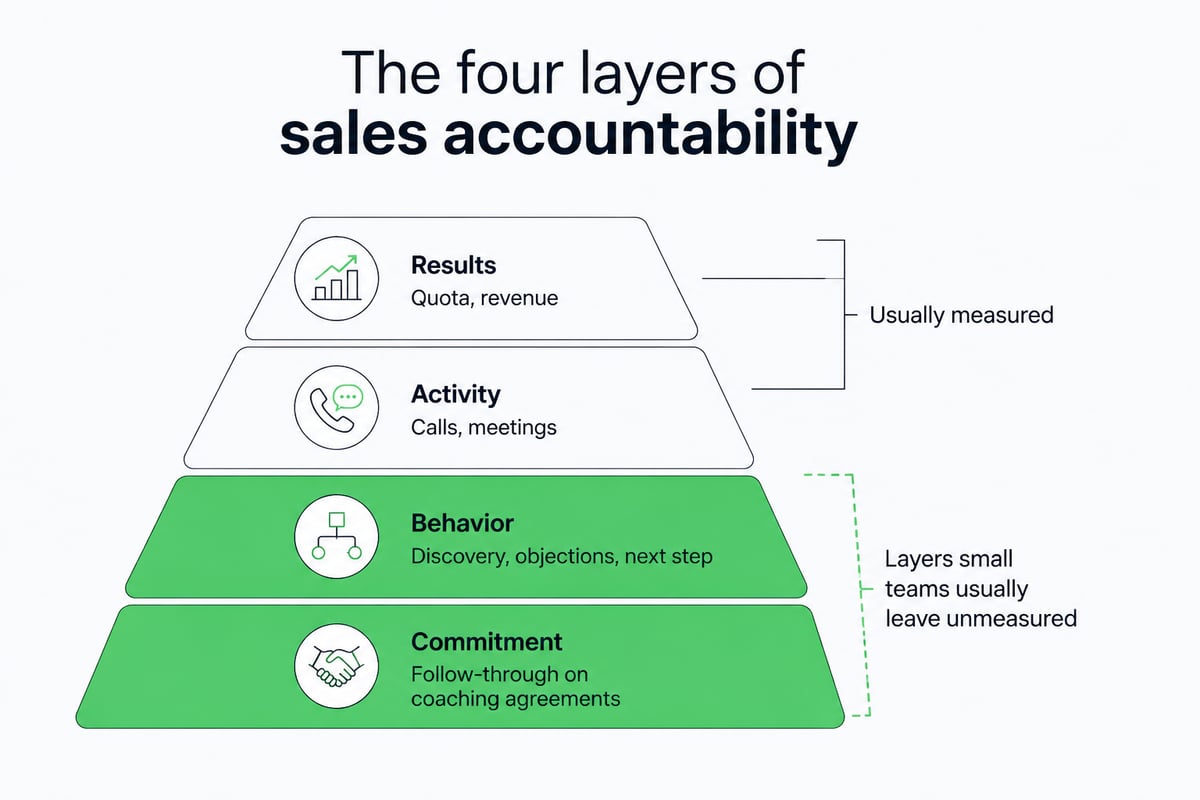
Four layers make this concrete:
- Results accountability: quota, revenue and win rate.
- Activity accountability: calls made, meetings held, follow-ups sent.
- Behavior accountability: how the rep runs discovery, handles objections and asks for the next step.
- Commitment accountability: doing what was agreed in the last coaching conversation.
Most small teams cover the first two and neglect the third and fourth. Behavior and commitment are where the improvement actually happens.
How Do You Set Standards Reps Can Be Measured Against?
You set measurable standards by writing your sales playbook as a short list of observable behaviors, each one something a reviewer could confirm from a call.
Start with the moments that decide deals in your business. For most B2B teams these are the opening, discovery, the budget and timeline conversation, objection handling and the close. For each moment, write two to four behaviors in plain language.
A weak standard: "Qualifies the prospect well."
A usable standard: "Asks about the decision process and who else is involved before presenting a solution."
The second version can be scored yes or no. That is the test for every line in your playbook. If two managers listening to the same call would disagree about whether the behavior happened, rewrite it until they would agree.
If you want a deeper look at turning a playbook into a scoring system, the guide on sales call scoring and behavior gaps walks through how to identify the single behavior holding a rep back.
Which Metrics Show Accountability Without Call Review?
The most useful metrics pair a lagging result with a leading behavior, so you can see both what happened and why.
The KPI Institute's 2025 sales KPI guide lists quota attainment and revenue per successful call among its recommended measures. It defines quota attainment as the percentage of sales targets met during a reporting period, and revenue per successful call as the average revenue generated per successful sales call in that period. Both are worth tracking, and both tell you what happened rather than why.
Pair them with behavior measures drawn from your own playbook:
| Measure | Type | What it tells you |
|---|---|---|
| Quota attainment | Result | Whether the rep is hitting target |
| Revenue per successful call | Result | How much value each winning conversation produces |
| Discovery questions completed | Behavior | Whether the rep is qualifying before pitching |
| Next step agreed on the call | Behavior | Whether the rep controls the process |
| Coaching commitment completed | Commitment | Whether the rep acts on feedback |
For more on choosing and interpreting these numbers, see this overview of sales performance metrics. Limit each rep to a handful of measures. Ten metrics produce a dashboard nobody reads; four or five produce a conversation.
How Can You Know What Happens on Calls You Never Hear?
You can know what happens on calls you never hear by capturing every conversation and scoring each one against your playbook, so you review results instead of recordings.
Manual sampling is the usual workaround, and it has limits. If you listen to two calls per rep per month, you are judging dozens of conversations by a tiny sample, and reps know which calls are likely to be picked. Scoring every call removes that gap. You see patterns across all of a rep's conversations: which behaviors are consistent, which are missing, and whether the trend is improving.
This is the practical meaning of sales call scoring software. The software does the listening, and you read the summary. A manager can scan a rep's scores in a few minutes and decide where a conversation is needed, rather than spending an afternoon on recordings.
Capture matters as much as scoring. Many small teams sell over video and in person, and calls that happen in a conference room or a coffee shop never reach a recording tool. If part of your pipeline is invisible, your accountability system has a blind spot exactly where owner-led teams often close their biggest deals.
How Should You Run Accountability Conversations?
Accountability conversations work best when they are short, scheduled, and focused on one behavior with a clear target for the next call.
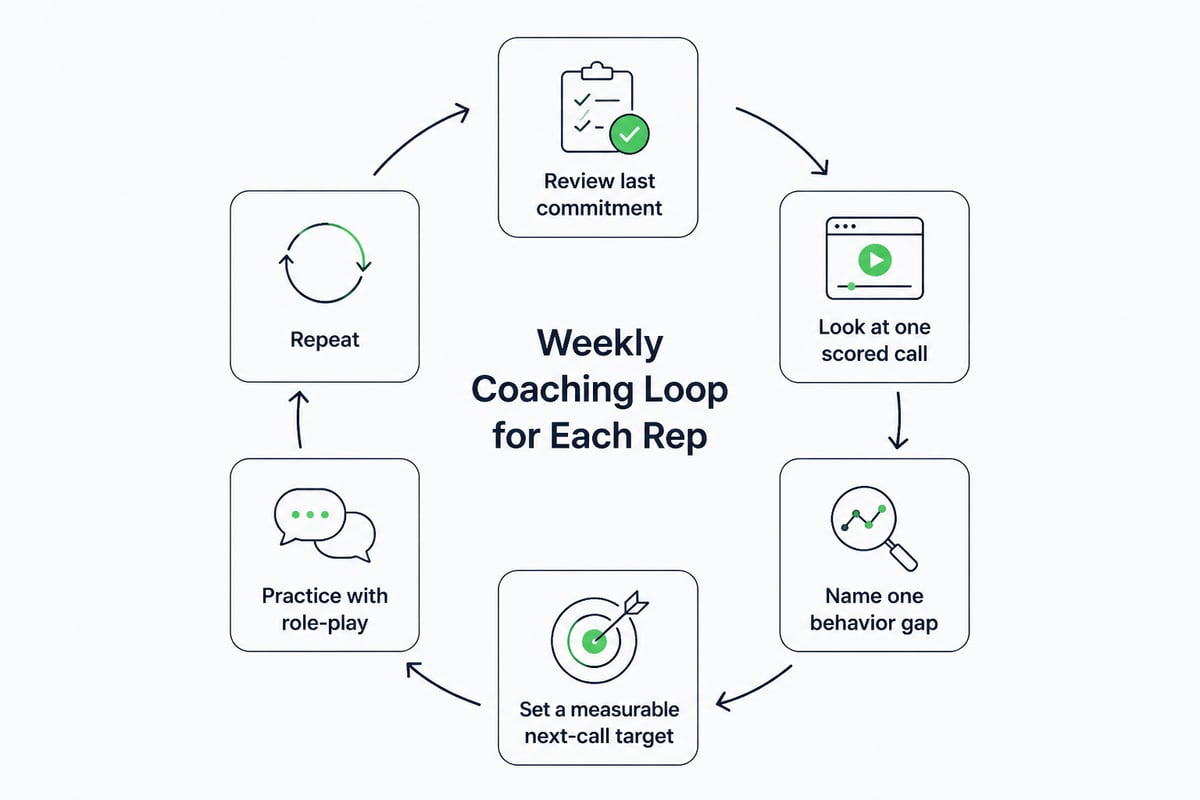
A simple weekly structure for each rep:
- Review the commitment from last time. Did they do what they agreed to?
- Look at one scored call. Pick the moment where the gap is clearest.
- Name one behavior to change. Not three. One.
- Define the measure. For example, "On your next three discovery calls, ask about the decision process before presenting."
- Practice it. Role-play the moment so the rep tries the new approach before a live prospect.
Naming one gap at a time is the discipline that makes the system work. A rep handed a list of eight improvements will attempt none of them. A rep handed one specific behavior and a measurable next call has a task they can finish and a result you can confirm.
Cadence matters too. The article on sales coaching cadence for small teams covers how often to meet when you have limited hours, and the piece on how to coach sales reps covers the conversation itself.
How Do You Keep Accountability From Feeling Like Surveillance?
You keep accountability from feeling like surveillance by being transparent about what is measured, keeping practice private, and using scores to coach rather than to punish.
Reps resist systems that feel like a hidden audit. They accept systems where the standard is written down, the scoring criteria are visible, and the first use of any data is a coaching conversation. A few practices help:
- Share the playbook and scorecard before scoring begins. Nobody should be graded on criteria they have not seen.
- Separate practice from performance. Role-play and self-review work better when reps can make mistakes without a manager watching.
- Praise specific behaviors. Reinforcing what is working builds trust and shows the scoring is not only a fault-finding tool.
- Apply the standard to yourself. If the owner sells, the owner's calls should meet the same criteria.
Coaching-industry research points the same direction. EntrepreneursHQ's compilation of coaching statistics gathers reported findings on accountability and sales coaching, and the common thread is that structured follow-up tends to change behavior more reliably than good intentions.

How Can Tools Support Sales Team Accountability?
The right tools support sales team accountability by handling capture, scoring and practice, which are the tasks a small team cannot do manually at volume.
Bizware AI Sales Coach captures virtual and in-person sales conversations in one place and scores every call against your own sales playbook. Each rep then receives private coaching and voice or text role-play built from the moments in their own calls, with one behavior gap targeted at a time and a measurable next call. Managers see progress on a dashboard without listening to recordings. The frameworks behind it are built on sales methods that have driven substantial sales growth for teams.
Whatever tool you consider, check it against a few questions:
- Does it score against your playbook rather than a generic template?
- Does it cover in-person and virtual conversations?
- Does it give reps something to do after scoring, not just a grade?
- Can a manager see trends in minutes?
For a wider comparison of options, the guide to AI sales coaching software outlines what to look for. Teams that need only meeting notes, or large organizations running forecasting across hundreds of reps, have different requirements than the small owner-led teams this approach is built for.
How Do Consultants Build Accountability Into Client Engagements?
Consultants build accountability into engagements by turning recommendations into scored behaviors and recurring checkpoints that continue after the workshop ends.
The common failure in sales advisory work is decay. A training day produces enthusiasm, and within a few weeks reps return to old habits because nothing measures the change. An ongoing scoring and coaching layer closes that gap. The consultant defines the target behaviors with the client, the system scores real calls against them, and the monthly review shows whether the engagement is changing what reps actually say.
This gives consultants evidence to show clients: behavior scores trending up across weeks, specific gaps closed, and next-call targets met. It also turns a one-time deliverable into continuing work. Advisors exploring this model can read more in the guide to B2B sales consulting services.
What Mistakes Undermine Accountability?
The most common mistakes are tracking too many measures, coaching too many gaps at once, and inspecting results without ever changing behavior.
- Metric overload. More numbers do not create more accountability. They dilute attention.
- Inconsistent follow-through. If the owner skips the weekly check-in twice, reps conclude it is optional.
- Scoring without practice. A low score tells a rep what was wrong. Role-play shows them what to do instead.
- Punishing honesty. If reps are penalized for admitting a weak call, they stop volunteering information.
- Treating accountability as a one-time rollout. Standards need revisiting as products, buyers and the team change.
FAQ
How do you hold your work team accountable?
Define what good looks like in observable terms, measure it consistently, and review progress at a fixed rhythm. Pair every review with one specific commitment, then check that commitment at the next meeting. Accountability holds when expectations are clear and follow-up is predictable.
What are four types of accountability?
A useful breakdown for sales teams is results, activity, behavior and commitment accountability. Results cover quota and revenue, activity covers calls and meetings, behavior covers how conversations are run, and commitment covers follow-through on coaching agreements. Most teams track the first two and gain the most by adding the last two.
What are the top skills for sales?
Strong discovery, active listening and clear next-step control are the skills that most often separate consistent performers. Objection handling and the ability to ask for a decision follow closely. Each of these can be written as a scoreable behavior and practiced through role-play.
Pick one deal-deciding moment in your sales process this week, write down two or three observable behaviors for it, and use them to review a single rep's next call. If you want to apply that standard to every conversation without listening to each one, Bizware AI builds Sales AI systems that score calls against your playbook and coach each rep on one behavior gap at a time, and you can see how the Bizware AI Sales Coach works in a short walkthrough when you schedule a free demo with Ryan Cook.