
A discovery call is a planned conversation, early in a B2B sale, where the seller and the buyer decide whether a problem is real, shared, and worth a next step. It is not a product tour with a few questions taped on the front. It is not a cold call. The seller already has a time, a reason, and a person who agreed to talk. The job of the call is to understand the buyer's situation well enough that both sides can say what should happen next, including nothing.
Start a 30-day free trial and score the next discovery call against your own playbook.
Key takeaway: You do not need a script. You need a sequence the buyer can follow, and one behavior you will review after the call.
Owner-led teams feel this gap first. A founder or a sales manager can sit on the early calls and still miss the same pattern: the rep hears a problem, nods, and moves to the offer. The buyer leaves with a deck and no clearer picture of the cost of staying put. This guide is for founders, sales managers, and solo sellers who run consultative sales and want a shared definition their team can actually use. When a call misses that picture, AI sales roleplay is where the rep can practice the missed question before the next buyer.
What is a discovery call, in plain terms?
What is a discovery call if you strip the jargon? It is a conversation that tests fit before anyone spends serious time on a proposal. The seller is trying to learn four things: what is happening now, why it matters, who else is involved, and what a useful next step would look like. The buyer is trying to learn whether this person understands the problem and is worth another meeting.
That is a narrower job than "have a good sales call." A later call might demo the product, handle a pricing objection, or negotiate terms. Discovery can touch those topics, but only to understand them. If the buyer asks what it costs, the useful move is to learn what they are comparing it with, not to recite a price sheet. The definition holds when the next step is earned by what was learned, not by how polished the pitch was.
A useful test is the recap you could send the same afternoon. If that note can name the current situation, a cost, the other people, and a next step in the buyer's words, the call did its job. If the note is a list of features you showed, the meeting was a demo that started early. Teams argue less about "good discovery" once they judge the recap instead of the vibe of the conversation.
Solo sellers can use the same test. There is no manager in the room, so the written recap is the only record of whether the call stayed on the problem. If you cannot write the four lines after you hang up, the call was not finished, even if it felt friendly.
What a discovery call is not
Most bad discovery calls are a different meeting wearing the wrong name. Naming the neighbors makes the real call easier to coach.
| Conversation | The job | What good looks like |
|---|---|---|
| Cold call | Earn a conversation with someone who did not expect you. | A booked meeting, not a diagnosis. |
| Discovery call | Learn the situation, the stakes, and the people involved. | Both sides can name the problem and a next step. |
| Demo or presentation | Show how the offer maps to a known problem. | The buyer can see their situation in the product. |
| Proposal review | Confirm scope, price, and the path to a decision. | Open questions get owners and dates. |
A discovery call that turns into a demo usually fails both jobs. The buyer did not get understood, and the product did not get a fair hearing, because nobody agreed on the problem it was supposed to solve. If your team already has a page on how to make a sales call that advances the deal, treat that as the wider skill. This page stays on the early conversation only.
Solo sellers mix these meetings up for a different reason. When one person does every call, the calendar label is the only thing that changes. Put the meeting type in the invite. "Intro and fit" is a discovery call. "Walkthrough of the workflow" is a demo. The label tells you which notes to take and which behavior to review later.
The same mix-up shows up in owner-led teams of five to twenty. A founder who still carries the first meetings will often treat every conversation as discovery, because learning feels safer than asking for a decision. A sales manager who used to carry a quota will often treat every conversation as a demo, because showing the product feels like progress. Neither habit is a method. The table above is the method: name the job before the call, and review the call against that job only.
When a discovery call belongs in the sale
Use a discovery call when the buyer has a problem that is not yet clear enough to price, scope, or demo against. That is the usual case in consultative B2B sales: services, software, and anything sold through a conversation rather than a cart. Skip it, or keep it very short, when the buyer already knows the offer, the price, and the decision maker, and only needs a quote.
Three signs show the call is early enough to be discovery.
- The buyer can describe a symptom, but not the cause. "Our reps miss follow-up" is a symptom. "Managers do not review calls, so the same miss repeats" is closer to a cause.
- More than one person will have to live with the decision, and you have not heard from them yet.
- A proposal written today would be a guess. You would be filling in scope the buyer has not confirmed.
Three signs you are past discovery and should not pretend otherwise:
- The buyer has a written set of requirements and is comparing vendors against it.
- Legal or procurement is already in the thread.
- The only open question is price or timing.
Owner-led companies often keep discovery too long. The founder enjoys the conversation and stays in learning mode after the buyer is ready to see the offer. Give the call a clock. Twenty-five to forty-five minutes is enough for a first conversation. If you need more, book a second call with a named purpose, instead of letting the first one sprawl.
There is a second failure that looks like patience and is not. The seller keeps asking questions after the buyer has already described the problem, the cost, and the people, because more questions feel thorough. Past that point, another question is stalling. Say the problem back, offer the next step you prepared, and stop. A buyer who wanted a deeper look will ask for it. A buyer who is ready to move will be grateful you did not add ten minutes.
Transactional teams should not force this meeting into a short cycle. If the buyer can choose, pay, and start without a conversation, a discovery call adds friction. Bizware is built for conversation-driven sales, where the call itself is the work. Use the meeting where the call changes the decision, not where a checkout page already can.
How to prepare for a discovery call without over-preparing
Preparation is a short list, not a dossier. Ten minutes is enough if you already know your buyer and your offer. Write four lines before the call, and stop.
- Why they took the meeting. Use their words from the email or the form, not your guess.
- What you already believe. One hypothesis about the problem. You will test it, not defend it.
- Who else might matter. A name or a role you want to ask about.
- The next step you would offer if the fit is real. A second call, a short workshop, or a clear no.
Read the buyer's site and the last email. Do not build a custom deck for a first conversation. A deck pulls you toward presenting, and presenting is the failure mode this call exists to avoid. If you want a single page in front of you, make it the four lines above, plus three questions you refuse to leave without answering.
Key takeaway: If you cannot say what would make this call a success, you are not ready. A good conversation is not a success. Leaving with their description of the problem, a cost, and a next step is.
Founders over-prepare in a specific way. They reread the product, the pricing, and the last three deals, then walk in ready to teach. That is useful for a demo. On a discovery call it crowds out the buyer's account. Cap the prep at the four lines. If you still feel underprepared, write the hypothesis more plainly. You might write that new managers are not reviewing calls, and that this is why ramp is slow. You will find out in the first ten minutes whether that sentence is wrong.
A sales manager preparing a rep should review the four lines, not the slide deck. Ask the rep to say the hypothesis out loud. If the hypothesis is "they need our platform," send them back. A hypothesis names the buyer's situation. It does not name your product. The same standard applies when the founder is the rep. Write the four lines on your own calls, or the team will treat prep as optional.
Discovery questions that create understanding instead of interrogation
Questions are the tool. A pile of questions is not a method. Use a few, and stay with the answer until you could explain it to someone who was not on the call.
Start with the current state, in their operation, not in your category. Ask them to walk through what happens after a rep finishes a first meeting. That produces a story. Asking how they handle sales coaching today produces a label they think you want to hear.
Then ask why it matters now. Timing is the difference between a real problem and a topic they are willing to discuss. "What changed in the last quarter?" and "What happens if this looks the same in six months?" are enough. If nothing changed and nothing happens, you may not have a deal. That is a useful finding, not a failed call.
Then ask who else lives with it. A problem that only one person feels is a different sale from a problem a manager, a finance lead, and a frontline team all feel. You are not building a stakeholder map for its own sake. You are learning whether a next step with only this person would be a waste of their time.
Close the question set by saying what you heard and asking what you got wrong. That last move is the behavior worth coaching. Reps who ask clever questions and then pitch have not discovered anything the buyer trusts. Reps who restate the problem, and wait to be corrected, have.
Three questions are enough for a first pass if you stay with the answers. Ask what a normal week looks like. Ask what it cost the last time it went badly. Ask who else has to agree before anything changes. A fourth question earns its place only when the first three are thin. Ask what they have already tried. That tells you whether they want a new tool, a new habit, or permission to stop a thing that is not working. Do not ask it as a trap. Ask it so you do not propose the thing they already abandoned.
Avoid the stacked question. "How do you coach, who owns it, and what is the budget?" gives the buyer permission to answer the easiest third and skip the rest. Ask one thing. Wait. Write their words. Then ask the next thing. Silence after a cost question is not a problem to fill. It is often the moment the real number shows up.
How to handle common turns in a discovery call
The sequence fails in the same few places. Decide the move before you are in the meeting, so the rep is not inventing a policy while the buyer waits.
The buyer asks for a price in the first five minutes
Give a range if you have a real one, then go back to the problem. A range without context trains the buyer to shop. A refusal to say anything trains them to assume you are hiding a large number. For Bizware, the public trial is the honest early answer. Software plans start with 30 days free, a card on file, and $0 due today. You can cancel before the trial ends.
The hours, and therefore the plan, depend on how much of the week is spent in sales conversations. That is a discovery question, not a price dodge. Ask how many hours a week their sellers are actually in calls. The answer tells both of you which plan is even relevant.
Do not invent a discount to keep the call alive, and do not quote a custom number you have not scoped. If the buyer is asking for price because they are comparing three vendors this week, say so out loud and ask what the comparison is trying to decide. You may learn that you are already past discovery. That is a better outcome than a half-hour of questions they will not use.
The buyer wants a demo immediately
Do not pretend you are still discovering while you click through screens. Offer a choice. "I can show you the workflow now, and we will treat this as a demo. Or we can spend the rest of this meeting on the problem, and I will show the workflow against it next time." Buyers respect the choice. They do not respect a seller who says yes and then keeps interrogating them between slides.
If they choose the demo, change your notes. You are no longer scoring this meeting as discovery. Score whether the product was shown against a problem you already understood. If you did not understand it yet, write that down. The review should say the demo started early.
The economic buyer is not on the call
Stay on discovery, and make the next step about the missing person. Ask what that person will care about, and what they have already rejected. Then agree to a second conversation where they are present, with a written problem statement this person can react to beforehand. A proposal sent around the missing buyer is how deals stall with no owner.
Ask one practical question before you leave. Would they send a four-line problem statement to the missing buyer, or would they rather you join a call where both people hear it? The answer tells you whether this contact can carry the problem or only report that a meeting happened. Both can be fine. They are different next steps.
The buyer is polite and vague
"We are always looking to improve" is not a problem. Ask for the last time the issue cost them something specific. If they cannot name a deal, a person, or a week, you do not have discovery material yet. Offer to stop, and tell them what would make a second call worth it. Polite vagueness, left unchallenged, becomes a pipeline full of meetings that never had a point.
A gentle version is enough. "I want to be useful, and I do not yet know what would change if we worked together. Can you point to one deal or one week where this showed up?" If the answer is still general, end the meeting kindly. Send a two-line note that says you did not hear a problem worth a proposal. Some of those buyers come back with a real example. The ones who do not were never a deal.
The problem is real, but it is not yours to solve
Say so. A discovery call that ends in a clear no is a success for both sides. The failure is a seller who stretches the product to cover a problem it does not solve, because the meeting felt good. Write the mismatch down in the same place you write wins. It keeps the next rep from reopening a deal the first call already answered.
Bizware is a sales coach for the conversations a team already has. It scores a real call, shows the gap against the team's playbook, and gives the rep a specific moment to practice. It is not a fix for a missing offer, a broken market, or a team that does not sell through conversation. If the call reveals one of those, the honest next step is to say that and stop. Forcing a trial onto a problem the product does not touch wastes the buyer's month and your onboarding time.
Three discovery call examples for owner-led B2B teams
Definitions stick when a team can see them. These are composites, not customer results. Use them to judge your own calls. None of them is a promise that a script produces revenue.
A founder selling to another founder
The buyer runs an 8-person B2B services firm. She says new reps "are not ramping." A weak discovery call spends the rest of the meeting on onboarding checklists. A useful one stays with her words. When did she last listen to a new rep's call? What did the rep miss? What did that miss cost on a deal she can name? Who else, besides her, notices when ramp slips?
The seller's job is not to agree that ramp is hard. The job is to find out whether she has any shared picture of a good first meeting. If she does not, the problem is a missing standard, not a missing tool. The next step might be a second call where she brings one recorded first meeting and you both listen for whether the rep said the problem back. That is a concrete next step. "I'll send a deck on onboarding" is not.
Notice what the seller does not do. They do not mention call recording in minute five. They do not ask for the whole pipeline. They leave with one deal, one missed behavior, and a person who will be in the next conversation. A founder buyer will often reward that restraint by talking more, not less, because she can tell you are not collecting slides.
A sales manager with ten reps
The buyer has a team and no time to sit in on calls. He says he "needs visibility." A weak call becomes a tour of dashboards. A useful call asks what he would do differently on Monday if he could see the one behavior his best rep does and his newest reps skip. If he cannot name the behavior, visibility will not help him. You have discovered that the team has no standard, which is a coaching problem before it is a software problem.
The next step is a working session, not a proposal. He picks two calls, one from a strong rep and one from a new rep. You listen for a single difference: did the seller say the problem back before offering a next step? How Bizware works is the product path after that standard exists. The discovery call's job is to find out whether the standard exists at all.
A manager in this spot often asks for "AI coaching" as if the phrase were the requirement. Treat that as a label, the same way you would treat "better reporting." Ask which conversation he wishes he had reviewed last week, and what he would have said to the rep. His answer is the real requirement. If he cannot answer, the proposal should wait.
A solo seller who is also the delivery team
The buyer is a consultant who sells and delivers. She does not have a manager, and she will not hire one this year. A weak discovery call talks to her as if she were a VP of Sales with a bench of reps. A useful one asks how she reviews her own first meetings today, and what she wishes she had asked on the last deal she lost.
The definition does not change because she is alone. She still needs the current state, the cost, the other people, and a next step. The coaching loop is just hers. She can score her own call, practice the one question she skipped, and listen for that question on the next call. A team plan is the wrong recommendation. An individual path is the honest one. Say that on the call, so she does not have to translate your team language into her week.
Solo sellers also lose discovery inside delivery. The same person who ran the first meeting is on the implementation call three weeks later, and the notes from discovery never get reread. A practical next step for this buyer is a four-line recap she files where the delivery work lives, not a CRM field she will not open. If she cannot point to that place, you have not finished discovery. You have pitched a habit she has no home for.
What the buyer and the seller each need
A discovery call fails when only one side gets what they came for. Write both lists down, because reps remember their own.
The buyer needs to feel that the seller understood the situation before offering anything. They need a sense of whether this is worth more time. They need to know what happens next, including the option that nothing happens next. They do not need a feature list, a company history, or a forced "pain" exercise.
The seller needs four things they can write down afterward: the current state in the buyer's words, why it matters now, who else is involved, and the agreed next step. If any of the four is missing, the call is incomplete, even if the buyer was friendly. Friendly is not a stage in the sale.
This is the point of a shared definition. Without it, one rep treats discovery as rapport, another treats it as qualification theater, and a third treats it as the opening of the pitch. The manager then reviews three different meetings and calls them all "discovery." The team cannot improve a motion it has not named.
Put the two lists where the notes go. A simple header is enough: "Buyer left with" and "We can write down." If either side is empty, the recap should say what is missing instead of papering over it with enthusiasm. Buyers can tell when the follow-up email describes a meeting they did not attend.
The shape of a useful discovery call
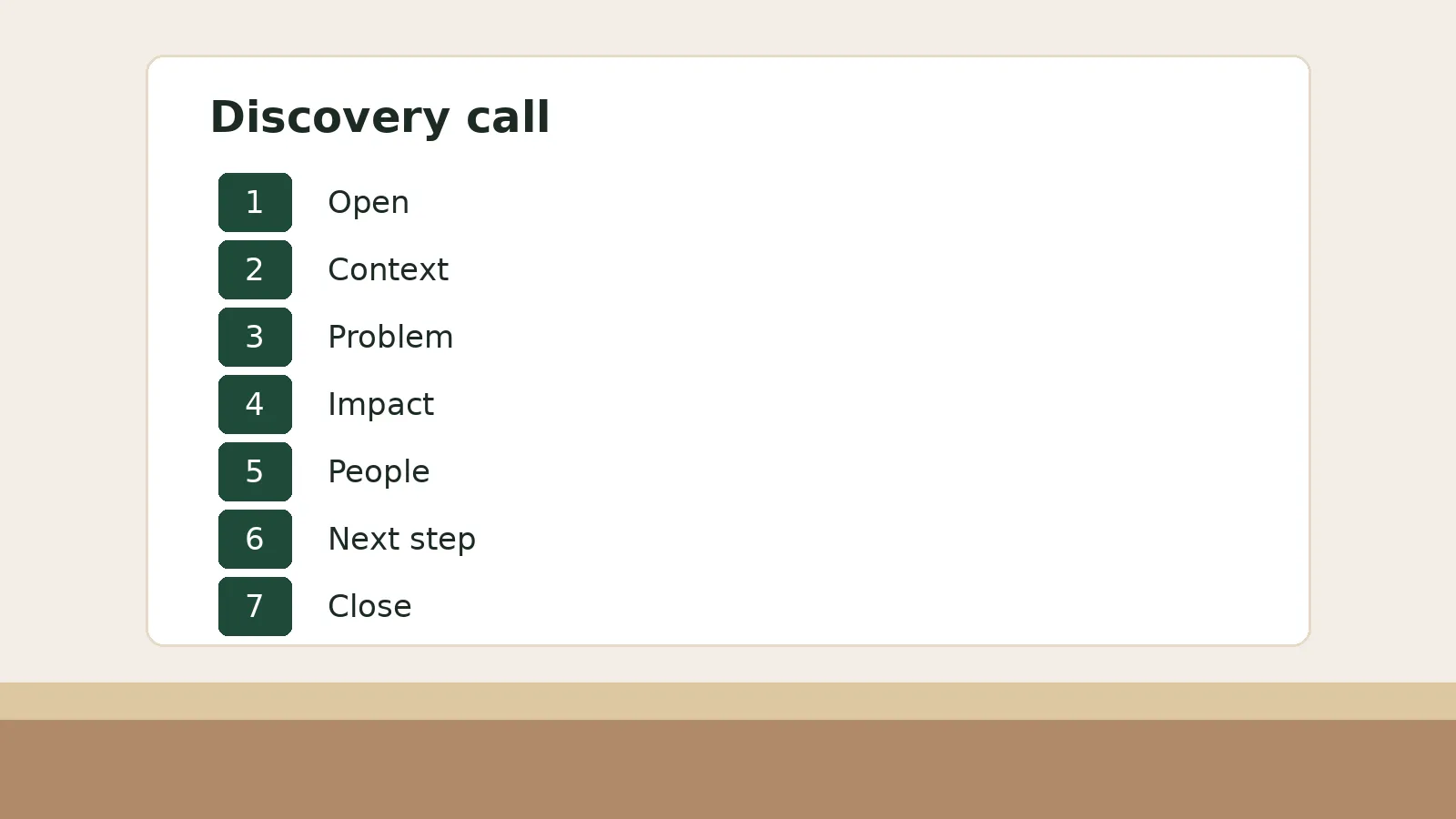
You do not need a script. You need a sequence the buyer can follow. Here is a shape that works for a 25 to 45 minute meeting. Adjust the minutes, not the order.
- Open with the point of the call. One or two minutes. Say, "We have 30 minutes. I want to understand what is happening with your new reps and whether we should spend more time on it. Does that match what you hoped to cover?"
- Confirm what you already know. Two or three minutes. Read back the reason they booked, and let them correct it. This keeps you from investigating the wrong problem.
- Map the current state. Eight to twelve minutes. Ask them to walk through the work as it happens. Take notes in their words. Do not translate into your product language yet.
- Find the cost. Five to eight minutes. Ask what the current state costs when it goes badly. Push once, gently, for a number or a recent example. "About how many deals last quarter?" is better than "Does that hurt revenue?"
- Find the people. Three to five minutes. Ask who else is affected, who has tried to fix it, and who would decide.
- Say the problem back. Two minutes. Say, "What I heard is that new reps take two quarters to run a clean discovery, and managers only hear the calls that reps choose to share. Did I miss a piece?"
- Agree on a next step, or agree to stop. Use the last few minutes. A second meeting with a named person, a written summary they can react to, or a clear no. Put the next step in the recap email the same day.
Key takeaway: The sequence is the coaching standard. A call can be warm and still fail if the seller never says the problem back or never names a next step.
The middle of that sequence is where reps rush. They hear a familiar problem and jump to the offer, because the offer is what they have practiced. The fix is not more product knowledge. The fix is staying in the buyer's account of the work until the cost and the people are clear. That is a behavior you can listen for on a recording.
Protect the close of the sequence with the same care. Reps burn the last five minutes saying thank you and promising to "send something over." That promise is not a next step. Before you leave, say the next step as a sentence you could put on a calendar: who will be there, what you will look at, and what decision that meeting is for. If you cannot say that sentence, you are not done, and adding it to the email later does not repair the call.
Online meetings make this sequence easier to review, because the call is already on a calendar and a recording. Zoom, Google Meet, and Teams are the usual rooms for this kind of B2B sale. The sequence itself does not depend on the room. The review does. If you cannot listen to the call again, you will remember the rapport and forget the minute you skipped the cost. Plan the review at the same time you plan the meeting.
A short example from an owner-led team
A sales manager at a 12-person services firm reviews a call with a new rep. The buyer, an operations lead, said their team "needs better reporting." The rep spent the next twenty minutes on the dashboard. The call ended with "send me something."
The manager does not grade the dashboard tour. They ask one question in the review: what did we learn about why the current reporting fails? The honest answer is almost nothing. The next coaching action is small. On the following call, the rep has to ask what decision the buyer cannot make today, and who is waiting on that decision, before any screen is shared. That is discovery. The dashboard can wait until the second meeting, when the problem has a shape.
This is also where a tool should stay in its lane. Bizware AI scores the real call, points at the gap, and lets the rep drill that moment before the next conversation. It does not replace the manager's judgment about whether the deal is real. The score is a way to see the behavior. The manager still decides what "good" means for this team.
Run the same example one step further, because this is where coaching usually stops. The rep's next call is with a similar buyer. At minute twelve the buyer says they just need a clearer view of the pipeline. The rep does not open the dashboard. They ask which decision was late last month because the view was unclear, and who had to make it.
The buyer names a forecast meeting and a director who rewrote the numbers by hand. Now there is a cost and a person. The dashboard can be the second meeting, shown against that meeting, not against a slogan.
If the rep still opens the dashboard at minute twelve, the review does not need a speech. Play that minute, ask the rep to say the question they wish they had asked, and have them practice it once out loud. Then score the next call for that question only. One repeated miss, caught on the next call, changes the habit. A quarterly workshop about "better discovery" usually does not.
How a sales manager can review discovery calls fairly
A definition is useless if every manager grades a different thing. Pick three checks and use them on every review for a month. More than three and the review becomes a lecture.
- Problem in the buyer's words. Can you point to a sentence the buyer said, not a sentence the rep translated into your product?
- Cost or consequence. Is there a number, a recent deal, or a named person who felt the miss? "It is a priority" does not count.
- A next step both sides named. A meeting, a summary, or a no. "I'll send info" is not a next step.
Review the call within a day, while the rep still remembers the moment they rushed. Ask them to find the minute themselves. "Where did you leave their words and start yours?" is a better question than "Why did you pitch so early?" The first one teaches listening. The second one teaches defensiveness.
Keep the review private to the rep unless the team has agreed to group review. Public grading of a bad call makes people hide recordings. Bizware is built so the rep sees coaching on the call first. A manager can still join the review. The point is that the rep does not have to wait for a weekly one-to-one to know what to practice.
Fair also means the founder is in the sample. If you only review the newest rep, the team learns that discovery is a beginner skill. Pull one of your own first meetings into the same three checks. If you skipped the cost, say so in the same words you would use with a rep. Owner-led teams copy the founder's calls. They do not copy the rubric the founder does not use.
Time-box the review to twenty minutes. Five minutes to find the minute that matters, ten minutes to name the one gap, five minutes to decide the drill before the next call. A review that rewatches the whole meeting becomes a second sales call about the sales call. The rep leaves tired and without a single behavior to repeat. The three checks exist so you can stop early.
From a low score to the next useful action
Scoring a discovery call only helps if the score names a behavior. A mark of 2 out of 5 only tells a rep they failed. A better note says they asked what the problem costs, then moved on before they got a number. That note tells them what to repeat. Tie every low mark to one action before the next call.
A practical loop for an owner-led team looks like this. The call is captured. The scorecard marks the gap against the playbook the team already uses. The rep practices that moment, out loud, before the next conversation. The following call is scored again, on the same behavior, so you can see whether it changed. What sales coaching is covers the wider practice. Here, the only claim is that a discovery call can be coached like any other behavior: one gap, one drill, one next call.
Do not score ten behaviors on a first pass. A new team should score whether the seller said the problem back. When that shows up on most calls, add the cost question. When that shows up, add the next step. Teams that roll out a twelve-row scorecard in week one argue about the rows and never change a call. Discovery call scorecard examples are for the day you are ready to score. They are not a substitute for the definition on this page.
Live guidance and practice are different jobs. On the current Bizware pricing page, Live Coach sits on a second screen during online meetings, where it can suggest a next question while the meeting is underway. That help is for online meetings only. It is not a phone-call feature, and it is not in-person coaching. Roleplay is the separate practice after the call, using the gap the call already showed. Do not describe either one as a substitute for the rep owning the four things the call was supposed to learn.
Use the score to choose the drill, not to rank the rep. A rep who misses the cost question on three calls in a row does not need a lecture about commitment. They need to hear their own wording, say the question they skipped, and try it on the next live conversation. A rep who hits the question and still loses the deal may have an offer problem, a timing problem, or a buyer who was never going to buy. The scorecard should not pretend those are the same miss.
Measure the next call, not a mood. Pick the one behavior, count how often it shows up on the next five discovery calls, and stop there. Confidence is not a result you can coach. A count is. Four of the last five calls restating the problem before a next step is a result. If the count does not move, the drill was too vague, or the rep practiced a different moment than the one the score marked. Fix the drill before you add a new behavior.
How to implement a discovery-call standard in one week
A founder does not need a program launch. They need one week in which every first meeting is reviewed the same way.
- Monday. Write the one-sentence definition and the seven-step sequence. Put both in the playbook the team already uses. Do not invent a second document.
- Tuesday. Each seller, including the founder, writes the four prep lines on that day's first calls.
- Wednesday. Review two recorded calls against the three checks only: the problem in the buyer's words, a cost, and a named next step.
- Thursday. Each rep practices the one gap from those reviews before the next first meeting. Voice practice is enough. A full classroom session is not required.
- Friday. Read the next-step emails from the week's discovery calls. If a next step is missing or vague, that is the only coaching topic for the following week.
At the end of the week, do not add new standards. Keep the same three checks for the rest of the month. Consistency is the implementation. A new rubric every Friday is how discovery "training" dies.
If the week produces nothing but arguments about wording, you started too big. Cut back to the one sentence at the top of this guide and the single behavior of saying the problem back. You can add the cost check in week three. You cannot recover a team that spent week one debating a glossary. The point of the week is that two real calls get the same review, not that the document looks finished.
A solo seller can run the same week alone. Monday, write the sentence where your notes already live. Tuesday, write the four lines before the first meeting. Wednesday, replay one call and mark the minute you skipped the problem or the cost. Thursday, practice that minute out loud once. Friday, read your own recap and see whether a stranger could tell what happens next. Nobody else has to attend. The week still works, because the standard is the written review, not a meeting about the standard.
How to coach one discovery behavior
Do not coach the whole call. Coach one behavior the team is dropping. For most teams new to a shared definition, the behavior is this: the seller says the problem back, in the buyer's words, before they offer a next step.
Listen to five recent discovery calls. Mark the minute where the seller either did this or skipped it. If they skipped it, that minute is the drill. The rep re-runs just that minute: the buyer's last sentence, the restatement, and a pause for the correction. Then they take the next live call and do only that. How to improve sales discovery calls goes further on practice. Start with one behavior or you will not be able to tell whether practice changed anything.
A founder who still sells should run the same drill on their own calls. The team's standard will follow the founder's calls, not the slide that describes the standard. If the founder restates the problem, reps will. If the founder jumps to the offer, the rubric will not save you.
Make the drill specific enough to hear. "Be more curious" cannot be scored on a recording. "Before you offer a next step, restate the problem in the buyer's words and pause" can. When you listen back, you are listening for that pause. If the rep restates the problem and then talks over the answer, the drill is not done. The pause is the part that lets the buyer correct you. Without it, the restatement is just another pitch in their vocabulary.
Practice belongs after the call, not in the middle of it. Live Coach, on a second screen during an online meeting, can point at a question while the conversation is happening. That is help in the moment, and only for online meetings. The drill is different. The rep already knows which minute failed. They practice that minute before the next buyer, in voice or text, against the playbook the team trained.
Then the next real call is the test. Mixing the two jobs makes both of them vague. The rep waits to be prompted, and the practice never has a before-and-after.
Make the definition stick across the team
Write the one-sentence definition where the team already works. Put it at the top of the call scorecard, on the Monday agenda, and in the playbook. Read it until it is boring. Boring means it is shared.
Then hold the line in reviews. When a rep wants credit for a "great conversation" that never named a cost or a next step, point at the definition and move on. Praise the calls that end with a clear no as readily as the calls that end with a second meeting. Both followed the job. A call that ends in enthusiasm and no next step did not.
Revisit the definition when the sale changes, not when a new manager wants a new framework. If you move upmarket and the first meeting is now with a buying group, the four things to learn stay the same. You may need a second discovery call to hear from the other people. You do not need a new word for the first meeting. Renaming the call every quarter is how teams lose the behavior they just started to coach.
For a solo seller, "the team" is the written standard you keep for yourself. Put the sentence at the top of your call notes. When a friendly meeting ends without a next step, mark it incomplete in the same way you would mark a rep's call. The discipline is identical. The only thing missing is someone else in the review, which is why the written note has to be blunt enough to argue with you a day later.
When you want every discovery call scored the same way, start a 30-day free trial. It is $0 today, and you can cancel before the trial ends.
FAQ: Questions people ask about a discovery call
What is a discovery call?
A discovery call is an early B2B conversation where the seller and the buyer test whether a problem is real, shared, and worth a next step. The seller learns the current situation, why it matters, who else is involved, and what should happen next. The buyer learns whether this seller understands the problem well enough to deserve more time.
How is a discovery call different from a cold call or a demo?
A cold call tries to earn a first conversation with someone who was not expecting you. A demo shows how the offer maps to a problem you already understand. A discovery call sits between them. You already have the meeting, and you do not yet have a problem clear enough to present against. If you are showing screens before you can say the problem back, you have started the demo early.
How long should a discovery call be?
Plan for 25 to 45 minutes. That is enough to map the current state, find a cost, name the other people, and agree on a next step. If you need longer, schedule a second call with a specific purpose instead of letting the first meeting turn into a presentation.
What should you send after a discovery call?
Send a short recap the same day. Include the problem in the buyer's words, the cost or consequence you heard, the people who still need to be involved, and the next step you agreed to. If you did not agree on a next step, say that plainly and ask whether there is a reason to continue. Do not attach a proposal until the buyer has confirmed the problem statement.
Can a solo seller run a discovery call without a manager?
Yes. Use the same definition and the same sequence. Write the four prep lines before the call, say the problem back before you offer a next step, and score your own recording against that one behavior. A manager makes the review harder to skip. The behavior itself does not require one.