
To improve sales discovery calls, define what a good call looks like, prepare every call against that definition, ask questions in a fixed sequence, and review real recordings so each rep fixes one behavior at a time. Most weak discovery comes from inconsistency, not from a lack of effort or talent.
For owners and sales managers who cannot sit in on every call, that inconsistency is the real problem. One rep digs into pain and budget. Another jumps to a demo in ten minutes. The pipeline looks the same on paper, but the quality underneath it is not. This playbook walks through the steps in the order you would apply them, then covers the mistakes that undo the work.
What You Need Before You Start
You need four things in place before changing how your team runs discovery.
- A written definition of a qualified opportunity. Two or three sentences covering the problem you solve, the buyer who feels it, and the signals that mean a deal is real.
- A short question set. Eight to ten questions your team agrees on, not a script of thirty.
- Access to real calls. Recordings or transcripts from virtual and in-person conversations. Without them, coaching rests on rep self-reports.
- A review rhythm. A fixed weekly slot, even 30 minutes, to look at two or three calls.
If you have no written playbook yet, start with how to build a sales playbook so the standards you coach against exist on paper.
Step 1: Define What a Good Discovery Call Looks Like
A good discovery call ends with you understanding the buyer's problem, its cost, who decides, and what happens next, and with the buyer agreeing that the conversation was worth their time.
Turn that into observable behaviors your team can be scored on. A workable list:
- The rep opens by stating the purpose and agenda, then asks permission to proceed.
- The rep asks at least three open-ended questions about the problem before mentioning the product.
- The buyer talks for more than half of the call.
- The rep confirms timeline, budget range and decision process.
- The rep summarizes what they heard and secures a dated next step.
Salesforce's sales-process guidance recommends qualifying prospects around need, purchase timing, budget, and who has purchasing authority. Those four areas make a sound backbone for your definition. Adapt the wording to your market, then keep the list short enough that a rep can hold it in their head during a live conversation.
Step 2: Prepare Each Call in Ten Minutes
Ten minutes of targeted preparation is enough to change the quality of a discovery call, provided the rep knows exactly what to look for.
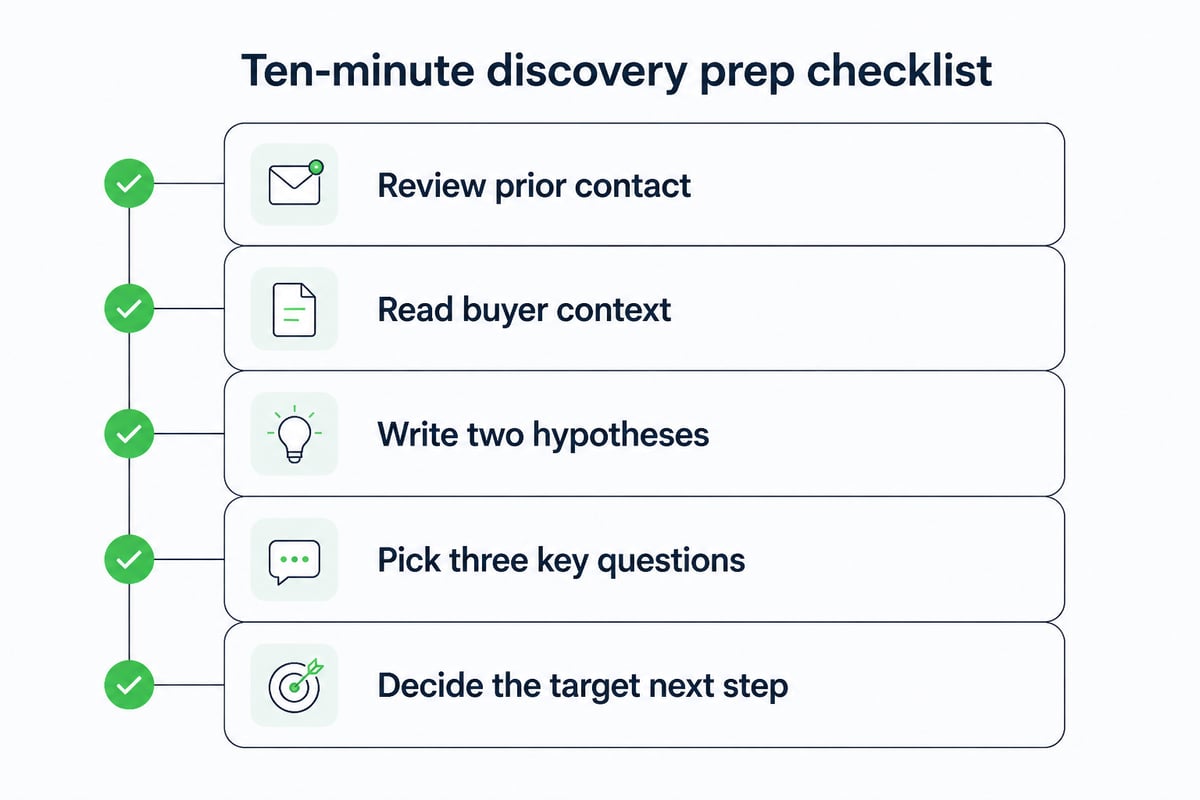
Salesforce advises researching the prospect's industry and business before a discovery conversation, asking about problems and aspirations, and closing with a clear next step. Convert that into a repeatable checklist:
- Review prior contact. Check the CRM for earlier emails, calls and notes so the buyer never repeats themselves. Reviewing CRM notes lets reps recall what prospects already shared.
- Read the buyer's context. Company size, recent news, role, and the likely metrics that person owns.
- Write two hypotheses. For example, "their onboarding is slow because it depends on one person." Hypotheses guide questions without turning the call into an interrogation.
- Pick the three questions that matter most for this buyer. Not ten. Three.
- Decide the ideal next step. Know what you will ask for before the call starts.
Owners who run founder-led sales will recognize that the best preparation habit is the one that survives a busy week. A short, fixed routine beats a thorough one that gets skipped. For more on that dynamic, see founder-led sales.
Step 3: Open With an Agenda and Permission
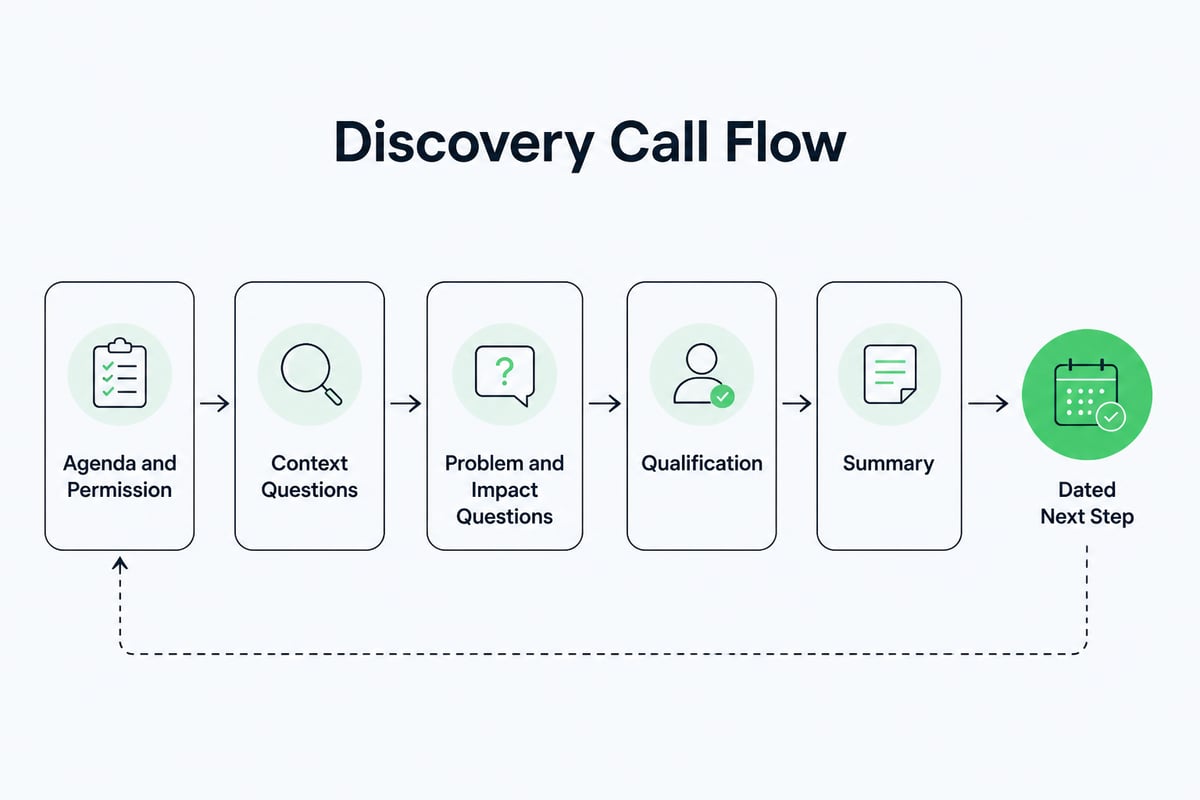
A strong opening takes under a minute: state the purpose, outline how the time will be used, and ask whether that suits the buyer.
An example structure: "Thanks for making time. I'd like to spend about 25 minutes understanding how your team handles inbound leads today, answer any questions you have about us, and then decide together whether a next conversation makes sense. Does that work for you?"
This does three things. It lowers the buyer's guard because they know there will be no surprise pitch. It gives the rep the right to ask direct questions. It also sets up the closing step, since "decide together" has already been agreed.
HubSpot's 2025 survey found that call structure, including the sequencing of opening, discovery and closing, is a primary factor limiting cold-call success. Although that finding concerns cold calling, the lesson carries over: sequence is a skill, and it can be coached.
Step 4: Ask Questions in a Deliberate Sequence
The most effective sequence moves from context to problem to impact to decision process, so each answer sets up the next question.
| Stage | Purpose | Sample question |
|---|---|---|
| Context | Understand the situation | "Walk me through how this works today." |
| Problem | Surface the pain | "Where does that process break down?" |
| Impact | Quantify the cost | "What does that cost you each month in time or lost deals?" |
| Priority | Test urgency | "Where does this sit against your other priorities?" |
| Decision | Map the buying process | "Who else would weigh in, and what would they need to see?" |
| Alternatives | Learn the competition | "What have you tried already, and what happened?" |
Resist the urge to rush to the impact questions. A buyer who has not yet described the problem in their own words will not trust a number you put on it. Equally, a rep who stays in context questions for twenty minutes never reaches the commercial heart of the call.
Follow-Up Questions Do the Heavy Lifting
The first answer a buyer gives is rarely the useful one. Train reps on short follow-ups such as "Say more about that," "What happened when you tried that?" and "Why does that matter now?" These three phrases pull out the specifics that make a deal forecastable. When you review calls, count how often a rep follows up versus moving to the next scripted question. That ratio predicts discovery quality better than the question list itself.
Step 5: Listen More Than You Talk
Reps should aim for the buyer speaking well over half the call, and the quickest way to check is to measure talk ratio on recorded conversations.
Talking too much usually signals one of two problems: nervousness filled with feature explanations, or a rep who has already decided the buyer's problem. Both are fixable. Give reps one concrete rule for a single week: after every buyer answer, pause for two seconds before responding. That pause feels long to the rep and natural to the buyer, and it often produces the additional detail you actually need.
Note-taking matters too. Reps who write down exact buyer phrases can reuse them later in proposals and follow-ups, which makes the buyer feel heard and keeps your messaging tied to their language.
Step 6: Qualify Without Interrogating
You can qualify budget, authority, timeline and need inside a normal conversation if you ask each one as a follow-up to something the buyer has already said.
Salesforce's Trailhead material on the sales process covers need, timing, budget and authority as qualification areas, learn about the sales process. The practical technique is to bridge from the buyer's own words:
- Buyer: "We want this fixed before Q3 planning." Rep: "What happens if it's not fixed by then?"
- Buyer: "Our ops lead will want to see it." Rep: "What does your ops lead usually need to see before saying yes?"
- Buyer: "We've set some money aside." Rep: "Roughly what range did you have in mind, so I don't propose something unrealistic?"
Each of these is a qualification question that feels like attention, not a checklist. If a buyer will not discuss budget or decision process at all after a reasonable attempt, treat that as data about the deal, not as a reason to push harder.

Step 7: Close the Call With a Summary and a Dated Next Step
End every discovery call by summarizing what you heard in two or three sentences, asking the buyer to correct anything, and booking a specific next step before you hang up.
A usable close: "So the main issue is that proposals are slowing your deals, and a new tool needs approval from your operations lead. Did I miss anything? Good. I'd suggest a 30-minute working session this week where I show you how we'd handle that. Does Thursday afternoon work?"
"I'll send some information" is not a next step. A calendar invite is. If your reps routinely end calls without a booked meeting, that single behavior is worth coaching before anything else. Strong closes also protect your forecast, a theme covered in more depth in how to improve sales close rates.
Step 8: Score Calls Against Your Own Playbook
Scoring means rating each recorded call against the behaviors you defined in Step 1, so feedback is based on evidence and not on impressions.
A simple scorecard can have five to seven yes-or-no or one-to-three-point items: agenda set, open questions asked, follow-ups used, buyer talk ratio, budget and authority covered, summary given, next step booked. Keep it tied to your playbook rather than a generic template, because your best reps probably do things that a generic rubric does not capture.
The obstacle for owner-led teams is time. Nobody has the hours to listen to every call. This is where sales call analysis software earns its place: it captures conversations, applies the scorecard consistently, and surfaces the calls worth a human's attention. For a closer look at how scoring reveals individual weaknesses, read about sales call scoring and the behavior gap.
Step 9: Coach One Behavior Gap at a Time
Pick the single lowest-scoring behavior for each rep, practice it, and check it again on the next call.
Coaching three things at once produces none of them. If a rep scores poorly on follow-up questions, the entire coaching conversation for that week is about follow-up questions. The sequence looks like this:
- Review a short clip where the gap shows up.
- Name the behavior and what it cost in that moment.
- Role-play the moment two or three times with the better version.
- Set a measurable target for the next call, such as "at least four follow-up questions."
- Score the next call on that one behavior and decide whether it is fixed.
Role-play matters because reps rarely change behavior from feedback alone. They change it by rehearsing the replacement. Practice sessions do not need to be long; ten minutes is enough when the target is narrow. For a wider view of the method, see how to coach sales reps and sales coaching best practices.
Bizware AI Sales Coach is built around this loop. It captures calls, scores them against your playbook, gives each rep private coaching with voice or text role-play on moments from their own calls, and shows managers progress in a dashboard.
Step 10: Review Patterns and Adjust the Playbook
Once a month, look across all scored calls to see which behaviors the whole team misses, and update your question set and training accordingly.
Individual coaching fixes individual gaps. Pattern review fixes the system. If six of eight reps never ask about the decision process, the problem may be that your playbook does not make it prominent, or that your qualification criteria are unclear. If every rep struggles with price anchoring, that belongs in team training, not one-on-one sessions.
Track a few measures consistently: the percentage of discovery calls ending with a booked next step, average talk ratio, the share of calls where budget and authority were covered, and the conversion rate from discovery to second meeting. These connect directly to the broader set of sales performance metrics that owners should watch.
For founders weighing deal fit as well as sales execution, a platform such as Aligned IQ offers a private space where business owners and potential buyers can explore strategic fit before committing to a deal process.
Common Mistakes That Undermine Discovery Calls
Most discovery failures trace back to a short list of repeatable errors, and each one is visible in a recording.
- Pitching too early. If the product appears before the buyer has described the problem, the call becomes a demo with weak context.
- Asking only closed questions. "Do you have a budget?" gets a yes or no. "How are you planning to fund this?" gets information.
- Skipping the decision process. Deals stall when the rep never met, or even learned about, the person who signs.
- Treating the question list as a script. Reps who read questions in order stop listening to answers.
- Coaching from memory or gut feel. Without recordings, feedback reflects the rep's version of the call.
- Fixing too many things at once. Broad feedback produces no change. One gap, one target, one check.
- Ending without a dated next step. An undated follow-up is the most common source of silent pipeline decay.
If discovery is solid but deals still stall in later stages, the next skill to coach is how to handle sales objections.
FAQ
How do you run a discovery call?
Open with a clear agenda and ask the buyer's permission, then move through context, problem, impact and decision-process questions while the buyer does most of the talking. Close by summarizing what you heard and booking a specific next step before the call ends.
What is the 10-3-1 rule in sales?
It is a rough funnel rule of thumb: roughly 10 prospects contacted yield about 3 real conversations and 1 sale. The exact ratios vary by market, so use it as a planning starting point and replace it with your own conversion data as soon as you have it.
What are the top skills for running better discovery calls?
Three skills carry most of the weight: asking open-ended questions with strong follow-ups, listening without rushing to pitch, and qualifying need, timing, budget and authority in a natural way. All three can be observed on a recording, which makes them coachable.
Pull one recent discovery call from each rep this week and score it against the five behaviors in Step 1; the lowest score tells you where to coach first. If you would rather not listen to every recording yourself, Bizware AI Sales Coach captures and scores calls against your playbook and gives each rep private role-play on their own moments. To see how that works for a small owner-led team, schedule a free demo with Ryan Cook and walk through your own call process.