

To build a sales playbook, document how your best reps already sell, organize it into a short set of repeatable plays tied to each stage of your sales cycle, and then measure whether real calls follow it. A playbook that lives in a shared folder and never touches a live conversation will not change rep behavior, so the build is only half the work. This guide walks through what goes in, how to write it, and how to keep it in use.
What Is a Sales Playbook?
A sales playbook is a written guide that tells your reps who to sell to, what to say, and how to handle each stage of a deal. It captures the buyer profile, the value message, the questions that qualify a deal, and the responses to common objections in one place.
The playbook is not a training manual or a script. A manual teaches a skill in general terms. A script dictates exact words. A playbook sits between them: it describes the situation, the goal of the conversation, and the moves that usually work, while leaving room for judgment.
For a small owner-led team, the playbook often exists only in the owner's head. That works until the second or third rep joins and each one sells a different way. Writing it down is how you make good selling repeatable without sitting in on every call.
Why Do Small B2B Teams Need a Playbook?
Small teams need a playbook because they cannot afford inconsistency and rarely have a manager with time to listen to every call. Without a shared standard, coaching becomes opinion. One rep hears "ask better discovery questions" and has no idea what better means.
A playbook gives you three practical benefits:
- A shared definition of good. Reps and managers judge a call against the same criteria.
- Faster onboarding. New hires learn the buyer, the pitch, and the process from a single source instead of shadowing for weeks. Our guide to sales onboarding software covers how to speed this up.
- Coaching that targets specific behavior. When the standard is written, a gap becomes visible and fixable.
If you are a consultant advising B2B teams, a playbook is also the cleanest deliverable you can hand a client. It turns your advice into something the team can use after you leave.
What Should a Sales Playbook Include?
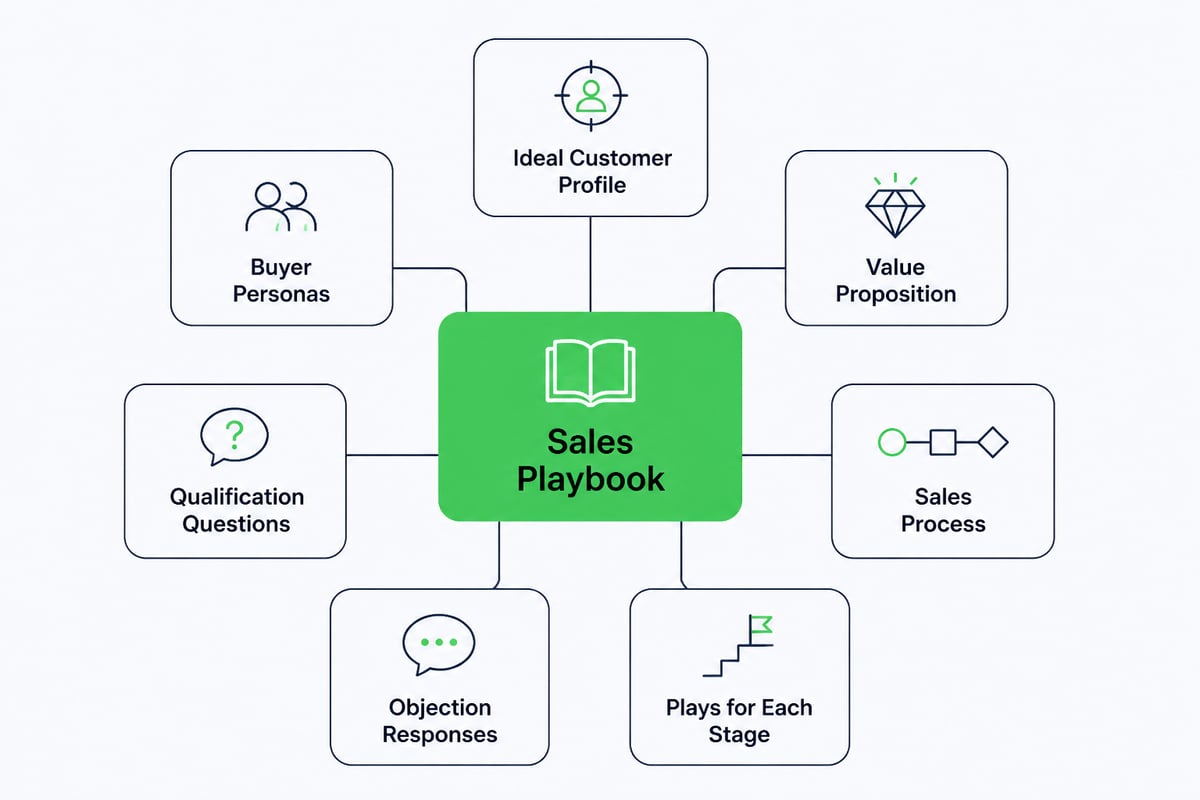
A sales playbook should include seven core components: your ideal customer profile, buyer personas, value proposition, sales process, qualification questions, objection responses, and the plays for each stage. Sales enablement guides commonly list similar elements, including buyer profiles, decision processes, and repeatable plays.
Here is how each component works in practice:
- Ideal customer profile (ICP). The company size, industry, trigger events, and disqualifiers that mark a good fit. Include who you should not sell to.
- Buyer personas. The roles involved in a purchase, what each one cares about, and the questions each tends to ask.
- Value proposition. What you solve, for whom, and the proof that backs it up, written in the buyer's language.
- Sales process. The stages from first contact to close, with a clear exit criterion for each.
- Qualification questions. The questions that confirm need, budget, authority, and timeline before you invest more time.
- Objection responses. The five or six objections your team hears most, with a recommended approach to each. For depth here, see our guide on how to handle sales objections.
- Plays. Step-by-step guidance for specific situations, covered in a later section.
How to Build a Sales Playbook Step by Step
The most reliable way to build a sales playbook is to start from your best real conversations, then structure what you find around your sales stages. Work through these steps in order.
Step 1: Define the Outcome
Decide what the playbook must change. Common targets are a higher close rate, a shorter sales cycle, or faster ramp for new reps. One clear outcome keeps you from writing a document that tries to cover everything.
Step 2: Study Your Best Calls and Closed Deals
Pull recordings or notes from your last ten to twenty won deals and a similar number of lost ones. Look for patterns: which questions the winners asked, how they framed the problem, where lost deals went quiet. This evidence is more reliable than anyone's memory of what works.
Step 3: Map Your Sales Stages
List each stage of your actual process, not the one in your CRM template. For each stage, write the goal, the buyer action that signals readiness to move on, and the common ways deals stall.
Step 4: Write the Plays
Draft one play for each recurring situation, starting with the three that matter most. Keep each to a page.
Step 5: Add the Supporting Material
Attach the resources reps need in the moment: a case study, a pricing explanation, a one-line answer to a tough question. Making these resources accessible in the flow of work, so reps do not hunt for them mid-deal, is a practical step worth building in.
Step 6: Review It With Your Reps
Ask your top performers to challenge the draft. They will spot where it differs from how deals really close, and their involvement makes adoption far more likely.
How Do You Write a Sales Play?
A sales play is a short, specific guide for one recurring situation, and the best ones follow the same structure every time. A consistent format lets a rep scan a play in seconds before a call.
Use this template for each play:
- Situation. When this play applies, such as "inbound demo request" or "deal stalled after proposal."
- Goal. What a successful conversation achieves.
- Opening move. How to start the conversation.
- Key questions. Three to five questions that surface the information you need.
- What good sounds like. A short description of the target behavior, such as "the rep confirms the business problem before presenting any solution."
- Common mistakes. The two or three errors you see most often.
- Next step. The commitment the rep should secure before the call ends.
Notice the "what good sounds like" line. It turns a vague aspiration into something you can check on a recorded call. That line is what makes the play scorable later.
Plays Worth Writing First
Start with the situations where deals are won or lost most often:
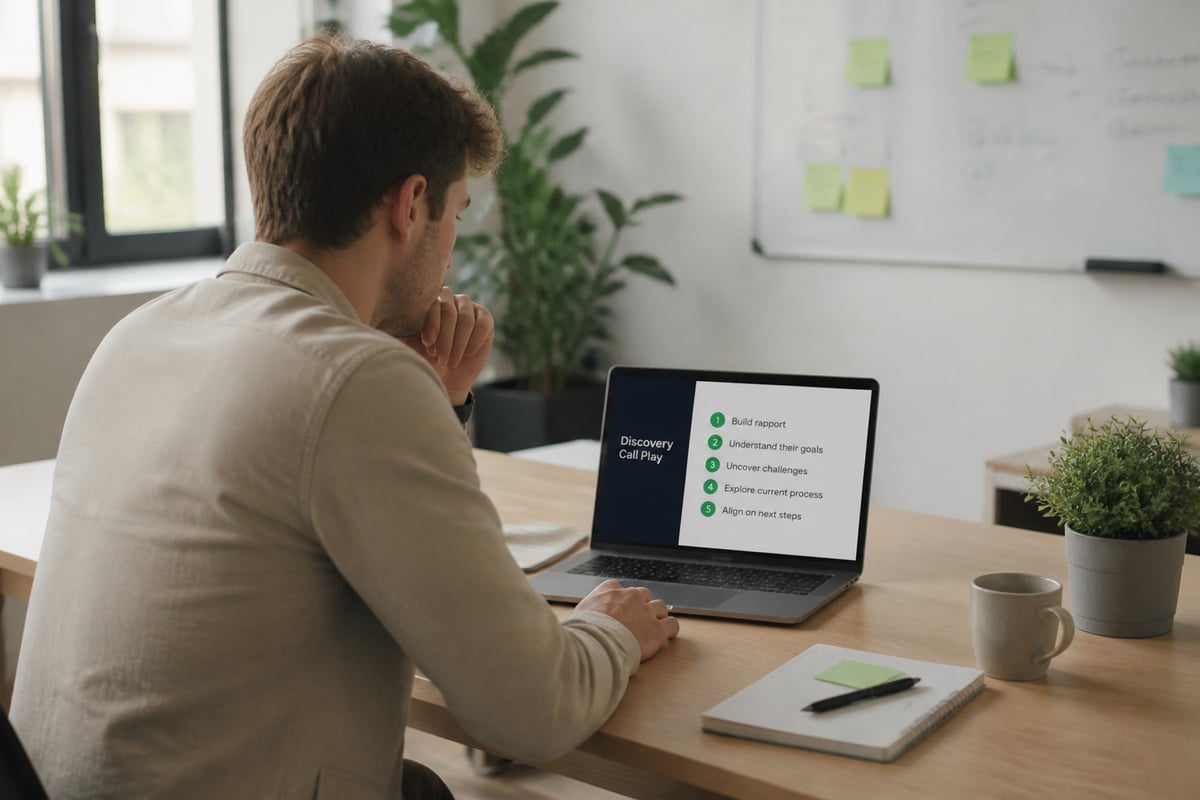
- Discovery call
- Inbound demo request
- Outbound first conversation
- Pricing and proposal discussion
- Stalled opportunity
- Closing call
How Do You Make the Playbook Specific to Behaviors?
You make a playbook behavioral by describing what a rep says and does on the call, not what they should believe or understand. "Build rapport" cannot be coached. "Ask about the buyer's current process within the first five minutes and restate it before moving on" can.
For every stage and play, ask whether a manager listening to a recording could answer yes or no. If the answer depends on interpretation, rewrite it.
Here is a before and after:
| Vague standard | Behavioral standard |
|---|---|
| Uncover the buyer's pain | Ask at least two follow-up questions on the stated problem and confirm its business impact |
| Handle objections well | Acknowledge the concern, ask one clarifying question, then respond before offering a discount |
| Close with confidence | State the proposed next step and a specific date before ending the call |
This level of detail is what allows consistent coaching. It also connects directly to sales call scoring, where each behavior becomes a line item you can measure across every call rather than a handful you happened to hear.
How Do You Get Reps to Actually Use It?
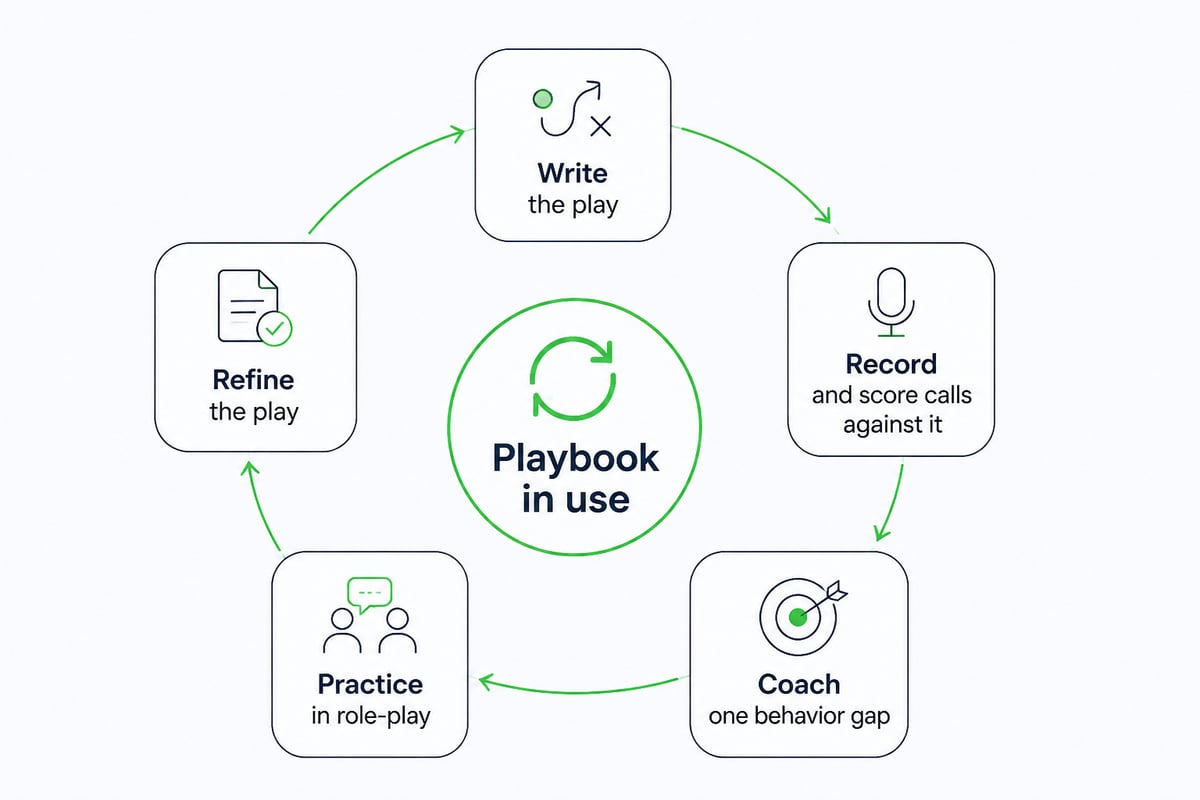
Reps use a playbook when it is short, easy to find, and tied to how they are coached. Most playbooks fail not because the content is wrong but because nothing in the weekly routine references them.
Four practices raise adoption:
- Keep it brief. A rep should find the right play in under a minute. If your playbook runs to sixty pages, split it into plays and reference material.
- Put it in the flow of work. Link plays from the CRM stage or the call prep checklist instead of a separate folder.
- Coach to it every time. When you review a call, name the play and the specific behavior. Reps learn quickly that the playbook is the standard.
- Practice before the live call. Reading a play and executing it are different skills. Role-play on the situations the playbook covers builds the habit before a real deal is at stake. Our guide to AI sales role-play software explains how teams do this without scheduling manager time.
How Do You Know If the Playbook Is Working?
You know the playbook is working when calls increasingly match its standards and your deal metrics move in the direction you set in Step 1. Measure both behavior and outcome, because outcomes lag.
Track these indicators:
- Adherence. The share of calls where reps performed the key behaviors in each play.
- Stage conversion. The percentage of deals moving from one stage to the next.
- Cycle length. The time between first conversation and close.
- Ramp time. How long a new rep takes to reach a normal close rate.
Adherence is the leading indicator. If reps are not doing what the playbook says, outcomes will not change, and you will know where to coach. If they are following it and results still lag, the playbook itself needs revising. For a broader view of what to track, see sales performance metrics.
How Do You Score Calls Against Your Playbook?
You score calls against a playbook by turning each play's target behaviors into a short checklist and rating every call on it. Five to eight criteria per call type is enough. More than that, and scoring becomes a burden that nobody keeps up.
Here is a simple scoring approach:
- Pick one call type, such as discovery.
- List the five behaviors from the play that matter most.
- Rate each as done, partly done, or missed.
- Look across a rep's last five to ten calls for the behavior that is missed most often.
- Coach that single behavior until it improves, then move to the next.
The single-behavior focus matters. Giving a rep six corrections after one call produces no change. Giving one clear target and checking it on the next call does. Our guide on how to coach sales reps goes deeper on this approach.
Manual scoring has an obvious limit for a small team: you cannot listen to every call. This is where Bizware AI Sales Coach fits. It captures virtual and in-person sales conversations in one place, scores each call against your own playbook, and gives each rep private coaching and voice or text role-play based on their real calls, one behavior gap at a time, with a measurable next call.
How Often Should You Update a Sales Playbook?
Review your sales playbook on a fixed schedule and update it whenever your market, offer, or buyer changes. Salesforce recommends reviewing a sales playbook regularly, such as at the beginning of each quarter, to keep it aligned with market conditions.
A quarterly review works well for small teams:
- Compare playbook behaviors against the calls that closed that quarter.
- Retire plays nobody uses and add plays for situations that keep recurring.
- Update objection responses with the new objections reps are hearing.
- Check whether buyers arrive better informed than before, since buyers who research on their own can change what your discovery questions should cover.
Assign a single owner for the playbook. Without one, updates drift and the document goes stale within a few months.
What Mistakes Should You Avoid?
The most common mistakes are writing too much, writing from theory, and treating the playbook as a one-time project. Each one is avoidable.
- Writing for an imaginary rep. Base every play on real calls and real wins, not on what sounds right.
- Burying the plays. If reps cannot find guidance quickly, they will improvise.
- Mixing standards and aspirations. Keep the playbook to behaviors you will actually check.
- Skipping the founder's input. In owner-led teams, the owner's selling instincts are the raw material. Capturing them is the point.
- Launching without a coaching plan. A playbook with no review routine is a document, not a system.
FAQ
What are the 5 C's in sales?
The 5 C's are commonly described as customer, company, competitors, collaborators, and context, a framework for analyzing a selling situation. Frameworks vary by author, so choose one version and write it into your playbook so every rep uses the same checklist.
How do you build a strategic sales plan?
Start with a revenue target, then work backward to the number of qualified opportunities, conversations, and rep activities required to reach it. Define your target customers, assign ownership of each stage, and set review points. A playbook is the execution layer of that plan, because it standardizes how reps run the conversations the plan depends on.
How long should a sales playbook be?
Long enough to cover your core plays, and short enough that a rep can find the right one in under a minute. For most small teams, that means a one-page summary of the process and buyer profile, plus one page per play. Add reference material separately so the playbook stays easy to scan.
Pick one call type, such as discovery, and write its five target behaviors on a single page this week, then check them against your next five recorded calls. If you cannot listen to every call yourself, Bizware AI Sales Coach can score each one against your playbook and coach each rep on one behavior gap at a time. To see how that works with your own sales process, Schedule a free Demo with Ryan Cook and put your playbook to work on real calls.