

Sales objections aren't roadblocks-they're opportunities disguised as questions. Every "I need to think about it" or "Your price is too high" reveals exactly what your prospect needs to hear before they commit. Understanding how to handle sales objections separates top performers from the rest of the sales team. In 2026, with AI-powered sales tools and sophisticated buyers, the stakes have never been higher. This guide provides actionable frameworks and proven techniques to transform objections into closed deals, specifically tailored for businesses selling custom AI solutions and marketing services.
The Psychology Behind Sales Objections
Sales objections rarely mean what they appear to mean on the surface. When a prospect says they're not interested, they're often communicating uncertainty, fear, or a lack of understanding. Research from Stanford Graduate School of Business demonstrates that skepticism stems from fundamental human needs: the desire to avoid loss, maintain control, and make informed decisions.
Understanding the four core objection types:
- Lack of need - The prospect doesn't see how your solution addresses their problems
- Lack of urgency - They acknowledge the problem but don't prioritize solving it now
- Lack of trust - They question your credibility, track record, or ability to deliver
- Lack of budget - Real or perceived financial constraints prevent commitment
Most objections combine multiple types. A "budget" objection often masks trust issues or unclear value perception. Knowing how to handle sales objections effectively requires diagnosing the true concern beneath the stated one.

Why Objections Signal Engagement
Contrary to popular belief, objections indicate active interest. Silent prospects who never push back rarely convert. When someone objects, they're mentally rehearsing ownership and identifying potential friction points. HubSpot's research on handling common sales objections shows that deals with 3-5 objections convert at higher rates than those with zero objections, proving that resistance often precedes commitment.
The key is recognizing objections as requests for more information. Your prospect is saying, "I'm interested, but I need these specific concerns addressed before I can proceed." This reframe transforms your entire approach.
The Framework: Listen, Acknowledge, Explore, Respond
Mastering how to handle sales objections requires a systematic approach. The LAER framework provides a repeatable process that works across industries and deal sizes.
Listen Without Interrupting
Top performers let prospects finish their objection completely. Analysis from Prospeo's objection-handling research reveals that reps who wait at least 3 seconds after an objection before responding close 28% more deals than those who jump in immediately. This pause communicates respect and gives you time to identify the real issue.
Active listening means:
- Maintaining focus on the prospect's exact words
- Noting tone, pace, and emotional indicators
- Avoiding formulating your response while they're still speaking
- Taking brief notes on specific phrases to reference later
Acknowledge Their Concern
Validation doesn't mean agreement. Simple acknowledgment phrases demonstrate you've heard them:
- "I appreciate you sharing that concern"
- "That's a fair question, and I'm glad you brought it up"
- "I understand why that would be a consideration"
This step prevents prospects from escalating their objection. When people feel heard, they become more receptive to alternative perspectives.
Explore the Objection Depth
Ask clarifying questions before attempting to resolve the objection. This exploration phase uncovers the real issue:
Sample exploration questions:
- "Can you help me understand what's driving that concern?"
- "When you say [their objection], what specifically are you referring to?"
- "What would need to change for this to work for you?"
Most sales reps skip this step and respond to surface-level objections, missing the underlying concern entirely. Harvard Business Review's work on persuasion emphasizes that influence begins with understanding, not convincing.
Respond With Evidence and Specificity
Only after completing the first three steps should you address the objection directly. Your response should include:
- Specific evidence: Case studies, data points, testimonials
- Relevant context: How similar clients overcame the same concern
- Clear next steps: What happens if they move forward
| Objection Type | Weak Response | Strong Response |
|---|---|---|
| "Too expensive" | "We're competitively priced" | "Based on the ROI our clients see-average 340% in year one-the investment typically pays for itself within 4 months. How does that timeline align with your budget planning?" |
| "Need to think about it" | "What questions can I answer?" | "Absolutely. What specific aspects do you need to evaluate? I can provide additional information on those areas right now." |
| "Not the right time" | "When would be better?" | "I understand timing matters. What's happening in Q1 2027 that would make this a priority then versus addressing it now?" |
Common Objections in AI and Marketing Services Sales
When selling custom AI solutions and marketing services, you'll encounter industry-specific objections. Knowing how to handle sales objections in this space requires addressing both technical and strategic concerns.
"We're Already Using Another Solution"
This objection appears in nearly every competitive sale. It's rarely about satisfaction with their current vendor-it's about switching costs and perceived risk.
Effective response framework:
Start by validating their existing relationship, then pivot to gaps and evolution. "That's great that you have a system in place. Most of our clients were using [competitor] before they came to us. What they found was that their existing solution handled X well, but struggled with Y and Z. Is that something you've experienced?"
The goal isn't to criticize competitors but to position your solution as complementary or next-generation. For AI sales systems specifically, focus on capabilities that simply didn't exist 12 months ago.
"AI Seems Complicated to Implement"
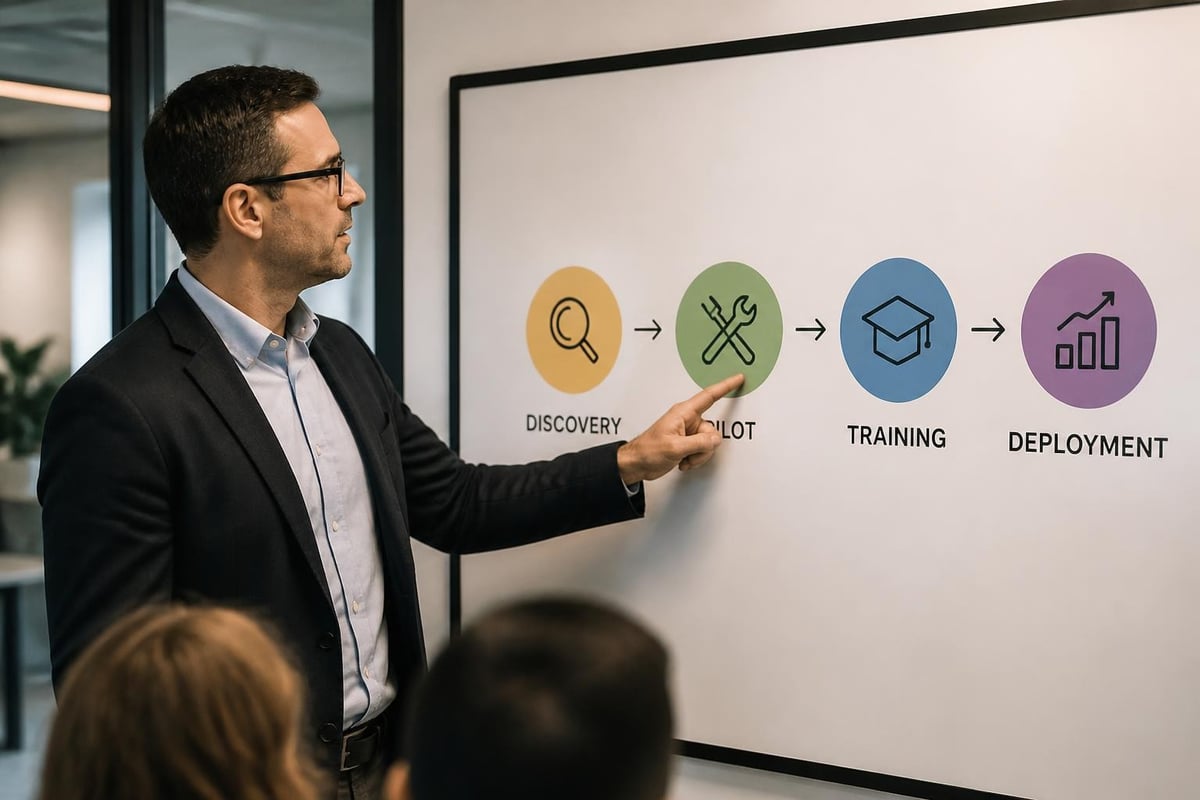
Technical complexity objections stem from fear of disruption and change management challenges. Address this by breaking implementation into concrete phases:
- Discovery and customization (Week 1-2)
- Pilot deployment with limited scope (Week 3-4)
- Team training and refinement (Week 5-6)
- Full rollout with ongoing support (Week 7+)
Providing a clear roadmap transforms abstract complexity into manageable steps. Share how your AI sales training approach ensures teams adopt new systems confidently.
"How Do We Know This Will Work for Our Specific Situation?"
Customization concerns require proof of adaptability. Build a response around:
- Similar client profiles: "We recently worked with [company in similar industry] who had the same question. Their specific challenge was [X], and we customized our approach by [Y], resulting in [Z outcome]."
- Flexibility demonstrations: Show how your solution adapts rather than forcing prospects to adapt to it
- Pilot programs: Offer limited-scope tests that prove value before full commitment
Your AI sales coach capabilities can be positioned as proof of customization-the AI learns each organization's unique sales language, objections, and processes.
"The ROI Timeline Is Too Long"
Marketing services and AI implementations both face this objection. Combat it with early-win metrics:
Short-term indicators (30-60 days):
- Lead quality improvements
- Sales conversation efficiency gains
- Time saved on manual tasks
Medium-term results (90-120 days):
- Conversion rate increases
- Deal velocity improvements
- Pipeline quality metrics
Long-term outcomes (6-12 months):
- Revenue growth attribution
- Customer acquisition cost reduction
- Lifetime value expansion
Frame ROI as a continuum rather than a single endpoint. Even businesses focused on sales performance improvement see measurable gains within the first quarter.
Advanced Objection Handling Techniques
Beyond the basic framework, sophisticated objection handling requires nuanced approaches for different scenarios and stakeholder types.
The Pre-Emptive Approach
SalesLoft's research on objection handling shows that addressing likely objections before prospects raise them increases close rates by 22%. This technique works especially well for known industry concerns.
Implementation strategy:
During your presentation, naturally incorporate common objections: "Now, you might be wondering how this integrates with your existing CRM. Here's exactly how that works..." By raising and resolving objections proactively, you demonstrate thoroughness and reduce later resistance.
The Comparison Reframe
When prospects compare your offering to cheaper alternatives, reframe the comparison criteria:
"You're right that Option A costs less upfront. Let's look at what you're comparing. Option A provides [basic features], while our solution delivers [strategic outcomes]. The real question isn't which costs less-it's which delivers the results you need. Based on your goals around [specific objective they mentioned], which approach gets you there?"
This technique shifts the conversation from price to value, making the objection about strategic fit rather than cost.
The Data-Driven Response
Numbers overcome skepticism more effectively than assertions. Build an objection response library with specific metrics:
- "83% of our clients report [specific outcome] within [timeframe]"
- "The average implementation requires [X hours] of your team's time"
- "Our retention rate is [Y%], indicating long-term satisfaction"
When selling AI marketing automation solutions, quantify efficiency gains: "Teams using our automation reduce campaign creation time from 14 hours to 3 hours on average."
Leveraging Social Proof Strategically
Different objections require different proof types:
| Objection Category | Best Proof Type | Example |
|---|---|---|
| Trust/Credibility | Industry awards, certifications, analyst reports | "Forrester recognized our approach to [specific capability]" |
| Implementation Risk | Video testimonials from similar companies | "Here's how [similar company] rolled this out in 6 weeks" |
| ROI Concerns | Detailed case studies with metrics | "Company X achieved 240% ROI in 5 months" |
| Feature Gaps | Product roadmap, beta access | "That feature launches in Q2, and I can get you early access" |
Handling Price Objections Specifically
Price objections deserve special attention because they're the most common and most misunderstood. When someone says "too expensive," they're rarely stating an absolute-they're expressing doubt about value relative to cost.
Unbundling the Price Objection
Ask diagnostic questions to understand the real concern:
- "Too expensive compared to what?"
- "What budget range were you expecting?"
- "If price weren't a factor, would this solve your problem?"
These questions reveal whether you're dealing with a genuine budget constraint, a value perception gap, or a negotiation tactic. Harvard's Program on Negotiation research demonstrates that price objections often signal information asymmetry-the prospect doesn't fully understand what they're buying.
The Cost of Inaction Framework
Shift focus from your price to the cost of their current situation:
"I understand the investment feels significant. Let's look at what maintaining the status quo costs you. You mentioned that [problem] currently costs you [X] in lost revenue and [Y] in team time. Over the next year, that's [total cost]. Our solution at [price] eliminates those costs while generating [additional benefit]. Seen in that context, what's the real cost?"
This approach works especially well for sales effectiveness solutions where the cost of poor performance is easily quantifiable.
Flexible Commercial Structures
When budget is genuinely constrained, explore creative commercial arrangements:
- Phased implementation: Start with high-impact use cases, expand later
- Performance-based pricing: Tie fees to achieved outcomes
- Annual vs. monthly payments: Match billing to cash flow preferences
- Pilot programs: Prove value before full commitment
Offering flexibility demonstrates partnership thinking while maintaining your value proposition. Many clients appreciate options presented transparently in your pricing structure.
The Role of Timing in Objection Handling
How to handle sales objections varies significantly based on when they arise in the sales cycle. Early objections require different treatment than late-stage resistance.
Discovery Phase Objections
Objections during discovery often indicate unclear value or poor qualification. If prospects object before understanding your solution, you've moved too fast:
Recovery approach:
- Step back to needs assessment
- Ask more questions about their challenges
- Let them articulate the pain points
- Only then introduce relevant capabilities
Early objections are often gifts-they prevent wasting time on poor-fit prospects and help you qualify effectively.
Proposal Phase Objections
Objections after presenting your proposal signal negotiation or final concerns. These require precision:
- Address each concern systematically
- Document your responses in writing
- Set clear next steps after resolving objections
- Ask for commitment once objections are handled
Atlassian's practical guide offers specific language for proposal-stage objections that can be adapted to your situation.
Contract Phase Objections
Last-minute objections often stem from implementation anxiety or internal political issues. Diagnose whether you're dealing with:
- Cold feet: Natural nervousness about change
- Internal resistance: Stakeholders not in earlier conversations raising concerns
- Competitor interference: Last-minute competitive offers
- Genuine new information: Changed circumstances or requirements
Each requires a different approach, but all benefit from patience and thorough exploration before responding.

Converting Objections Into Opportunities
The most sophisticated approach to learning how to handle sales objections involves viewing them as strategic intelligence. Every objection reveals market perceptions, competitive positioning, and product development opportunities.
Building an Objection Intelligence System
Track objections systematically:
- Document every objection in your CRM with context
- Categorize by type, deal stage, and prospect profile
- Analyze patterns monthly to identify trends
- Refine your messaging, positioning, and product based on insights
Companies implementing this approach using AI knowledge management tools identify emerging objection patterns 40% faster than manual tracking.
Creating Objection-Based Content
Transform common objections into content assets:
- White papers addressing technical concerns
- Case studies proving specific ROI claims
- Comparison guides for "already using competitor" objections
- Implementation playbooks reducing complexity fears
This content serves double duty: it helps prospects self-educate and arms your sales team with resources to send after objection conversations. Marketing services that include objection-based content creation see 34% higher win rates.
Training Teams on Objection Patterns
Your sales team's ability to handle objections determines revenue outcomes. Implement ongoing training that includes:
- Role-playing common objection scenarios
- Recording review of actual objection handling calls
- Peer learning sessions where top performers share techniques
- AI-powered coaching that provides real-time feedback
AI sales enablement platforms can analyze thousands of calls to identify which objection responses correlate with closed deals, then coach reps on those specific patterns.
Measuring Objection Handling Effectiveness
What gets measured gets improved. Track specific metrics to evaluate and enhance your objection handling:
Key performance indicators:
- Objection-to-close rate: Percentage of deals that move forward after major objections
- Average objections per deal: Too few suggests poor qualification; too many indicates positioning problems
- Time to resolve objections: Efficiency in addressing concerns
- Objection recurrence: Whether the same concerns reappear in later conversations
| Metric | Benchmark | Improvement Strategy |
|---|---|---|
| Objection-to-close rate | 45-60% | Improve response quality and evidence |
| Average objections per deal | 3-5 | Better discovery and pre-emptive handling |
| Time to resolve | <48 hours | Create response templates and asset library |
| Objection recurrence | <15% | More thorough initial handling |
Use these metrics to identify coaching opportunities and refine your approach continuously. Understanding how to handle sales objections becomes easier when you measure what works.
Integration With Modern Sales Technology
In 2026, technology enhances but doesn't replace human objection handling. AI tools support sales teams by:
- Suggesting responses based on successful historical patterns
- Providing real-time coaching during live conversations
- Analyzing sentiment to detect hidden objections
- Automating follow-up with relevant content after objections
The combination of human empathy and AI-powered intelligence creates the most effective objection handling. AI sales automation tools can transcribe calls, identify objection moments, and recommend proven responses from your top performers.
Building a Knowledge Base
Create a searchable repository of:
- Objection response scripts
- Supporting evidence and case studies
- Competitive intelligence
- Product documentation for technical objections
When reps can access the right information instantly, objection handling becomes faster and more consistent. AI knowledge base systems make this information accessible through conversational interfaces during live calls.
Mastering how to handle sales objections transforms your entire sales process-turning resistance into conversation, skepticism into trust, and concerns into closed deals. The frameworks, techniques, and strategies in this guide provide a foundation for systematic improvement. When you need custom AI solutions that support your sales team in real time, analyze objection patterns, and provide coaching at scale, Ryan Cook specializes in sales AI systems designed specifically for marketing services and complex B2B sales. Our solutions integrate seamlessly with your existing processes while delivering measurable improvements in objection handling and overall sales performance.