October 13, 2026 · Bizware
AI Sales Coach: Transform Your Team's Performance in 2026
Discover how an AI sales coach can elevate your team's performance with personalized training, real-time feedback, and data-driven insights.

Sales teams today face unprecedented pressure to perform. Quotas rise, buyer expectations evolve, and competition intensifies. Traditional coaching methods-sporadic one-on-ones, annual training sessions, quarterly reviews-struggle to keep pace with modern demands. Enter the ai sales coach, a technology-driven solution that delivers personalized, scalable coaching to every sales professional on your team. By analyzing conversations, identifying patterns, and providing actionable feedback in real time, AI-powered coaching systems are transforming how organizations develop talent, improve win rates, and accelerate revenue growth.
Understanding the AI Sales Coach Revolution
An ai sales coach represents a fundamental shift from reactive training to proactive development. Unlike human managers who can only review a handful of calls per week, AI systems analyze every customer interaction-phone calls, video meetings, email exchanges, and chat conversations. These platforms use natural language processing and machine learning to identify what separates top performers from the rest of the team.
The technology examines multiple dimensions simultaneously. Talk-to-listen ratios, question patterns, objection handling techniques, pricing discussions, and closing behaviors all come under scrutiny. Stanford research demonstrates that generative AI tools can boost productivity without replacing workers, particularly when used for skill development and performance enhancement.
How AI Coaching Differs from Traditional Methods
Traditional sales coaching relies heavily on manual observation and subjective assessment. Managers attend occasional calls, take notes, and schedule follow-up discussions days or weeks later. This approach creates several problems:
- Limited coverage: Managers can only review 5-10% of actual sales interactions
- Delayed feedback: Days pass between the call and the coaching conversation
- Inconsistency: Different managers emphasize different techniques and priorities
- Scalability issues: Each manager can effectively coach only 6-8 representatives
An ai sales coach addresses these limitations through continuous monitoring and instant analysis. Every conversation generates insights. Feedback arrives while the interaction remains fresh in the representative's mind. AI sales training methodologies ensure consistent application of best practices across the entire organization, regardless of team size or geographic distribution.
Core Capabilities of Modern AI Sales Coaches
The most effective ai sales coach platforms combine multiple analytical engines to create comprehensive development programs. These systems go far beyond simple call recording to deliver actionable intelligence.
Conversation Intelligence and Analysis
Conversation intelligence forms the foundation of AI coaching. Microsoft's Dynamics 365 documentation explains how these systems transcribe conversations, identify key moments, and track seller KPIs throughout the sales process. The technology recognizes when representatives successfully handle objections, when they miss buying signals, and when they dominate conversations instead of listening.
Advanced platforms track specific coaching metrics:
| Metric | What It Measures | Target Range |
|---|---|---|
| Talk-Listen Ratio | Percentage of time seller speaks vs. listens | 40-45% seller |
| Question Rate | Number of discovery questions per conversation | 8-15 questions |
| Objection Response Time | Seconds between objection and response | Under 3 seconds |
| Next Step Clarity | Percentage of calls ending with defined action | Above 85% |
| Pricing Confidence | Hesitation patterns when discussing cost | Minimal pauses |
These metrics provide objective baselines for sales performance improvement initiatives, replacing gut feelings with data-driven insights.
Personalized Learning Paths
Generic training programs treat all sales professionals identically, wasting time on skills people have already mastered while neglecting individual weaknesses. An ai sales coach creates customized development plans based on each person's actual performance data.
For example, if conversation analysis reveals that a representative excels at discovery questions but struggles with pricing conversations, the system prioritizes objection-handling scenarios and value articulation exercises. Another team member might receive completely different recommendations focused on active listening or competitive positioning.
These personalized paths adapt continuously. As representatives improve in weak areas, the ai sales coach shifts focus to the next development priority. The system never runs out of relevant content because it generates recommendations from the representative's own conversation history.
Real-Time Feedback and Coaching Moments
Timing dramatically affects coaching effectiveness. Feedback delivered weeks after a call loses impact and relevance. Modern ai sales coach systems provide guidance at three critical moments: before, during, and after customer interactions.
Pre-Call Preparation
Before important conversations, AI systems surface relevant information about the prospect, previous interactions, common objections in similar deals, and recommended talking points. This preparation increases confidence and reduces the chance of missing key opportunities.
For high-ticket service businesses, Rise Reign Rule emphasizes how strategic frameworks like Profit Architecture rely on consistent execution-exactly the type of discipline that AI-powered preparation supports. When representatives enter calls fully prepared, they demonstrate professionalism that builds trust and accelerates the buying process.
In-Call Assistance
Some advanced ai sales coach platforms offer real-time guidance during live conversations. These systems listen alongside representatives and display contextual prompts on screen:
- Suggested responses to specific objections
- Reminder to ask discovery questions in certain situations
- Alerts when the talk-listen ratio becomes unbalanced
- Competitive positioning points when competitors are mentioned
Forbes discusses how conversational AI transforms sales training by enabling realistic roleplay scenarios and providing immediate corrections-capabilities that extend naturally into live-call assistance.
Post-Call Analysis and Improvement
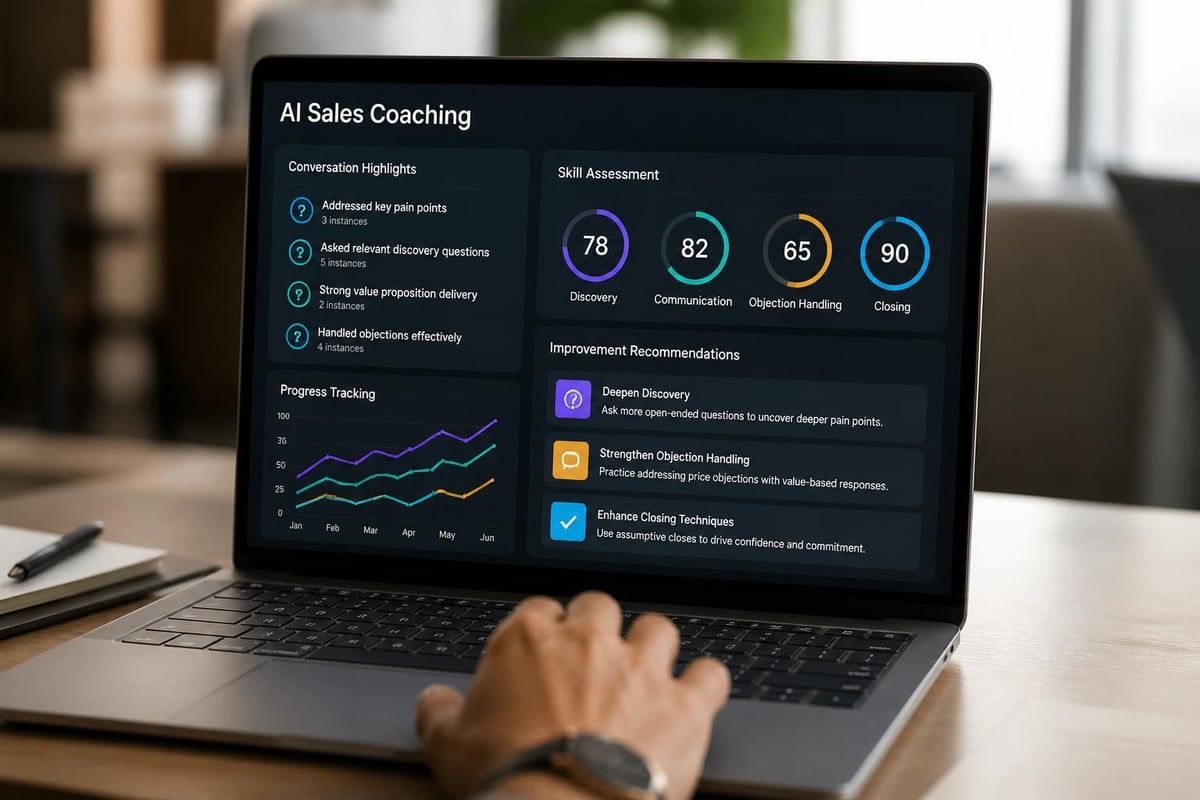
After each conversation, the ai sales coach generates detailed performance summaries. These reports highlight what went well, identify missed opportunities, and recommend specific improvements. Representatives can review call recordings with AI-generated timestamps marking critical moments-the first objection, pricing discussion, closing attempt, and commitment request.
Measuring ROI and Business Impact
Implementing an ai sales coach requires investment in technology, integration, and change management. Organizations need clear methods to measure returns and justify ongoing commitment to AI-driven development.
Sales Performance Metrics
Sales performance metrics provide the clearest evidence of coaching effectiveness. Organizations should track these indicators before and after AI coach deployment:
- Win rate improvement: Percentage increase in deals closed
- Average deal size: Growth in typical transaction value
- Sales cycle length: Reduction in days from first contact to close
- Quota attainment: Percentage of team hitting targets
- Ramp time: Weeks for new hires to reach productivity
Studies show that effective AI coaching typically improves win rates by 15-25% and reduces sales cycles by 10-20%. These gains translate directly to revenue growth and market share expansion.
Efficiency and Productivity Gains
Beyond revenue metrics, ai sales coach implementations deliver operational benefits. Harvard Business Review research examines how AI assistants add value to sales teams through increased efficiency and reduced administrative burden.
Key efficiency improvements include:
- Reduced coaching time: Managers spend 40% less time on basic performance reviews
- Faster skill development: New representatives reach productivity 30% faster
- Better pipeline management: More accurate forecasting through conversation analysis
- Lower turnover: Improved support and development increase retention by 15-20%
These gains compound over time. As the ai sales coach learns your specific business context, recommendations become increasingly relevant and impactful.
Implementation Strategies for Maximum Impact
Successfully deploying an ai sales coach requires more than purchasing software. Organizations must thoughtfully integrate the technology into existing workflows, address adoption barriers, and maintain ongoing optimization.
Selecting the Right Platform
Not all AI coaching solutions offer identical capabilities. When evaluating options, prioritize platforms that:
- Integrate seamlessly with your existing CRM, communication tools, and sales stack
- Provide transparent explanations for recommendations rather than black-box suggestions
- Support customization of coaching frameworks to match your methodology
- Offer robust security and compliance features for sensitive customer conversations
- Scale efficiently as your team grows and requirements evolve
AI implementation services can help organizations navigate the selection process and avoid common pitfalls that delay ROI.
Change Management and Adoption
Even the most sophisticated ai sales coach fails without user adoption. Representatives may initially resist technology that analyzes their performance, particularly if they fear negative consequences from honest feedback.
Address these concerns through transparent communication:
- Emphasize development over punishment-AI coaching identifies growth opportunities, not termination candidates
- Involve top performers in pilot programs to build credibility and generate peer advocates
- Share anonymized success stories showing measurable improvement from AI recommendations
- Provide adequate training so representatives understand how to interpret and act on feedback
- Celebrate wins publicly when team members apply AI coaching insights to close deals
Deloitte's insights on generative AI transformation highlight that organizational considerations and change management often determine success more than technical capabilities alone.
Continuous Optimization and Refinement
An ai sales coach improves through ongoing refinement. Regular review cycles should examine:
- Which coaching recommendations generate the highest performance improvements
- Where representatives ignore or dismiss AI feedback (indicating poor recommendation quality)
- How recommendation acceptance rates vary across team segments
- What customizations to coaching frameworks would better align with company methodology
- Which new data sources could enhance coaching accuracy and relevance
Organizations treating AI coaching as "set and forget" technology miss significant value. Those that actively optimize and refine their systems see compounding returns over time.

Integration with Broader Sales Enablement
An ai sales coach delivers maximum value when integrated into comprehensive sales enablement strategies rather than operating as a standalone tool. This integration creates synergies across multiple development initiatives.
Complementing Human Coaching
AI augments rather than replaces human managers. While the ai sales coach handles continuous performance monitoring and basic skill development, human coaches focus on strategic mentorship, career development, complex deal strategy, and emotional support. This division of labor lets managers concentrate on high-value activities where human judgment and relationship-building matter most.
For organizations using professional coaching services like Noomii, AI systems provide data-driven inputs that make executive coaching and leadership development sessions more focused and productive. Coaches arrive at meetings with detailed performance data rather than relying solely on self-reported challenges.
Supporting Onboarding and Ramp
New sales hires face steep learning curves. They must master product knowledge, sales methodology, competitive positioning, objection handling, and company culture simultaneously. An ai sales coach accelerates this process through targeted feedback on every practice call and customer interaction.
Employee onboarding automation combined with AI coaching creates powerful onboarding experiences. New representatives receive consistent, patient feedback without monopolizing manager time or delaying their development.
The technology also identifies when new hires struggle with specific competencies, triggering additional resources or human intervention before small problems become significant obstacles. This early warning system reduces new hire failure rates and protects customer relationships from inexperienced handling.
Enhancing Sales and Marketing Alignment
Conversation intelligence from an ai sales coach provides marketing teams with invaluable insights about customer concerns, competitive positioning, and messaging effectiveness. When sales conversations reveal that prospects consistently ask about features marketing materials don't emphasize, marketing can adjust content priorities accordingly.
This feedback loop improves marketing services by ensuring campaigns address actual customer questions rather than assumed pain points. Sales and marketing teams work from shared intelligence, reducing friction and improving lead quality.
Advanced Applications and Future Directions
The ai sales coach category continues evolving rapidly. Emerging capabilities promise even greater impact on sales performance and organizational efficiency.
Predictive Performance Management
Next-generation systems move beyond analyzing past performance to predicting future outcomes. By identifying early warning signs-declining question rates, increasing talk ratios, hesitant pricing discussions-AI coaches can flag at-risk deals and struggling representatives before results deteriorate noticeably.
This predictive capability enables proactive intervention. Managers can provide additional support precisely when representatives need it most, preventing deal losses and protecting team morale.
Scenario-Based Practice Environments
Advanced ai sales coach platforms now offer realistic practice environments where representatives rehearse difficult conversations with AI-powered customer simulations. These virtual buyers present objections, ask challenging questions, and exhibit buying signals just like real prospects.
Representatives can practice high-stakes conversations repeatedly until they develop confidence and capability-something impossible with real customers where mistakes cost deals. The AI system evaluates each practice session and recommends improvements, creating a safe space for experimentation and growth.
Multi-Modal Analysis Integration
Future AI coaches will analyze more than just spoken words. Video analysis can assess body language, facial expressions, and presentation skills during video calls. Email and chat analysis extends coaching beyond synchronous conversations to written communication. Document analysis evaluates the quality of proposals, presentations, and follow-up materials.
This multi-modal approach creates comprehensive performance pictures, identifying hidden strengths and weaknesses that voice analysis alone might miss. For businesses sharing digital business cards through platforms like Spreadly, AI systems could even analyze how effectively representatives leverage modern networking tools and follow up on connections.
Building Competitive Advantage Through AI Coaching
Organizations that effectively deploy ai sales coach technology create sustainable competitive advantages. These advantages manifest across multiple dimensions that competitors struggle to replicate.
Institutional Knowledge Capture
Every sales conversation contains valuable lessons-successful techniques, common objections, effective responses, buying signals, and competitive intelligence. Without AI systems, this knowledge remains trapped in individual representatives' memories, disappearing when people leave the organization.
An ai sales coach captures and codifies this institutional knowledge. The system identifies patterns across thousands of conversations, recognizing what works and what doesn't. This intelligence becomes organizational property that survives personnel changes and accelerates new hire development.
Scalable Excellence
Top performers often succeed through intuition they can't easily articulate or teach. AI systems reverse-engineer excellence by analyzing what top performers do differently. Once identified, these techniques can be taught systematically to the entire team through personalized coaching recommendations.
This democratization of excellence transforms good teams into great ones. Instead of relying on a few star performers, organizations develop consistently strong teams where everyone applies proven techniques.
Continuous Adaptation
Markets change, competitors evolve, and customer preferences shift. An ai sales coach adapts coaching recommendations as conditions change, ensuring representatives always employ current best practices rather than outdated techniques that no longer work.
This continuous adaptation maintains sales effectiveness even as market dynamics evolve. Organizations using AI coaching respond faster to competitive threats and capitalize more quickly on emerging opportunities.
Privacy, Ethics, and Responsible AI Deployment
Implementing an ai sales coach raises important questions about privacy, consent, and ethical use of conversation data. Responsible organizations address these concerns proactively through clear policies and transparent practices.
Data Security and Compliance
Sales conversations often contain sensitive information about customers, pricing, competitive positioning, and business strategy. AI coaching platforms must implement robust security measures:
- Encryption of conversation recordings and transcripts both in transit and at rest
- Access controls limiting who can review individual conversations and aggregate data
- Compliance frameworks meeting industry requirements (GDPR, CCPA, HIPAA where applicable)
- Audit trails documenting who accessed which data and when
- Data retention policies automatically removing old conversations after defined periods
Organizations should work with legal and compliance teams to ensure AI coaching implementations meet all regulatory requirements and protect both customer and employee privacy.
Transparency and Consent
Representatives deserve to know when conversations are being recorded and analyzed. Clear communication about AI coaching purposes, data usage, and performance evaluation prevents misunderstandings and builds trust.
Best practices include:
- Explicit consent from representatives regarding conversation recording and analysis
- Customer notification about call recording (required by law in many jurisdictions)
- Clear explanation of how AI insights influence performance reviews and compensation
- Opt-out mechanisms for particularly sensitive conversations when appropriate
- Regular review of consent policies as technology capabilities evolve
Academic research on augmenting coaching with generative AI highlights effectiveness and adoption patterns while also examining ethical concerns that organizations must address thoughtfully.
An ai sales coach represents one of the most impactful applications of artificial intelligence in business today, delivering measurable improvements in team performance, accelerated development, and sustainable competitive advantage. Organizations that thoughtfully implement AI coaching-addressing both technical integration and human change management-position themselves to thrive in increasingly competitive markets. Ryan Cook specializes in custom AI solutions including sales AI systems that transform how organizations support their sales, marketing, and onboarding functions, helping businesses unlock the full potential of their teams through intelligent automation and personalized coaching at scale.