
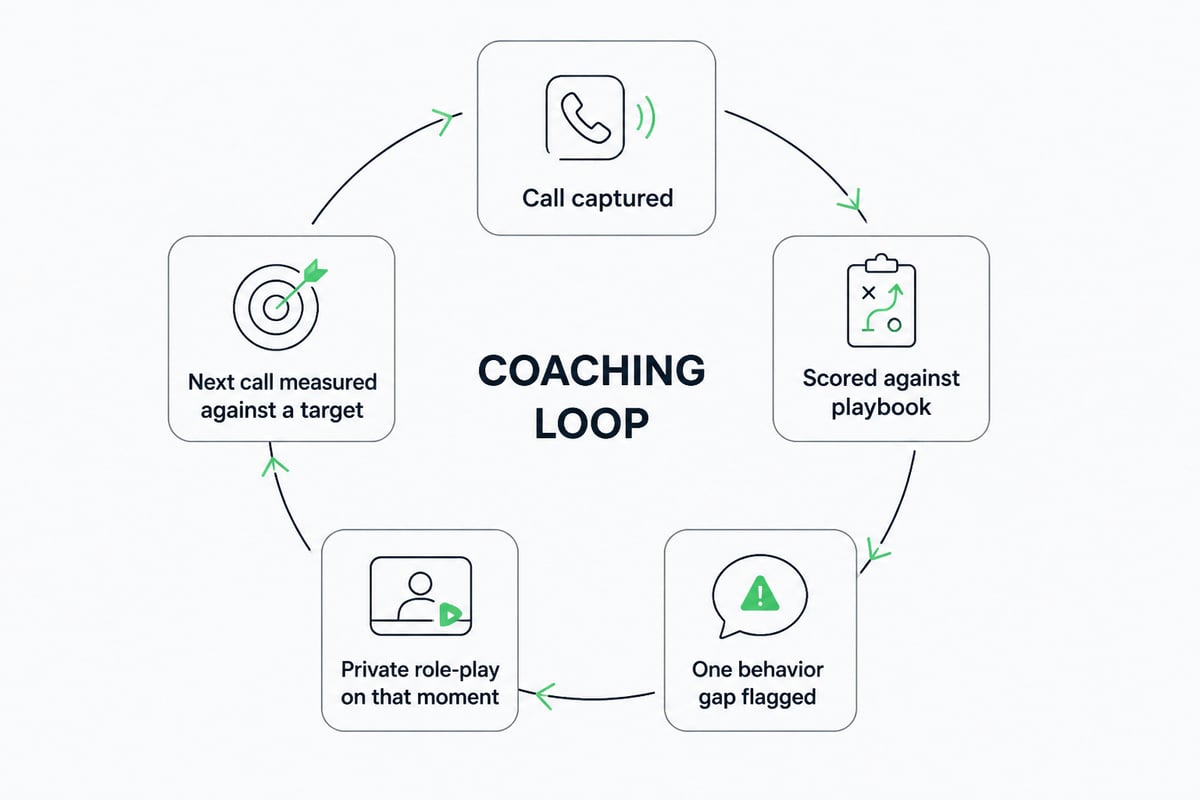
The most reliable way to improve sales close rates is to coach reps on the specific behaviors inside their real calls, one gap at a time, and then measure whether the next call changes. Pipeline volume and product tweaks matter, but the conversation is where deals are won or lost. For owners and sales managers who cannot listen to every call, the challenge is building a repeatable system that surfaces the right moments and turns them into practice.
This guide walks through that system step by step, from defining what a good call looks like to measuring whether coaching moved the number.
What You Need Before You Start
You need four things in place before call coaching can lift your close rate:
- Access to call recordings or transcripts, covering both virtual and in-person conversations
- A written sales playbook, even a one-page version, that defines your stages and expected behaviors
- A baseline close rate, calculated from qualified opportunities rather than every lead
- Thirty minutes per week of protected coaching time for each rep
If your playbook lives only in the owner's head, start there. Coaching without a standard is opinion, and reps can tell the difference.
Step 1: Measure Your Baseline Close Rate Honestly
Your baseline close rate is the number of won deals divided by the number of qualified opportunities in the same period, and it only works if "qualified" has a definition. Many small teams count every inbound inquiry as an opportunity, which makes the rate look low and hides where the real problem sits.
Set a simple qualification rule: the prospect has a confirmed problem, a budget range, and a named decision maker. Count only opportunities that meet it. Then track three numbers per rep:
- Qualified opportunities worked
- Deals won
- Stage-to-stage conversion, from discovery to proposal and from proposal to close
The stage-level view tells you where to aim coaching. A rep who converts discovery to proposal at a strong rate but loses most proposals has a different gap than a rep who stalls before the proposal. HubSpot's overview of structured sales coaching recommends tracking win rate and stage conversion for exactly this reason.
Step 2: Define What a Winning Call Looks Like
A winning call is one where the rep completes the behaviors your best deals have in common, and you write those behaviors into a scorecard. Without that definition, feedback drifts toward personal style rather than outcomes.
A practical scorecard uses five to eight criteria, according to Claap's sales call coaching guide, including discovery quality, objection handling, decision-process questions, and agreement on a dated next step. Build yours from your own closed-won calls. Listen to three or four of them and note what the rep did in common.
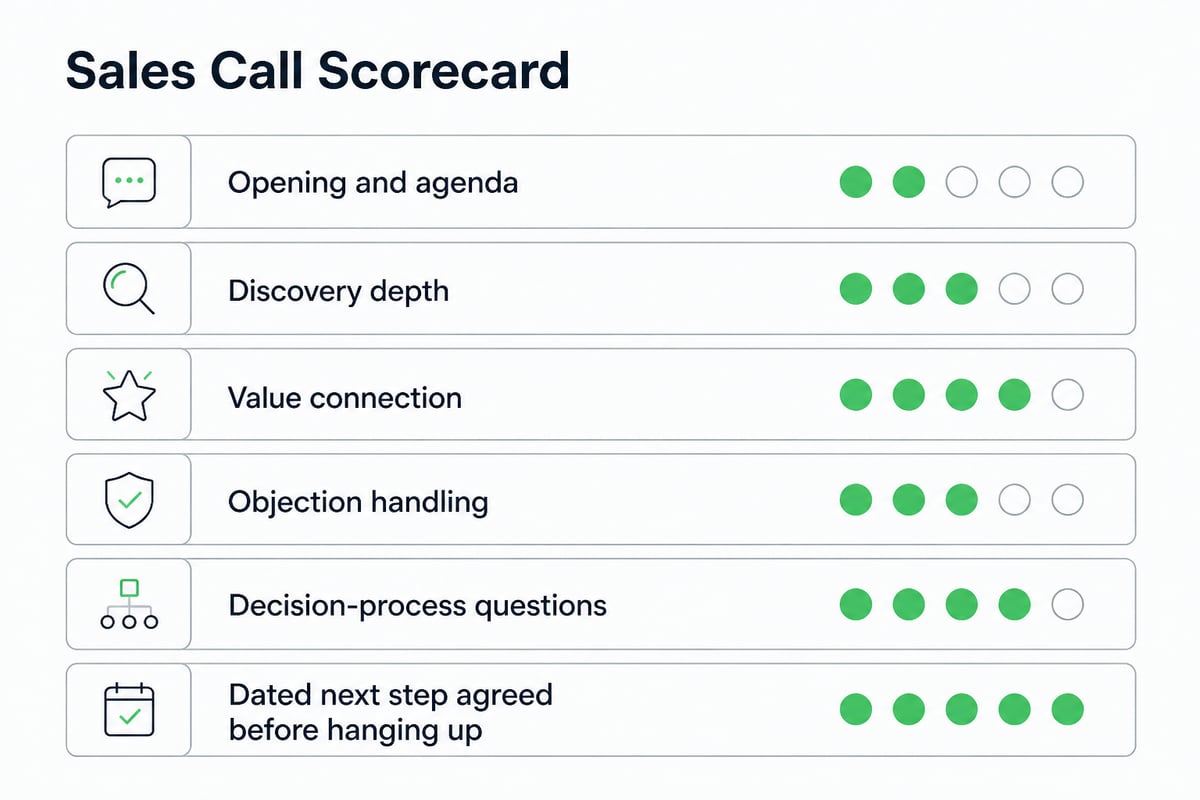
Keep the scorecard short enough that a rep can remember it during a live call. Six criteria scored consistently will do more than twenty scored loosely. If you want a deeper look at turning a playbook into scored criteria, this guide to sales call scoring software covers the mechanics.
Step 3: Capture Every Call in One Place
Coaching depends on evidence, so every sales conversation needs to land in one searchable place, whether it happened on a video call, a phone line, or across a table. Teams that sample only the calls a rep chooses to share get a flattering and incomplete picture.
For small owner-led teams, the practical barrier is time. An owner who closes deals and runs the business cannot sit through eight hours of recordings each week. The goal of capture is not to listen to everything. It is to make sure nothing important is invisible, so scoring and flagging can point you to the five minutes that matter in a forty-minute call.
Be transparent with your team about recording and how the data will be used. Reps engage with coaching when they trust it exists to help them win, not to catch them out. That is also why private feedback delivered to the rep first works better than public call reviews. If privacy is a concern on your team, the piece on AI sales coaching privacy explains how to set expectations.
Step 4: Score Calls Against Your Playbook
Scoring every call against the same playbook is how you find patterns that no single call review can show. One missed next step is an off day. Seven missed next steps across ten calls is a behavior gap.
Score on observable behavior, not impressions. "Asked who else is involved in the decision" is scorable. "Built good rapport" is not. For each call, record whether the behavior happened, and where possible, the timestamp of the moment.
Then look across calls for the biggest gap per rep. Common patterns include:
- Pitching before the problem is confirmed
- Accepting "send me a proposal" without a decision timeline
- Skipping the budget conversation until late
- Talking far more than the buyer does
On that last one, Gong Labs research cited in Claap's guide found the highest-converting B2B calls had about 43% rep talk and 57% buyer talk. A rep who talks 70% of the time is probably selling past the buyer's real concerns.
Step 5: Coach One Behavior Gap at a Time
Coaching improves close rates fastest when each rep works on one behavior gap until it changes, rather than receiving a long list of fixes after every call. Reps cannot apply eight pieces of feedback on their next live conversation, so they apply none.
Pick the single gap most tied to lost deals. If the rep's calls end without agreed next steps, that is the gap. Name it in one sentence, show the exact moment from a real call, and describe what better looks like. Salesforce's coaching guidance makes the same point: set goals, encourage self-evaluation, and improve one area at a time.
A simple coaching conversation has four parts:
- The rep listens to the flagged moment and says what they notice
- You compare it to the playbook standard
- You agree on one behavior to change
- You define the measurable target for the next call
That fourth part matters most. "Ask about the decision process" becomes "ask who else signs off in every discovery call this week, and score it." For more on the mechanics, see this walkthrough on how to coach sales reps.
Step 6: Add Role-Play on Moments From Real Calls
Role-play works when it rehearses the exact moments where a rep struggled, not generic scenarios. A rep who froze on a pricing objection last Tuesday gets more from replaying that objection than from a scripted exercise about a fictional buyer.
Short, frequent practice beats long workshops. Ten minutes of rehearsal on a flagged moment, repeated a few times before the next call, builds the response so it comes out naturally under pressure. Voice or text role-play lets reps practice privately, which lowers the embarrassment that makes many people avoid rehearsing in front of a manager.
This is where most small teams hit a wall. Managers believe in role-play but do not have the hours to run it for every rep each week. Automating the practice setup, based on each rep's own call data, removes that bottleneck. The article on AI sales role-play software explains what to look for.
Step 7: Improve Objection Handling and Buyer Fit
Many lost deals trace back to two things: unresolved objections and a buyer who never connected the offer to their problem. A 2025 HubSpot statistic cited in Qwilr's sales statistics roundup says a large share of deals fail to close because buyers do not see product fit. That is a discovery and value-connection problem, which coaching can address directly.
Coach reps to confirm the buyer's challenge in the buyer's own words before presenting anything. Salesforce's guidance on sales calls emphasizes confirming the prospect's challenge and keeping the conversation centered on their needs. When a rep restates the problem and the buyer says "exactly," the later proposal lands differently.
For objections, review calls for how reps respond in the first ten seconds after one is raised. Weak responses tend to argue, discount, or change the subject. Strong responses acknowledge, ask a clarifying question, and then address the real concern. A focused read on how to handle sales objections can serve as the basis for a practice set.

Step 8: Make Coaching a Weekly Habit
Coaching lifts close rates only when it repeats on a schedule, so build a weekly rhythm that survives a busy month. The RAIN Group study summary found that only a minority of surveyed organizations rated their sales training as extremely or very effective, and that organizations with highly effective training were far more likely to give managers resources to coach. Tools and time for managers are a differentiator, not an afterthought.
The same research tied effective training to retention, with turnover lower at organizations with highly effective training than at those with less effective training. For a small team, losing a trained rep costs months of ramp-up, so coaching protects the close rate by keeping skilled people.
A workable weekly cadence for a small team:
- Monday: Review last week's scores and pick each rep's one gap
- Midweek: Reps complete private practice on their flagged moments
- Friday: Ten-minute check on whether the target behavior showed up in calls
Step 9: Track Results and Adjust
Track whether coaching moved behavior first, then whether behavior moved outcomes. Close rate lags by weeks, so behavior scores are your early signal.
Watch these in order:
- Behavior adoption: Did the target behavior appear in the next several calls?
- Stage conversion: Did discovery-to-proposal or proposal-to-close improve for that rep?
- Close rate: Did the qualified close rate rise over a full sales cycle?
- Cycle length: Did deals with agreed next steps move faster?
If behavior changed but conversion did not, your scorecard may reward the wrong behavior. Revisit the playbook and compare against recent wins and losses. If behavior did not change, the coaching target was probably too broad. Narrow it.
Consultants advising B2B teams can use the same loop as a repeatable service: a baseline, a scorecard tied to the client's playbook, and a monthly report showing behavior and conversion trends by rep.
Where Bizware AI Sales Coach Fits
For teams that cannot listen to every call, Bizware AI Sales Coach captures virtual and in-person conversations in one place, scores each call against your own playbook, and gives each rep private coaching plus voice or text role-play on moments from their real calls. Each coaching step targets one behavior gap with a measurable next call, and a manager dashboard shows progress across reps. It is built on sales frameworks designed for small owner-led B2B teams.
Common Mistakes That Stall Close Rates
Most coaching programs fail for a handful of predictable reasons:
- Coaching on too many things at once. Reps retain one change at a time. Pick one.
- Using a scorecard no one agreed on. If reps cannot see how they are scored, they will dispute it instead of using it.
- Reviewing only wins or only losses. Compare both to find the behaviors that separate them.
- Treating close rate as the only number. It moves slowly. Behavior scores show progress sooner.
- Skipping the practice step. Feedback without rehearsal rarely changes what happens under pressure.
- Coaching irregularly. A burst of attention followed by silence resets the habit.
- Counting unqualified leads. A diluted denominator makes good reps look weak and hides the real gap.
Troubleshooting a Flat Close Rate
If you have coached for several weeks and the rate has not moved, work through these checks:
- Behavior did not change: The target was too vague. Rewrite it as an observable action with a count.
- Behavior changed, results did not: The behavior may not drive wins. Compare your recent closed-won calls to the scorecard again.
- One rep improved, others did not: Individual gaps differ. Avoid copying one rep's coaching plan to another.
- Calls look strong but deals stall late: Review proposal and negotiation calls, where the gap is often missing decision-maker access or no dated next step.
- Close rate fell after coaching started: Reps may be qualifying harder, which shrinks volume before conversion improves. Check qualified opportunities alongside the rate.
FAQ
How to improve sales conversion rate?
Improve conversion by tightening qualification, then coaching reps on the call behaviors that move deals between stages. Track stage-to-stage conversion per rep so you can see whether the weak point is discovery, proposal, or closing, and coach that specific stage.
What is the 10-3-1 rule in sales?
The 10-3-1 rule is a rough pipeline heuristic: ten conversations or prospects lead to three meaningful opportunities, which lead to one sale. Treat it as a planning guide and replace it with your own numbers once you have a baseline close rate from qualified opportunities.
What are the top 3 skills for sales?
The three that most affect close rates are discovery questioning, objection handling, and securing a clear next step. All three are observable on a recorded call, which makes them practical to score and coach.
Start this week by listening to three of your last closed-won calls and writing down the two or three behaviors they share, because that list becomes your first scorecard. If you want those calls captured, scored against your own playbook, and turned into private coaching for each rep, a good place to start is a demo with Ryan Cook, where you can schedule a free demo and see how it works on your team's real conversations.