

Online marketing is the practice of promoting a business through internet channels such as search engines, email, social media, paid ads, and content, with the goal of attracting prospects and turning them into customers. For a small B2B team, the work does not end when a lead arrives. Marketing creates the conversation, and the sales call decides whether it becomes revenue. This guide covers the channels, the role of AI, a simple budget rule, and the step most plans leave unfinished: coaching reps on the calls that online marketing produces.
What is online marketing?
Online marketing is any promotional activity delivered through internet-connected channels and measured through digital data. It includes organic tactics, such as search engine optimization and blogging, and paid tactics, such as pay-per-click ads and sponsored social posts.
"Digital marketing" and "online marketing" are used almost interchangeably. Digital marketing sometimes extends to offline digital touchpoints like digital signage or text messaging, while online marketing refers specifically to activity that happens on the web. For a B2B team, the practical difference is small. What matters is that every channel produces trackable behavior: a click, a form fill, a reply, a booked call.
That trackability is the main advantage over print, radio, or events. You can see which channel produced which lead, and you can adjust spending weekly rather than annually.
What are the main types of online advertising and marketing channels?
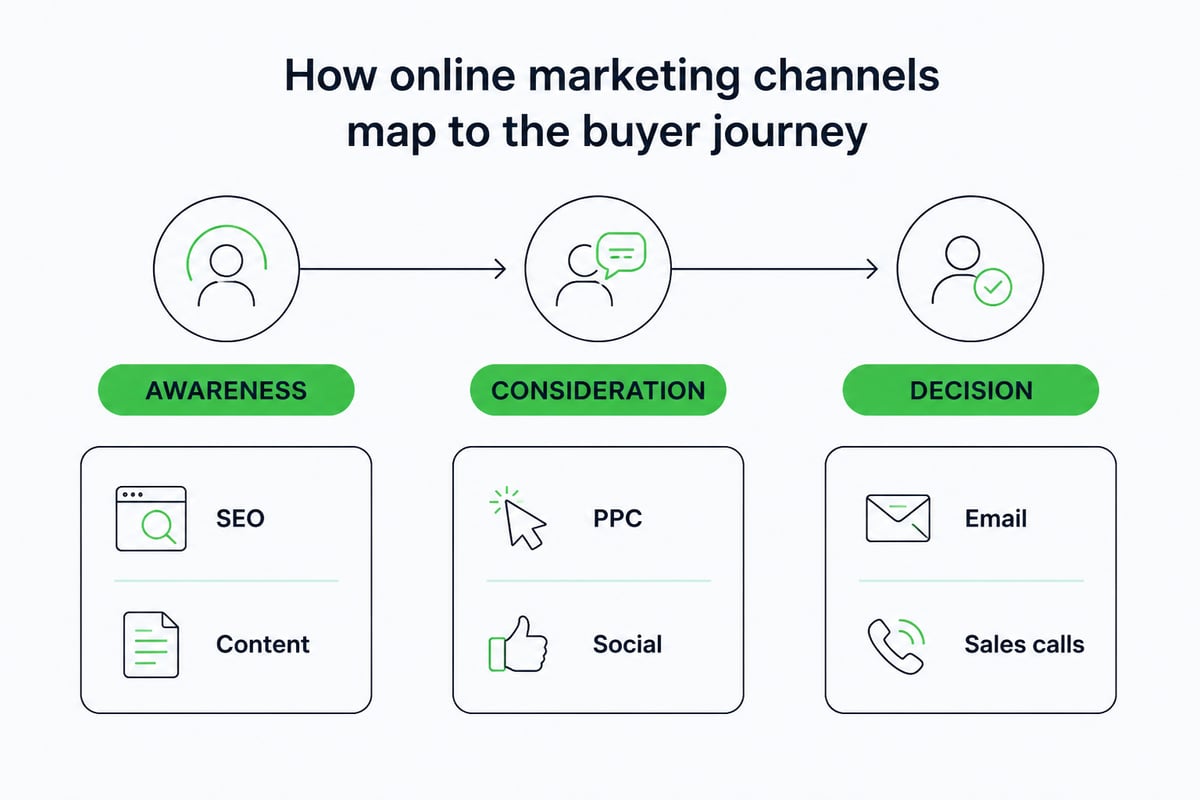
The core channels are search engine optimization, pay-per-click advertising, content marketing, email marketing, social media marketing, affiliate marketing, and local listings. Each serves a different stage of the buying process.
- Search engine optimization (SEO): Earns unpaid visibility when buyers search for solutions. It compounds over time but is slow to start. Our overview of SEO advertising explains how organic and paid search work together.
- Pay-per-click (PPC): Buys visibility immediately and charges per click. It suits teams that need pipeline within weeks. See this breakdown of pay-per-click marketing for how bidding and budgets work.
- Content marketing: Articles, case studies, and guides that answer buyer questions and build trust before a rep ever speaks to the prospect.
- Email marketing: The most direct channel for nurturing leads and re-engaging past conversations. A primer on email marketing covers list building and sequencing.
- Social media marketing: Reaches decision-makers where they already spend time, with LinkedIn the usual starting point for B2B.
- Affiliate and partner marketing: Pays referral partners for qualified leads or sales.
- Local listings: Google Business Profile and directory entries that matter for firms serving a defined region. A local agency such as Bing Digital, a 27-year-old ecommerce and marketing agency, is the type of outside partner some teams bring in for channel execution.
Common types of online advertising include search ads, display ads, social ads, video ads, native ads, email ads, and affiliate placements. Search and social ads are the two most B2B teams start with.
How is AI changing online marketing and selling?
AI is now standard equipment for sales and marketing teams, handling drafting, targeting, bidding, and analysis. In HubSpot's 2025 survey of 1,000 global sales professionals, only a small minority said they did not use AI, and most said AI saves time and optimizes processes.
Ad platforms have moved the same way. Google reports that advertisers using Demand Gen saw higher conversions per dollar spent for goals such as purchases and leads. Campaigns using Smart Bidding Exploration see more conversions.
Confidence has not caught up with adoption. HubSpot's 2025 State of Marketing data shows that fewer than half of marketers agreed they understand how to incorporate AI into their strategy, and a similar share said they know how to measure its impact. Many of the market is still guessing.
Two practical conclusions follow:
- Let AI handle volume tasks such as bidding, first drafts, and audience testing.
- Keep humans responsible for positioning, offers, and the sales conversation itself.
Google's own AI advertising guide recommends aligning campaign KPIs with business goals, which is a useful check before you hand any budget to automation. For deeper reading, see this overview of AI in marketing.
A caution on claims: the FTC's Operation AI Comply targeted deceptive AI-related claims in September 2024. If you advertise AI-driven results, make sure every claim is one you can substantiate.
How do you run an online marketing business or program?
You run online marketing by working in a fixed loop: define a target buyer, pick two or three channels, publish consistently, track results by channel, and review monthly. Small teams fail by spreading effort across eight channels instead of finishing the loop on two.
A workable sequence looks like this:
- Define the buyer. Write down the job title, company size, and the problem that triggers a purchase.
- Set one revenue-linked goal. Qualified calls booked per month is better than traffic or followers.
- Choose channels by speed and fit. Need pipeline in 30 days? Start with PPC and email. Playing a longer game? Add SEO and content.
- Build the destination. A fast site with one clear offer and a booking path beats a polished homepage with five competing calls to action.
- Track from click to closed deal. Tag every source so you can see which channel produces revenue, not just leads.
- Review and cut. Drop the weakest channel each quarter and reinvest in the strongest.
If you would rather hire than build, compare options in guides on marketing agency cost and marketing for a small business before signing a retainer.
What is the 50/30/20 rule in marketing?
The 50/30/20 rule is a budgeting guideline that splits spending into three buckets, commonly 50% to proven channels, 30% to growth experiments, and 20% to brand or long-term assets. There is no single official version, so treat it as a starting framework rather than a standard.
For a small B2B team, a practical reading looks like this:
| Share | Use | Example |
|---|---|---|
| 50% | Proven channels | The PPC campaign or email sequence already producing booked calls |
| 30% | Experiments | A new LinkedIn ad format or a partner referral offer |
| 20% | Long-term assets | Case studies, SEO content, sales coaching |
The last bucket is where many budgets quietly leave money out. Coaching the people who take the calls belongs there, because it raises the return on every other dollar in the first two buckets.

Why do leads from online marketing still fail to close?
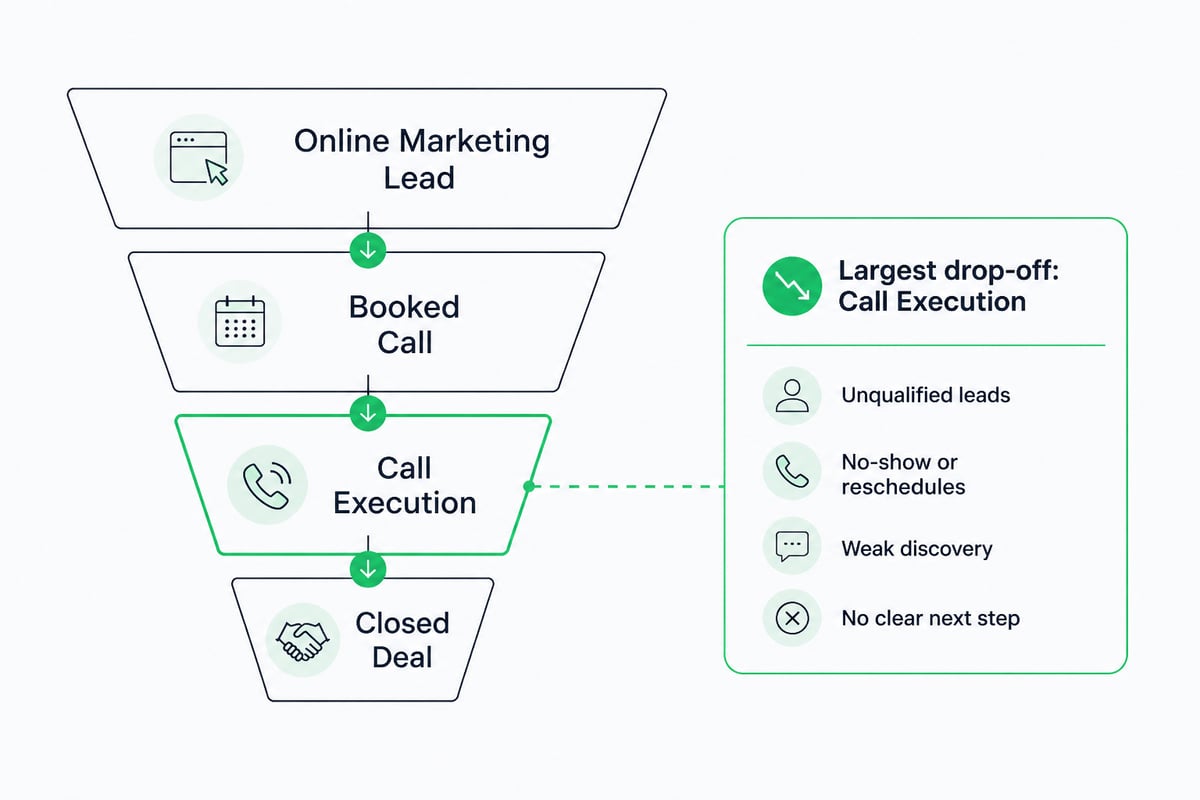
Leads fail to close mostly because of what happens on the call, not what happened in the ad. Lead quality is not the main problem for many teams: HubSpot's 2025 report found that most sales professionals said lead quality improved year over year.
If lead quality is rising and revenue is flat, the gap sits in conversion. Typical causes include:
- Reps skipping discovery questions and pitching too early
- Inconsistent handling of price and timing objections
- Weak next steps at the end of the call
- Each rep running a different process, so results cannot be repeated
An owner or sales manager running a team of three to ten reps cannot listen to every recorded call. Spot-checking two calls a week gives a skewed picture, and feedback arrives days after the moment that mattered. This is the same problem consultants and coaches face when advising B2B teams: they can teach a framework, but they cannot sit in on every conversation between sessions.
How does call coaching fit into an online marketing plan?
Call coaching fits at the point where marketing hands a prospect to sales, and it works by turning every real conversation into feedback a rep can act on before the next call. Treat it as the final channel stage, measured the same way as the rest.
Bizware AI Sales Coach captures sales calls, scores them, and gives each rep private coaching and voice or text role-play practice before the next call, with a manager dashboard. Ryan Cook's approach is built around one behavior gap at a time, with a measurable next call, so a rep works on a single skill rather than a long list. Calls are scored against your own sales playbook, and virtual and in-person conversations are captured in one place. The underlying methods draw on sales frameworks behind significant annual sales growth.
This is built for owner-led teams that want consistent coaching without listening to every call. It is not a forecasting or deal-analytics platform for hundreds of reps, and it is not a meeting-notes tool.
Consultants can also use the same structure to add an ongoing coaching layer to their client engagements.
How do you measure online marketing results?
Measure online marketing by tracking a short chain of metrics from first touch to closed revenue, and review it at the same interval every month. A shorter chain is easier to act on than a dashboard of twenty numbers.
- Cost per qualified lead by channel
- Lead-to-call booking rate (are leads responding?)
- Call-to-proposal rate (are reps advancing the deal?)
- Close rate and sales cycle length
- Customer acquisition cost against first-year revenue
Read the chain left to right and fix the first weak link. If booking rates are healthy but call-to-proposal is low, more ad spend will not help. HubSpot's sales statistics roundup is a useful reference for benchmarking prospecting and deal-execution numbers against industry data.
Creative quality also moves the top of the chain. Google's creative performance best practices cover how asset choices affect results in AI-driven campaigns.
What is the future of online marketing?
The future of online marketing is more automation in channel management and higher expectations for human quality in the conversations that follow. As AI handles bidding, drafting, and targeting for everyone, those tasks stop being a competitive edge.
Expect three shifts:
- Search will include AI-generated answers, which rewards clear, specific, well-sourced content over keyword repetition.
- Personalization will be assumed. HubSpot's 2025 survey found most sales professionals said AI personalizes prospect interactions.
- Differentiation will move to the live conversation, where trust, discovery, and objection handling decide outcomes.
Teams that pair efficient channels with disciplined coaching will convert the same traffic at a higher rate than competitors who automate the front end and neglect the call. See this look at an AI marketing strategy for planning ahead.
FAQ
Is online marketing the same as digital marketing?
Nearly, yes. Digital marketing is the broader term and can include offline digital touchpoints, while online marketing refers to promotion that happens over the internet. Most small businesses can treat them as one discipline.
Can a small team do online marketing without an agency?
Yes, if it starts with two channels and a clear goal. In-house work is usually practical for email, content, and basic PPC, while specialist tasks such as technical SEO or complex ad accounts are common reasons to hire help.
Which online marketing channel should a B2B team start with?
Start with the channel that matches your timeline. PPC and email produce pipeline within weeks, while SEO and content take months but cost less per lead once established. Most B2B teams pair one fast channel with one slow channel.
Pick one recent booked call, listen to it against your playbook, and write down the single behavior that cost you the next step. That one gap is where coaching should start. Bizware AI Sales Coach turns that exercise into a repeatable routine for every rep, and you can see how it works on your own calls when you start a 30-day free trial with Ryan Cook.