
Modern sales teams face unprecedented complexity. Buyers conduct extensive research before engaging, sales cycles stretch longer, and competition intensifies across every industry. Sales enablement software has emerged as the strategic answer to these challenges, providing teams with the content, training, coaching, and analytics needed to engage prospects effectively and close deals faster. For marketing services firms developing custom AI solutions, understanding how these platforms work and deliver value is essential for supporting clients' revenue growth objectives.
What Sales Enablement Software Actually Does
Sales enablement software serves as the central nervous system for revenue-generating activities. These platforms consolidate content management, training delivery, sales coaching, and performance analytics into unified systems that support every stage of the buyer journey.
At its core, sales enablement encompasses the processes, tools, and content that equip sales professionals to have more valuable conversations with prospects. The software component automates and scales these capabilities across entire organizations.
Core Capabilities That Drive Results
Modern platforms deliver several mission-critical functions:
- Content management and distribution that ensures reps access the right materials at the right time
- Training and onboarding modules that accelerate new hire productivity
- Sales coaching tools that provide real-time guidance during customer interactions
- Analytics dashboards that measure content effectiveness and rep performance
- CRM integration that embeds enablement resources directly into existing workflows
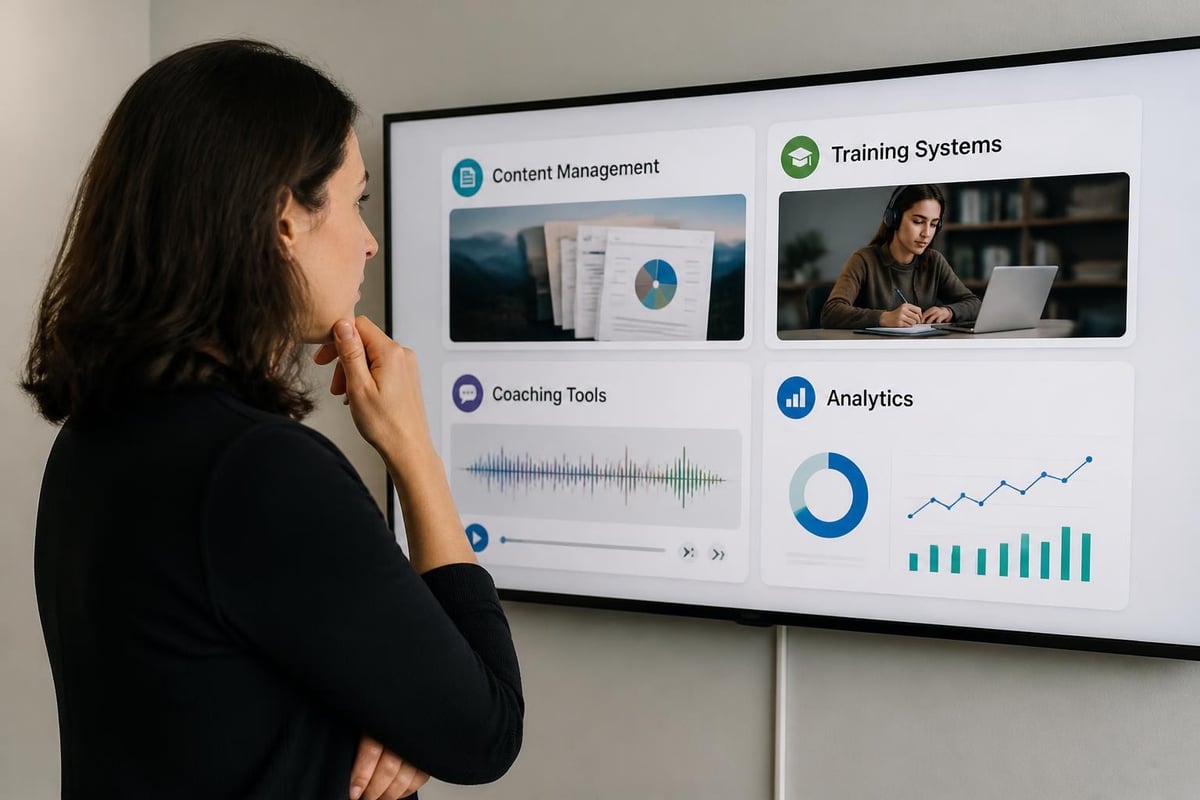
The technology eliminates the fragmentation that plagues many sales organizations. Instead of searching multiple repositories for current presentations, jumping between systems for training, and manually tracking which content drives results, teams operate from a single source of truth.
How AI Is Reshaping Sales Enablement
Artificial intelligence has fundamentally transformed what sales enablement software can accomplish. Traditional platforms organized and distributed content. AI-powered solutions actively guide sellers toward better outcomes.
Machine learning algorithms now analyze thousands of sales conversations to identify winning patterns. These systems detect which questions top performers ask, which objections they handle most effectively, and which content assets correlate with closed deals. AI sales coaching capabilities then deliver personalized recommendations to each rep based on their specific gaps and opportunities.
Natural language processing enables conversation intelligence features that transcribe calls, extract key moments, and surface coaching opportunities automatically. Sales managers no longer need to manually review hours of recordings. The platform highlights exactly which skills need development and provides specific examples from actual customer interactions.
Predictive Analytics and Content Recommendations
AI-driven sales enablement software predicts which content will resonate with specific prospects based on industry, company size, buying stage, and past engagement patterns. When a rep opens an opportunity record, the system surfaces the three presentations, case studies, or one-pagers most likely to advance that specific deal.
This contextual intelligence extends to training delivery through AI platforms that adapt learning paths based on individual performance. Reps who struggle with discovery conversations receive targeted modules on questioning techniques. Those who excel at discovery but falter at closing get focused content on negotiation strategies.
| Traditional Enablement | AI-Powered Enablement |
|---|---|
| Static content libraries | Dynamic, context-aware recommendations |
| Scheduled training programs | Adaptive, personalized learning paths |
| Manual call review | Automated conversation analysis |
| Lagging performance metrics | Predictive deal guidance |
| Generic best practices | Rep-specific coaching insights |
Measuring the Business Impact
The question isn't whether organizations should invest in sales enablement software, but rather how to quantify the returns these platforms generate. Forward-thinking companies establish clear metrics before implementation to track progress and prove ROI.
Revenue velocity serves as the ultimate measure. This metric combines deal size, win rate, sales cycle length, and pipeline volume into a single indicator of how quickly an organization generates revenue. Strong enablement programs typically increase velocity by 15-25% within the first year.
Time to productivity for new hires represents another critical metric. Organizations using comprehensive enablement platforms report new reps reaching quota 30-40% faster than those relying on traditional onboarding methods. The impact on sales effectiveness becomes evident quickly.
Key Performance Indicators Worth Tracking
Sales leaders should monitor these specific metrics:
- Content utilization rates showing which assets reps actually use during deals
- Content engagement scores tracking how prospects interact with shared materials
- Win rates by content usage correlating specific assets with closed deals
- Training completion rates and subsequent performance improvements
- Coaching session frequency and impact on quota attainment

Research from the Sales Enablement Collective demonstrates that organizations with formal measurement frameworks achieve significantly better outcomes than those implementing technology without clear success criteria.
Integrating Enablement Into Revenue Operations
Sales enablement software doesn't operate in isolation. The most sophisticated organizations embed these platforms within broader revenue operations strategies that align marketing, sales, and customer success functions.
Harvard Business Review research shows that companies integrating digital tools across the entire sales process achieve 30% higher win rates than those applying technology sporadically. This integration requires thoughtful architecture connecting enablement platforms with CRM systems, marketing automation tools, and customer data platforms.
The workflow looks something like this: Marketing creates content based on buyer persona research and campaign performance data. This content flows automatically into the sales enablement system, tagged by industry, buyer stage, and use case. Sales reps access these materials directly within their CRM during opportunity management. The enablement platform tracks which content gets used, how prospects engage with it, and whether deals close. This feedback loop informs future content creation.
Building Cross-Functional Alignment
Successful enablement requires commitment beyond the sales organization:
- Marketing teams contribute content, messaging frameworks, and competitive intelligence
- Product management provides technical documentation, feature updates, and roadmap information
- Customer success shares implementation best practices and expansion play strategies
- Sales leadership defines skill requirements, coaching standards, and performance expectations
When these functions collaborate through shared technology platforms, organizations create the conditions for sustainable revenue growth. Deloitte's research on business transformation emphasizes that go-to-market success increasingly depends on this type of operational alignment.
Choosing the Right Platform for Your Organization
The sales enablement software market has exploded over the past five years. Dozens of vendors now offer solutions spanning simple content repositories to comprehensive revenue enablement suites. Making the right choice requires clarity about organizational needs and readiness.
Start by assessing current pain points. Do reps struggle to find content? Is new hire onboarding taking too long? Are managers unable to provide consistent coaching at scale? Different platforms excel at different capabilities, so prioritizing problems ensures you select software matched to your specific situation.
Essential Selection Criteria
Evaluate potential solutions against these requirements:
- User adoption drivers including interface simplicity and mobile accessibility
- Integration capabilities with existing CRM, marketing automation, and communication tools
- Content governance features that maintain version control and brand compliance
- Analytics depth providing both aggregate trends and individual performance insights
- Scalability to support growth without platform migration
- Training and support from the vendor during implementation and beyond
| Consideration | Why It Matters | Questions to Ask |
|---|---|---|
| Current tech stack | Integration complexity | Does it connect seamlessly with our CRM? |
| Team size | Pricing and scalability | How does licensing work as we grow? |
| Content volume | Search and organization | Can reps find assets in under 30 seconds? |
| Remote selling | Mobile and video support | Does it work on tablets and smartphones? |
| Compliance needs | Security and permissions | Can we control who accesses sensitive content? |
Request proof-of-concept deployments with actual sales reps before committing to enterprise agreements. Software that looks impressive in vendor demos sometimes falters when confronted with real-world workflows and content complexity.
Implementation Strategies That Ensure Adoption
Technology alone doesn't transform sales performance. Even the most sophisticated sales enablement software fails without proper implementation planning and change management. Organizations should allocate as much time to adoption strategy as to platform selection.
Begin with a pilot program involving 10-15 reps across different experience levels and territories. This approach surfaces workflow issues, content gaps, and training needs before company-wide rollout. The pilot group also becomes your internal champion network, sharing success stories and best practices with colleagues.
Content migration represents the most underestimated implementation challenge. Most organizations discover they have far more outdated, duplicate, and off-brand materials than expected. Conducting a thorough content audit before migration prevents polluting your new system with legacy problems. Archive obsolete materials, consolidate duplicates, and update branding on keeper assets.
Onboarding and Training Best Practices
Platform launch requires comprehensive training that addresses different user needs:
- Sellers need task-based training showing how the platform helps them close specific deals faster
- Managers require coaching workflows and analytics interpretation guidance
- Administrators must understand content governance, user permissions, and system configuration
- Content creators in marketing need guidance on tagging, formatting, and optimization standards
Workplace learning research from LinkedIn confirms that continuous learning opportunities drive adoption far more effectively than one-time training events. Plan for ongoing education through quick-win tutorials, monthly feature spotlights, and regular office hours with platform experts.
The connection between employee onboarding automation and sales enablement is particularly strong. New hire success depends on rapid access to training content, role-specific learning paths, and structured coaching, all of which enablement platforms deliver efficiently.
Content Strategy for Maximum Impact
Sales enablement software is only as valuable as the content it delivers. Organizations often invest heavily in technology while neglecting the content strategy required to make that technology useful. Developing high-impact content requires understanding buyer needs, sales process stages, and content format preferences.
Buyer-centric content addresses specific questions prospects ask at different stages of their evaluation journey. Early-stage content educates on problems and potential solutions. Middle-stage materials compare approaches and establish evaluation criteria. Late-stage assets address implementation concerns, pricing structures, and ROI expectations.
Sales reps need more than customer-facing presentations. Effective content libraries include internal resources like battle cards, objection handling guides, discovery question frameworks, and competitive positioning documents. These materials prepare reps for conversations rather than simply providing something to share with prospects.
Content Formats That Drive Engagement
Different selling scenarios require different content types:
- Micro-demos (60-90 seconds) for email follow-up and social sharing
- Interactive ROI calculators for quantifying value propositions
- Customer video testimonials organized by industry and use case
- One-page solution briefs tailored to specific verticals
- Implementation roadmaps showing typical deployment timelines
The rise of AI content marketing capabilities has accelerated content production, but quality still matters more than quantity. Ten highly relevant, frequently used assets deliver more value than 100 generic pieces that reps never access.
The Evolution Toward Revenue Enablement
The sales enablement software category is evolving rapidly. Leading analysts, including Forrester, predict the shift from sales enablement to revenue enablement as platforms expand beyond frontline sellers to support the entire revenue team.
This evolution reflects the reality that customer success, account management, and support teams increasingly drive revenue growth through expansion and retention. Enabling only new customer acquisition misses the majority of revenue opportunity in subscription and recurring revenue business models.
Revenue enablement platforms provide:
Consistent messaging across all customer-facing teams preventing the confusion that occurs when prospects hear different value propositions from sales and implementation teams. Cross-functional playbooks that guide handoffs between sales and customer success, ensuring nothing falls through the cracks during transitions. Unified analytics showing how enablement investments impact not just new bookings but also expansion revenue, retention rates, and customer lifetime value.
Organizations building AI sales enablement capabilities should architect for this broader scope from the beginning rather than retrofitting sales-only systems later.

Future Trends Shaping the Market
Several emerging trends will define the next generation of sales enablement software. Organizations planning technology investments should consider how these developments might impact their choices and roadmaps.
Conversational AI integration enables reps to ask questions and receive immediate answers without searching content libraries. Natural language interfaces will make enablement resources as easy to access as asking a knowledgeable colleague. The technology supporting AI sales assistants will embed directly into enablement platforms.
Automated content creation tools will help marketing teams produce personalized assets at scale. AI systems will generate custom presentations, proposals, and follow-up materials based on CRM data, previous interactions, and similar deals. This capability addresses the perennial challenge of content personalization without requiring manual customization for every opportunity.
Skills gap identification through conversation analysis will become increasingly sophisticated. Platforms will diagnose specific development needs with surgical precision, then automatically recommend training content and practice scenarios tailored to each rep's unique profile.
The convergence of enablement with AI marketing automation will blur traditional boundaries between marketing and sales technology. Unified platforms will support the entire buyer journey from initial awareness through customer advocacy.
Building Business Cases for Investment
Securing budget approval for sales enablement software requires demonstrating clear financial returns. Technology leaders and sales executives must collaborate on business cases that translate platform capabilities into revenue impact.
Calculate the opportunity cost of current inefficiencies. How much time do reps spend searching for content versus selling? What percentage of new hires leave before reaching productivity? How often do deals stall because reps lack the right materials or skills? These problems carry quantifiable costs that enablement addresses.
Project conservative improvement estimates across key metrics:
- 5-10% reduction in sales cycle length
- 10-15% improvement in win rates
- 20-30% faster new hire ramp time
- 15-20% increase in content utilization
- 8-12% boost in average deal size
Apply these percentages to your current numbers to estimate incremental revenue. Compare this against total implementation costs including software licensing, integration services, content development, and training. Most organizations achieve positive ROI within 12-18 months when accounting for improved sales performance metrics.
Remember that enablement delivers benefits beyond quota attainment. Reduced employee turnover, improved sales and marketing alignment, and enhanced brand consistency all contribute value even when difficult to quantify precisely.
Sales enablement software has transitioned from nice-to-have to essential infrastructure for competitive sales organizations. The platforms that integrate content management, AI-powered coaching, adaptive training, and predictive analytics deliver measurable improvements in revenue velocity and team performance. For marketing services firms supporting clients' growth objectives, understanding these technologies and their strategic applications is critical. Ryan Cook specializes in developing custom AI solutions that enhance sales enablement capabilities, delivering the intelligent coaching systems and automation tools that transform how teams sell, onboard new members, and serve customers.