
The most reliable sales performance improvement strategies for a small owner-led team are to define what a good call looks like, measure every rep against that standard, and coach one behavior gap at a time until the next call proves it changed. Everything else, from new tools to new incentives, works only when it sits on top of that loop. This guide walks through the loop step by step, in the order an owner or sales manager can put it to use.
What does sales performance actually mean for a small team?
Sales performance is the measurable result of how well your reps turn conversations into revenue, and it has two layers: outcomes and behaviors. Outcomes are what the CRM reports, such as revenue, win rate, and quota attainment. Behaviors are what reps do on calls that produce those outcomes, such as how they open, how they qualify, and how they handle a price objection.
Most small teams manage only the outcome layer because it is easy to see. The trouble is that outcomes arrive late. By the time a quarter shows a weak win rate, a dozen deals have already been handled the same flawed way. Improving performance means moving your attention upstream to the behaviors that cause the numbers.
For a deeper look at the definition and how it connects to management practice, see this overview of sales performance.
Which metrics should you track to measure sales performance?
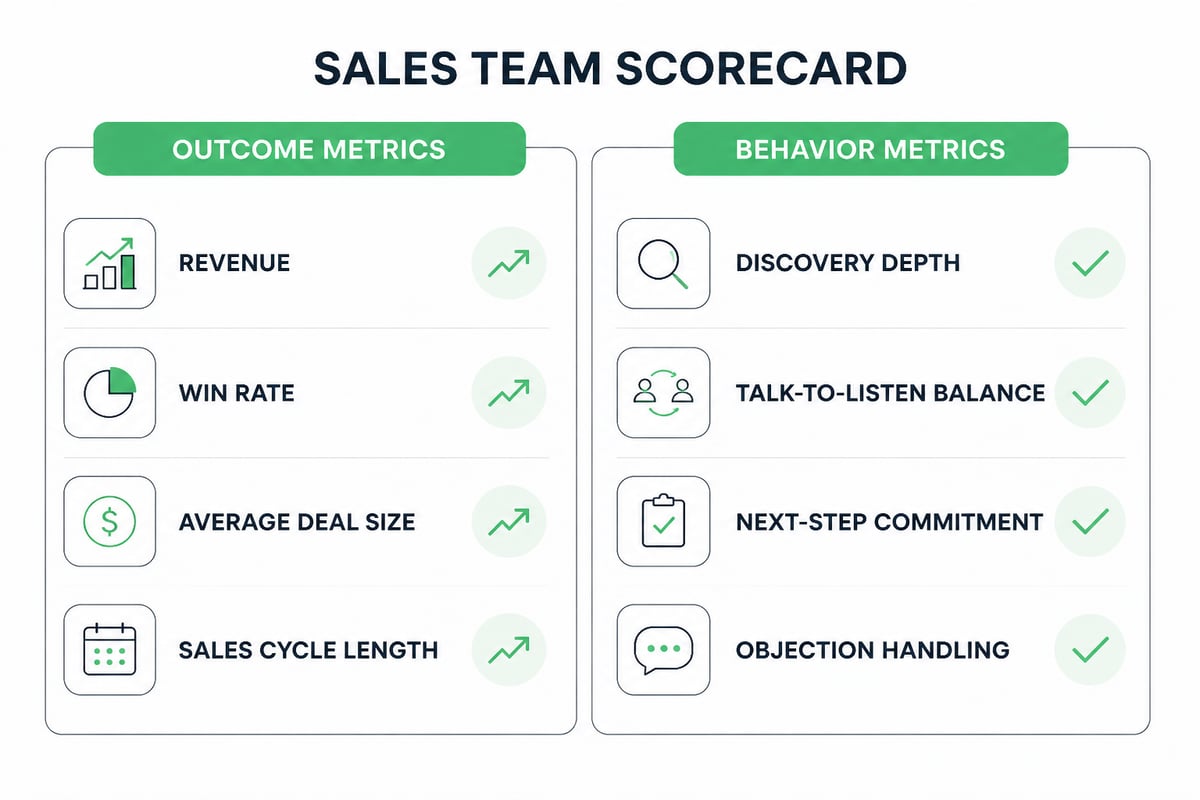
Track a short set of outcome metrics and a short set of behavior metrics, and review them together. Outcome metrics tell you whether performance is moving. Behavior metrics tell you why.
HubSpot's 2025 State of Sales Report shows what sales professionals themselves prioritize: annual recurring revenue was the most-cited success metric, followed by conversion rate, win rate, and quota attainment.
A workable scorecard for a small B2B team looks like this:
- Outcome metrics: revenue closed, win rate, average deal size, sales cycle length, and conversion from first call to proposal.
- Behavior metrics: discovery depth, talk-to-listen balance, next-step commitment at the end of each call, and objection handling quality.
- Consistency metrics: the spread between your best and weakest rep on each behavior.
The consistency metrics matter most to an owner who cannot sit in every conversation. A wide spread tells you the playbook exists on paper but not on calls. For a fuller treatment of what to include, review these sales performance metrics.
How do you find out where performance is actually breaking down?
You find the breakdown by listening to a representative sample of real calls and scoring them against one standard. Pipeline reports show where deals stall, but only the conversation shows why.
Most owners rely on three weak sources of information: rep self-reports, CRM notes, and the occasional ride-along. Each is filtered. Reps remember calls generously, notes are written after the fact, and a ride-along changes how the rep behaves. None of them scales past three or four people.
A stronger approach has three parts:
- Capture every conversation in one place, whether it happened on video or in person.
- Score each call against a written playbook, so two managers reviewing the same call reach the same conclusion.
- Look for patterns across calls, not single-call verdicts. One missed objection is noise. The same missed objection in eight calls is a coaching target.
This is the practical case for sales call scoring software: it turns an impossible listening task into a review you can finish in an afternoon.
Why does your sales playbook come before everything else?
A written sales playbook comes first because you cannot coach, score, or improve against a standard that exists only in the owner's head. In many founder-led businesses, the owner closes deals by instinct, and the instinct never gets documented. New reps then learn by imitation, which produces uneven results.
A usable playbook for a small team does not need to be long. It should answer these questions in plain language:
- What does a qualified buyer look like, and what disqualifies one?
- What must be learned on a discovery call before a proposal is justified?
- How should the team respond to the five objections it hears most?
- What is the required next step at the end of every call?
Write it from your own best calls, not from a generic template. Then use it as the scoring rubric. When the rubric is the playbook, a call score stops being an opinion and becomes a statement about whether the rep did what the team agreed to do. If you are building this from scratch, the guide to founder-led sales covers how to turn owner instinct into a repeatable process.
How does coaching improve sales performance?
Coaching improves sales performance by changing specific rep behaviors between calls, and the evidence for it is consistent. Salesforce cites a Gartner study finding that effective sales coaching can increase sales performance.
The gap between knowing this and doing it is wide. According to the State of Sales report cited in that same Salesforce piece, only a minority of sales representatives say they receive one-on-one coaching weekly. In a small team, the reason is plain: the person who would coach is also the person selling, hiring, and running the company.
Coaching fails in small teams for predictable reasons:
- Feedback is based on memory instead of a recorded call.
- Sessions cover five things at once, so nothing sticks.
- There is no agreed way to check whether the rep changed.
The fix is structure. Pick one behavior, show the rep the exact moment on a real call, practice it, and define how you will judge the next call. A practical walkthrough appears in this guide on how to coach sales reps.
What is a one-behavior coaching cycle?
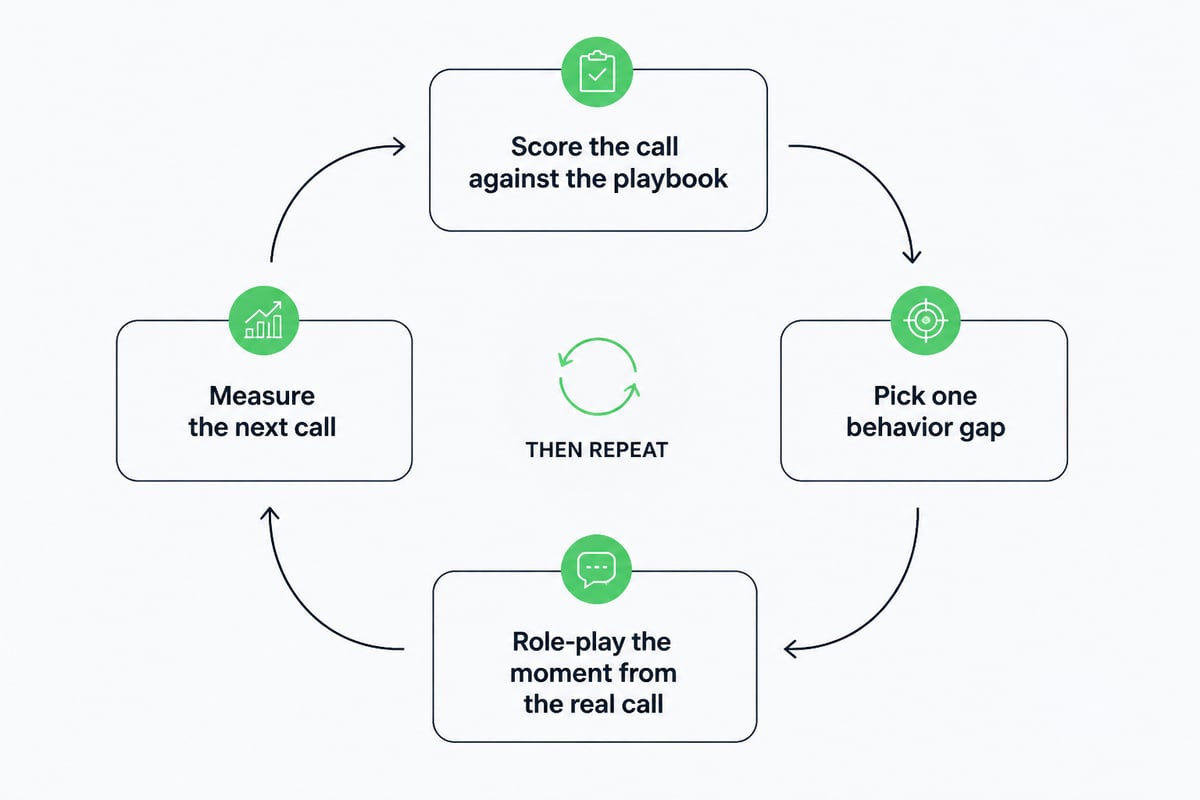
A one-behavior coaching cycle is a repeating four-step routine that targets a single gap, practices it, and checks the result on the next real call. Narrow scope is the point. A rep can change one habit in a week. A rep cannot change seven.
Here is how a cycle runs in practice:
- Score the call. Compare it against the playbook and list where it fell short.
- Choose one gap. Select the behavior with the biggest effect on the outcome, such as failing to ask about budget authority.
- Practice the moment. Replay the real exchange, then role-play a better version, by voice or in text, until the rep can deliver it without notes.
- Set a measurable next call. Define the observable change, for example "the rep asks who else signs off before ending the call," and score that item on the next recorded conversation.
Then repeat with the next gap. Over a quarter, a rep closes several gaps in sequence, and each one is documented. For more on the discipline behind this, see these sales coaching best practices.
Why does role-play practice matter before the next call?
Role-play matters because reps need a place to fail cheaply before they try a new behavior with a live buyer. Hearing feedback about a call is not the same as rehearsing the better answer. Without rehearsal, most reps return to old habits under pressure.
Good practice is specific. It rebuilds the exact moment from the rep's own call, such as a price objection in minute twenty, and lets the rep try new language several times. Practice that uses generic scenarios teaches generic skills. Practice built from a rep's own transcript teaches the skill that rep is missing.
Voice practice suits objection handling and tone. Text practice suits teams that sell by phone but want a lower-pressure way to work on phrasing. Private practice also reduces the embarrassment that stops some reps from asking for help.

Where do customer relationships fit into sales performance?
Customer relationships belong in your improvement plan because repeat and expansion revenue is often cheaper and faster to win than new business. Salesforce reports that many small and midsize businesses say repeat buyers generate more than half of their revenue.
HubSpot's survey points to how those sales happen. In the 2025 results, understanding customer goals was named a top driver of repeat sales and upsells, and trust and rapport were named the most effective upsell or cross-sell strategy. Both are conversational skills. A rep who asks sharp questions about the buyer's goals, and who ends each call with a clear commitment, is building the base for the next sale.
This is a good reason to score existing-customer calls with the same playbook discipline you apply to new-business calls. Account conversations are where expansion revenue is won or lost, yet they rarely get reviewed.
What are the main types of sales strategies a small team can use?
The main types of sales strategies a small team can use are inbound, outbound, consultative, and account-based selling, and most owner-led teams blend two of them. The right mix depends on how buyers find you and how complex your offer is.
| Strategy | How it works | Fits best when |
|---|---|---|
| Inbound | Reps respond to prospects who raise their hand | Buyers research before contacting you |
| Outbound | Reps start conversations with a defined target list | You know exactly who your buyer is |
| Consultative | Reps diagnose the problem before proposing a solution | The offer is complex or high value |
| Account-based | Reps focus effort on a short list of named accounts | A few large deals drive most revenue |
Whichever you choose, the improvement loop is identical: define the standard, score the calls, coach one gap at a time. Strategy decides who you talk to. Call quality decides how many of those conversations convert.
How do you hold the team accountable without micromanaging?
You hold the team accountable by making the standard visible and the review routine, so accountability becomes a process instead of a confrontation. Reps accept scrutiny more readily when scoring is consistent and tied to a written playbook rather than to a manager's mood.
A light weekly rhythm works for most small teams:
- Monday: each rep sees the score and the single behavior focus for the week.
- Midweek: the rep completes a short practice session on that behavior.
- Friday: the manager checks the next recorded call against the stated target.
Keep private coaching private and share team-level trends openly. Reps are more willing to practice weaknesses when feedback does not become public. More on building this structure is in this piece on sales team accountability.
How can Sales AI make this loop practical for a small team?
Sales AI makes the loop practical by doing the parts that consume a manager's time: capturing calls, scoring them, and preparing practice, while the owner decides what to coach. The Bizware AI Sales Coach captures virtual and in-person conversations in one place, scores each call against your own sales playbook, and gives each rep private coaching and voice or text role-play based on moments from real calls. Each coaching step targets one behavior gap, with a measurable next call, and a manager dashboard shows progress without requiring you to listen to every recording.
Consultants who advise B2B sales teams can use the same structure to keep their guidance alive between engagements, since the scoring and practice continue after the workshop ends. For a wider comparison of approaches, read about AI sales coaching.
FAQ
What is a performance improvement plan (PIP) in sales?
A sales performance improvement plan is a documented, time-limited agreement that names the specific behaviors or results a rep must improve, the support provided, and how progress will be judged. It works best when the targets are observable behaviors on calls, not just a revenue number, so the rep knows exactly what to change.
What are the 7 golden rules of sales?
No single official list exists, but commonly cited rules include knowing your buyer, asking before telling, listening more than speaking, qualifying honestly, handling objections calmly, asking for a clear next step, and following up consistently. A small team gets more value from turning these into scored playbook items than from memorizing them.
How fast can a team see results from these changes?
Behavior changes can appear on the very next scored call, while outcome metrics such as win rate usually take a few sales cycles to move. Track the behavior metric weekly and the outcome metric monthly so you do not judge progress too early.
Start this week by picking one recent call from each rep and scoring it against a short checklist drawn from your own best conversations; the single weakest behavior across those calls becomes your first coaching target. If you want that scoring, private coaching, and practice handled in one system, Bizware AI Sales Coach is built for exactly that kind of owner-led team, and you can schedule a free demo with Ryan Cook to see how it would run against your own playbook.