

The competitive landscape of 2026 demands sales teams that are not only skilled but continuously evolving. Organizations investing in professional development through a sales training consultant see measurable improvements in win rates, quota attainment, and revenue growth. These specialized professionals bridge the gap between theoretical knowledge and practical application, transforming average performers into top producers through systematic coaching, data-driven insights, and modern technology integration.
The Strategic Value of Working with a Sales Training Consultant
A sales training consultant brings specialized expertise that internal teams often lack. These professionals have worked across industries, methodologies, and organizational structures, accumulating insights that would take years to develop internally. Their external perspective identifies blind spots and inefficiencies that become invisible to those working within the system daily.
Objective Assessment and Diagnosis
The first value a sales training consultant delivers is unbiased evaluation. They assess current capabilities without organizational politics or preconceived notions influencing their judgment. This objective analysis covers multiple dimensions:
- Skills gaps across prospecting, discovery, presentation, negotiation, and closing
- Process inefficiencies that slow deal velocity or reduce conversion rates
- Technology adoption barriers preventing teams from leveraging available tools
- Coaching quality and consistency from frontline managers
- Content effectiveness in supporting the buyer journey
Research from Forrester's evaluation of sales training services highlights that organizations benefit most when consultants combine behavioral change expertise with measurement frameworks that prove ROI.
Customized Program Design
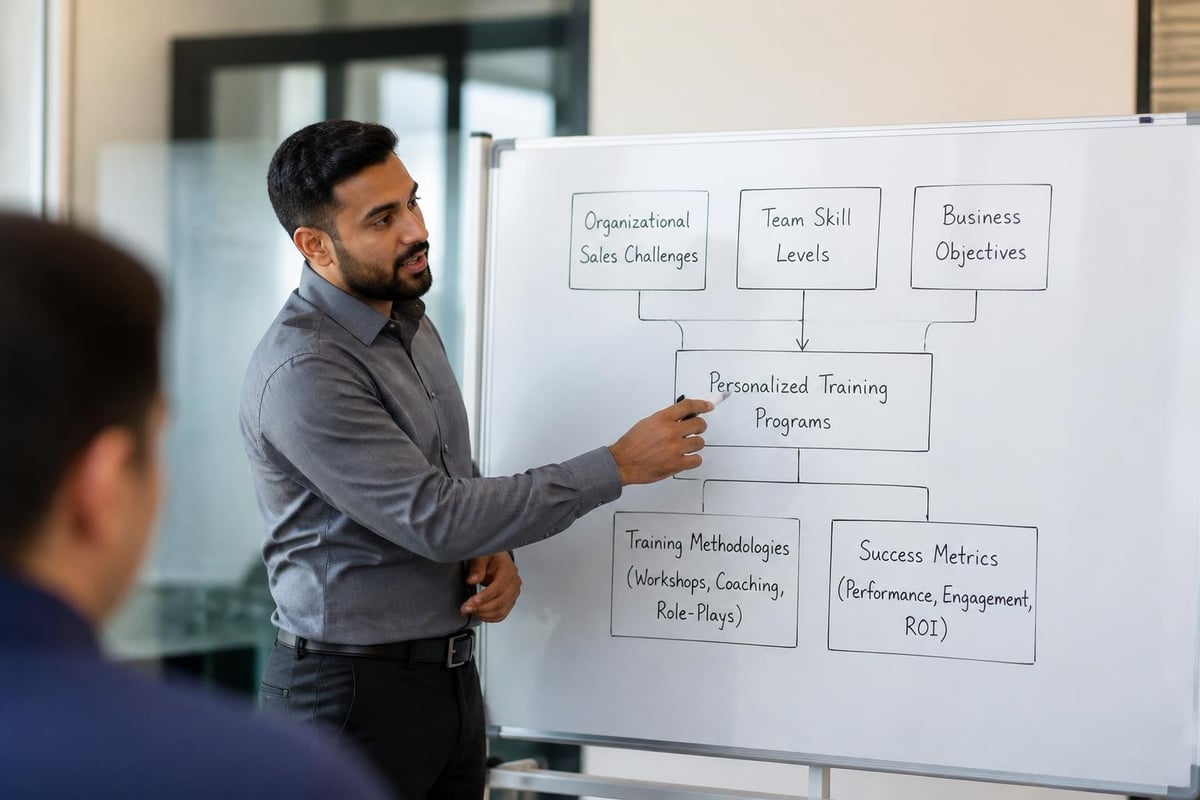
Generic training produces generic results. A skilled sales training consultant designs programs tailored to your specific market dynamics, buyer personas, product complexity, and sales cycle length. This customization ensures relevance and immediate applicability.
| Training Component | Generic Approach | Customized Approach |
|---|---|---|
| Content Examples | Industry-agnostic scenarios | Your actual deals and objections |
| Practice Sessions | Standardized role-plays | Simulations using your sales process |
| Measurement Metrics | Universal KPIs | Metrics aligned to your business goals |
| Follow-up Coaching | Scheduled check-ins | Triggered by performance data |
The customization extends beyond content to delivery modality, pacing, and reinforcement mechanisms that fit your team's learning preferences and workflow constraints.
Integrating AI into Sales Training Programs
The intersection of artificial intelligence and sales training represents one of the most significant shifts in capability development. A forward-thinking sales training consultant now incorporates AI tools not as replacements for human skills but as amplifiers of effectiveness.
AI-Powered Coaching at Scale
Traditional one-on-one coaching doesn't scale efficiently. AI sales coaching platforms enable consultants to provide personalized feedback to entire teams simultaneously. These systems analyze call recordings, email communications, and CRM data to identify coaching opportunities specific to each seller.
The technology tracks improvement over time, adjusting recommendations based on what interventions produce the best results for different personality types and experience levels. This data-driven approach eliminates guesswork from capability development.
However, as Harvard Business Review notes regarding GenAI adoption, salespeople often misunderstand how to effectively integrate these tools. A sales training consultant helps teams avoid common pitfalls like over-reliance on AI-generated content without personalization or failing to validate AI insights with human judgment.
Automated Training Delivery and Reinforcement
Modern AI training platforms allow consultants to create learning experiences that adapt in real-time. Instead of static courses, sellers receive microlearning content triggered by specific situations:
- Pre-call preparation briefings based on prospect research
- In-the-moment objection handling suggestions during conversations
- Post-call analysis highlighting improvement opportunities
- Spaced repetition of key concepts aligned to individual forgetting curves
This continuous learning model proves far more effective than quarterly training events that quickly fade from memory.
Measuring Training Effectiveness and Business Impact
The question "Did training work?" requires rigorous measurement frameworks. A competent sales training consultant establishes baseline metrics before intervention and tracks leading indicators throughout the program.
Establishing the Right Metrics
Training effectiveness appears at multiple levels, each requiring different measurement approaches:
Level 1: Reaction measures immediate participant satisfaction but correlates weakly with business results. While important for engagement, a sales training consultant focuses primarily on deeper metrics.
Level 2: Learning assesses knowledge retention through assessments, role-play evaluations, and certification tests. These confirm comprehension but don't guarantee application.
Level 3: Behavior tracks actual changes in sales activities, measured through:
- Call quantity and quality metrics
- Email response rates and meeting conversion percentages
- CRM data completeness and accuracy
- Adoption rates of recommended methodologies
- Manager observation scores using standardized rubrics
Level 4: Results connects training to business outcomes including win rates, deal sizes, sales cycle length, quota attainment, and revenue growth.
The Sales Enablement Analytics Report provides benchmark data showing that high-performing organizations measure across all four levels, with particular emphasis on behavioral change and business results.
Creating Accountability Through Dashboards
Modern sales performance metrics dashboards make training impact visible to all stakeholders. A sales training consultant works with revenue operations teams to build tracking systems that show:
| Metric Category | Example Metrics | Measurement Frequency |
|---|---|---|
| Activity Behavior | Calls per day, emails sent, LinkedIn touches | Daily |
| Pipeline Health | New opportunities created, stage progression velocity | Weekly |
| Skill Application | Methodology adherence scores, objection handling success | Per opportunity |
| Business Outcomes | Win rate, ASP, quota attainment | Monthly/Quarterly |
These dashboards reveal which training elements drive performance improvements and which need adjustment, enabling continuous program optimization.

Developing Manager Coaching Capabilities
Even the best sales training consultant cannot sustain capability development alone. Long-term success requires building coaching competency among frontline managers who interact with sellers daily.
The Manager Enablement Gap
According to the LinkedIn Workplace Learning Report, manager effectiveness represents one of the top factors influencing learning culture and skill application. Yet most organizations promote top performers into management without providing adequate coaching training.
A comprehensive sales training consultant addresses this gap through manager-specific programs covering:
- Diagnostic skills to identify individual development needs
- Feedback delivery techniques that motivate rather than deflate
- Call review frameworks that extract learning from wins and losses
- Accountability systems that balance support with performance expectations
- Time management strategies to prioritize coaching within operational demands
Creating Coaching Cadences
Effective coaching happens through consistent rhythms, not sporadic interventions. The consultant helps establish:
- Weekly one-on-ones focused on pipeline progression and skill development
- Deal reviews examining strategy for high-value opportunities
- Call debriefs immediately following important conversations
- Monthly skill assessments tracking progress against development plans
- Quarterly business reviews connecting individual growth to team objectives
These cadences become embedded in organizational culture, ensuring coaching continues long after the consultant's engagement ends.
Technology Stack Integration and Optimization
A modern sales training consultant must understand the technology ecosystem supporting revenue teams. Training effectiveness multiplies when properly integrated with existing tools rather than existing as a standalone initiative.
CRM and Sales Engagement Platforms
Training content should flow naturally through systems sellers already use daily. This means integrating learning resources into:
- CRM workflows with contextual tips during specific deal stages
- Sales engagement platforms providing messaging templates and sequences
- Conversation intelligence tools offering just-in-time coaching
- Content management systems surfacing relevant materials for buyer situations
AI sales enablement solutions facilitate this integration, automatically delivering the right training content at precisely the moment sellers need it.
Building the Learning Technology Stack
Different organizations require different combinations of learning technology based on team size, geographic distribution, and complexity:
- Learning Management Systems (LMS) for structured courses and certification tracking
- Video coaching platforms for practice and peer review
- Microlearning apps for mobile-accessible bite-sized content
- Virtual reality simulations for immersive practice of high-stakes scenarios
- Analytics platforms aggregating data across all training touchpoints
A skilled sales training consultant evaluates existing infrastructure, identifies gaps, and recommends investments that deliver measurable ROI rather than implementing technology for its own sake.
Addressing Complex Sales Environments
B2B selling in 2026 involves longer sales cycles, larger buying committees, and more sophisticated evaluation processes. A sales training consultant must prepare teams for these realities.
Multi-Threading and Stakeholder Mapping
Modern deals require engaging 6-10 stakeholders across multiple departments, each with different priorities, success metrics, and decision authority. Training programs must cover:
- Stakeholder identification techniques to map the complete buying committee
- Value messaging customization for different roles and personas
- Political navigation within complex organizational structures
- Champion development strategies to build internal advocates
- Consensus building across competing priorities and agendas
These advanced skills separate high performers from average sellers in complex environments.
Virtual and Hybrid Selling Mastery
With remote work now standard, sellers must excel through screens rather than conference rooms. This shift requires specific capabilities:
- Engaging virtual presentations that maintain attention
- Reading subtle digital body language cues
- Building rapport without in-person interaction
- Managing technical logistics smoothly
- Creating interactive experiences despite distance
A contemporary sales training consultant incorporates virtual selling best practices throughout their curriculum, not as an afterthought but as core methodology.

Continuous Improvement and Program Evolution
Training is never truly complete. Markets shift, competitors adapt, and buyer expectations evolve. A strategic sales training consultant builds continuous improvement mechanisms into every engagement.
Feedback Loops and Iteration
High-performing training programs incorporate multiple feedback mechanisms:
- Seller surveys capturing perceived value and application barriers
- Manager assessments evaluating behavioral change and skill transfer
- Win/loss analysis identifying training gaps revealed in actual deals
- Customer feedback showing how training improvements manifest in buyer experience
- Performance data trends highlighting which training elements correlate with results
According to the Sales Enablement Collective's measurement research, organizations that systematically gather and act on training feedback achieve 32% higher program effectiveness than those using static curricula.
Staying Current with Market Dynamics
A valuable sales training consultant invests heavily in ongoing market research, competitive intelligence, and methodology innovation. They bring fresh perspectives including:
- Emerging buyer preferences and decision-making patterns
- Competitive positioning strategies and differentiation approaches
- New technologies impacting the sales process
- Regulatory changes affecting sales conversations
- Economic conditions influencing buyer behavior and budget allocation
This external perspective prevents organizations from becoming insular, ensuring training remains relevant as markets evolve.
Selecting the Right Sales Training Consultant
Not all consultants deliver equal value. Organizations should evaluate candidates across multiple dimensions before making engagement decisions.
Experience and Specialization
Look for consultants with deep experience in your specific industry, deal complexity, and sales motion. A consultant who primarily works with transactional inside sales teams will struggle to design effective training for enterprise field sales organizations, and vice versa.
Ask detailed questions about:
- Industries and company sizes they've served
- Specific sales methodologies they've implemented
- Technology platforms they've integrated with training programs
- Results achieved with clients similar to your organization
- Their approach to customization versus standardized programs
Request case studies with quantified outcomes, not just testimonials praising their effectiveness.
Philosophical Alignment
Training philosophy matters enormously. Some consultants emphasize rigid methodology adherence while others favor adaptive frameworks. Some focus heavily on psychology and mindset while others concentrate on process and technique.
Ensure their approach aligns with your organizational culture and sales team preferences. A mismatch in philosophy undermines even well-designed programs.
Measurement Commitment
Insist on consultants who commit to measuring impact rigorously. They should propose specific success metrics during the sales process, not only after engagement begins. Their pricing model should ideally include some performance-based component, demonstrating confidence in their ability to deliver results.
Building Sales Training into Organizational DNA
The ultimate goal extends beyond any single training program. A transformational sales training consultant helps embed continuous learning into organizational culture, making capability development an ongoing priority rather than periodic initiative.
Creating Self-Sustaining Systems
This requires developing internal capabilities across multiple areas:
- Training content creation skills within enablement teams
- Coaching competencies among all levels of management
- Measurement disciplines connecting learning to business outcomes
- Technology fluency to leverage AI and automation effectively
- Continuous improvement mindsets that embrace experimentation
Organizations that successfully build these capabilities reduce dependence on external consultants over time while maintaining program quality and relevance.
Investing in Long-Term Partnerships
Rather than transactional one-time engagements, consider ongoing partnerships with a sales training consultant who becomes deeply familiar with your business. These relationships enable:
- Faster program adaptation as priorities shift
- Deeper integration with strategic initiatives
- Institutional knowledge preservation
- Consistent methodology reinforcement
- Continuous calibration based on market feedback
The best consultants view themselves as extensions of your team, invested in long-term success rather than maximizing short-term fees.
The ROI of Professional Sales Training
Leadership teams rightly demand financial justification for training investments. A competent sales training consultant provides clear ROI frameworks demonstrating value.
Calculating Training Return
Consider multiple value streams when assessing return:
Direct revenue impact from improved win rates, larger deal sizes, and faster sales cycles. Even modest improvements generate substantial returns given sales team size and quota levels.
Retention benefits as better-trained sellers experience more success, reducing costly turnover. Replacing a sales professional typically costs 1.5-2x their annual compensation when accounting for recruiting, ramping, and lost productivity.
Efficiency gains from sales performance improvement reducing the time managers spend correcting mistakes or intervening in struggling deals. This frees leadership capacity for strategic initiatives.
Competitive advantages as superior sales capabilities differentiate your go-to-market approach, creating barriers competitors cannot easily replicate.
Organizations tracking these elements comprehensively typically calculate training ROI between 300-800%, varying based on implementation quality and organizational commitment.
Developing world-class sales capability requires more than periodic training events. It demands strategic thinking, systematic implementation, rigorous measurement, and continuous evolution. The right sales training consultant brings proven methodologies, objective perspective, and specialized expertise that internal teams struggle to replicate. When you're ready to transform your sales organization's performance through custom AI solutions that integrate coaching, enablement, and automation into a comprehensive capability development system, Ryan Cook delivers the technology and strategic guidance to make lasting improvement inevitable rather than hopeful.