
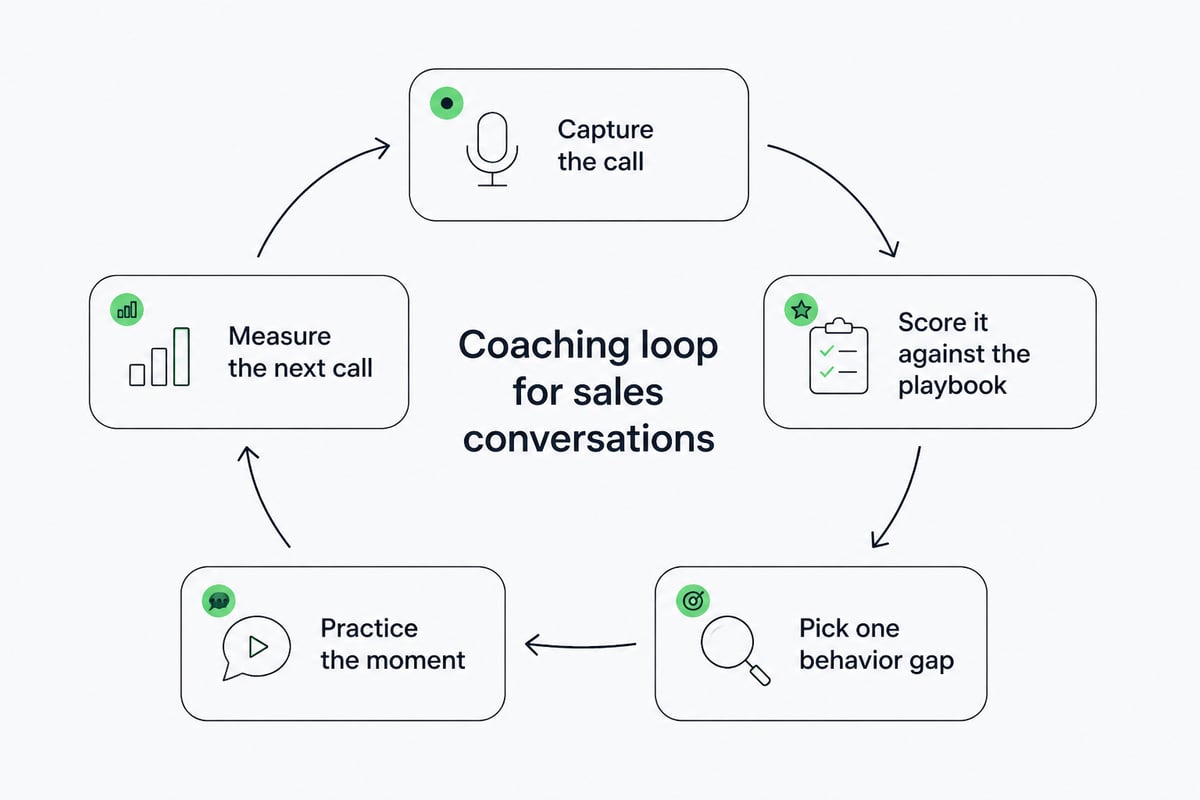
The fastest way to learn how to improve sales conversations is to coach reps on the calls they actually had, one behavior at a time, and then check the next call for change. Generic scripts and one-off training days fade quickly, while feedback tied to a real moment in a real conversation sticks. For owners and managers who cannot listen to every call, the answer is a repeatable system: capture the calls, score them against a clear standard, coach one gap, and measure the result.
This article gives you five ways to do that, and a short list of tools that support each approach.
1. Avoma: Score Calls Against a Consistent Standard
Avoma records, transcribes and summarizes meetings, and its Conversation Intelligence add-on adds AI call scoring and coaching scorecards. Pricing starts at $19 per recorder seat per month on the Startup plan with annual billing, and the Conversation Intelligence add-on is $29 per seat per month.
Best use: smaller teams that want meeting notes, call scoring and scorecards at published per-seat prices. A manager who sits in on two calls a week can use scorecards to see patterns across the other twenty.
Verdict: a practical way to turn recordings into a consistent score without a custom contract.
2. tl;dv: Recording-First Coaching on a Small Budget
tl;dv provides meeting recording, transcripts, AI summaries and coaching features. The Pro plan runs $18 per user per month on annual billing, and a free plan is available.
Best use: small and midsize teams that want to start capturing calls before investing in a heavier system. The free plan lets you build the recording habit, which is the prerequisite for every coaching method below.
Verdict: an affordable starting point when the first goal is simply to have the calls on file.
3. Dialpad: Coaching Inside the Calling Platform
Dialpad captures calls natively and offers real-time transcription, AI summaries and conversation scorecards within the phone system itself. The Connect Standard plan starts at $15 per user per month with annual billing.
Best use: teams that already make most of their sales calls by phone and want coaching built into the tool reps use all day. Because capture is native, there is no separate recorder to remember.
Verdict: a sensible fit when the phone system is the center of your sales activity.
4. Jiminny: Coaching-Focused Conversation Intelligence
Jiminny is a conversation intelligence platform with post-call coaching and an EU-hosted option. Pricing is not publicly listed, and a 14-day free trial is available.
Best use: mid-market B2B teams that want a coaching-centered review process and have a manager or enablement lead to run it. The EU hosting option matters for teams with data residency requirements.
Verdict: a coaching-oriented platform suited to teams with a dedicated person reviewing calls.
5. Bizware AI Sales Coach: One Behavior Gap, One Measurable Next Call
Bizware AI Sales Coach captures sales calls, scores them, and gives each rep private coaching plus voice or text role-play practice before the next call, with a manager dashboard. Bizware AI Sales Coach starts at $77 per user per month billed annually (Starter). It captures virtual and in-person conversations in one place, scores every call against your own sales playbook, and is built around one behavior gap at a time. Its frameworks are built on established sales methods.
Best use: small owner-led B2B teams where the owner or manager cannot listen to every call and wants each rep coached on a single, measurable change. It also suits consultants who want an ongoing tool to offer clients between engagements. It is not built for teams that only need meeting notes or for large organizations that need forecasting across hundreds of reps.
Verdict: the strongest fit when the goal is consistent coaching and practice, not just recordings.
Comparison of the Tools
| Tool | Approx. price (as of November 2026) | Core strength | Best use |
|---|---|---|---|
| Avoma | $19 per recorder seat, plus $29 per seat for Conversation Intelligence | Call scoring and scorecards | Smaller teams wanting published pricing |
| tl;dv | $18 per user per month (Pro), free plan available | Recording and coaching features | Budget-conscious teams starting to record |
| Dialpad | $15 per user per month (Connect Standard) | Coaching inside the phone system | Phone-centered sales teams |
| Jiminny | Not publicly listed, 14-day trial | Post-call coaching, EU hosting | Mid-market teams with a coaching owner |
| Bizware AI Sales Coach | From $77 per user per month (Starter) | Playbook scoring, private coaching, role-play | Small owner-led B2B teams |
The price column deserves a closer reading before you compare totals. Avoma's $19 recorder seat covers recording, transcription and summaries, while scoring and coaching scorecards sit in the $29 Conversation Intelligence add-on, so a team that wants both should budget for the two together. tl;dv's free plan makes it the lowest-risk way to test whether reps will record consistently, and Dialpad's price assumes your reps already work inside its phone system. Jiminny has no published price, so its 14-day free trial is the practical way to get a real number and see whether your team uses its post-call coaching. Bizware's higher per-user price reflects playbook scoring, private coaching and role-play practice in one product.
How to Improve Sales Conversations Step by Step
Tools only help when a method sits behind them, so use this sequence regardless of what you buy.
- Capture every call. You cannot coach what you cannot hear. Record virtual and in-person conversations in one place.
- Define what good looks like. A written sales playbook gives you a standard to score against, so feedback is not based on a manager's mood.
- Choose one behavior. HubSpot recommends recurring weekly or biweekly one-to-one coaching and using one or two specific, observable behaviors as coaching topics. Talk ratio, question quality or next-step commitment are all observable.
- Practice before the next call. Rehearse the exact moment that went wrong, out loud or in text.
- Measure the next call. Define in advance what change you expect to hear, then check for it.
For a deeper look at the coaching cadence itself, see this guide on how to coach sales reps.
What to Coach: The Behaviors That Move Conversations
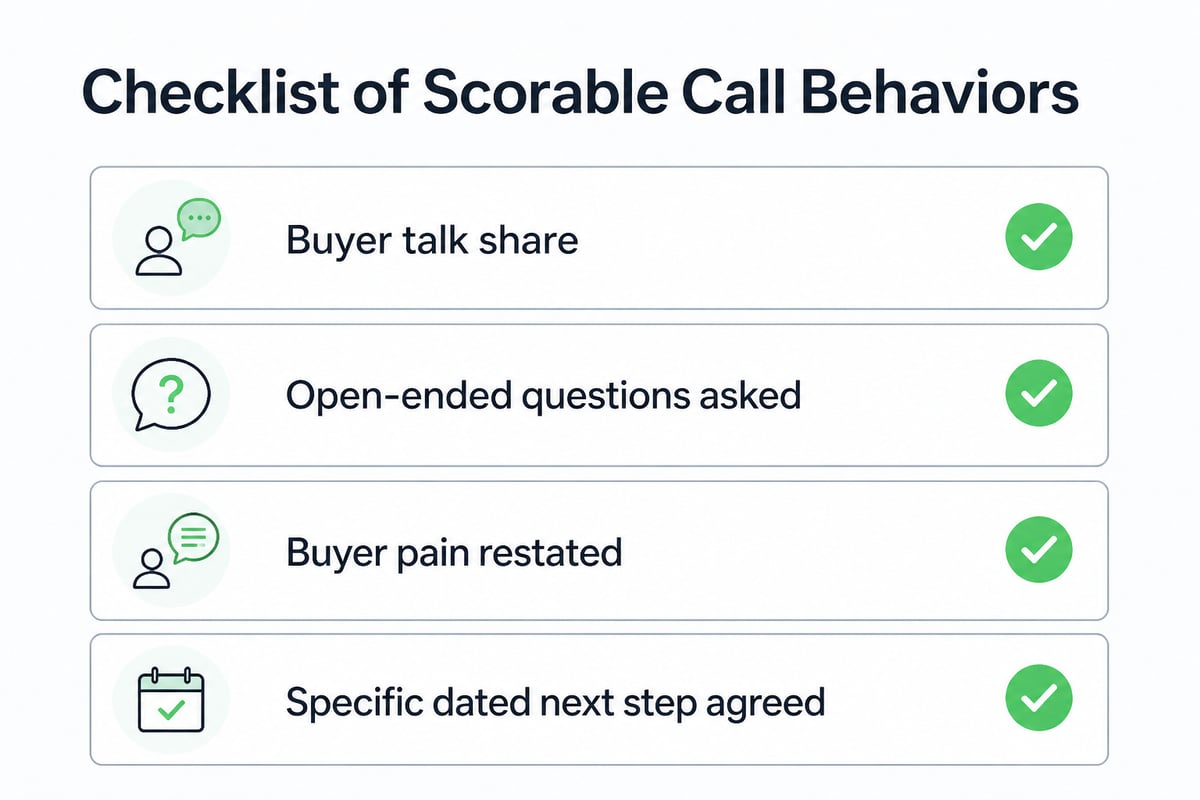
Most improvement comes from a short list of behaviors, and each can be scored from a transcript.
- Listening more than talking. Reps who monologue lose the buyer's real problem. Track the share of call time the buyer speaks.
- Open-ended questions. Questions that start with "how" or "what" surface pain points that yes-or-no questions hide.
- Preparation. HubSpot advises preparing for sales conversations, focusing on buyer pain points, building rapport, discussing value, listening, and keeping the exchange conversational.
- Tying value to the buyer's words. Repeat the buyer's own problem back before you present anything.
- Owning the next step. End every call with a specific, dated commitment from both sides.
If discovery is your weak point, this walkthrough on improving sales discovery calls covers the question patterns in more detail.
Why Practice Matters as Much as Feedback
Feedback tells a rep what to change, but practice is where the change happens. VirtualSpeech reports that most learners in its data scored higher on a second attempt, while many stopped after one attempt. The takeaway for a manager is direct: a single review session is often not enough, and repeated attempts can carry much of the gain.
This is also where a private setting helps. Reps are more willing to try a new approach to an objection when the first rehearsal is not in front of a manager or a buyer. AI role-play for sales lets a rep replay the same difficult moment several times in a day.

What Are Good Conversation Starters?
Good conversation starters are specific, relevant to the buyer and focused on their situation instead of your product. Five that work in B2B settings:
- "What prompted you to take this meeting now?"
- "I noticed your team recently [specific change]. How has that affected [relevant process]?"
- "What does a good outcome look like for you this quarter?"
- "Who else is affected by this problem on your side?"
- "What have you already tried?"
Each one invites the buyer to talk, which is the point of the opening. Sales training firms such as the Brooks Group also stress research, active listening and open-ended questions as the base of effective sales conversations. HubSpot's guidance points the same way: prepare before the call, focus on buyer pain points, build rapport and keep the exchange conversational. In practice, that means spending a few minutes on the second starter before the meeting, since it only works when the bracketed detail is real and drawn from the buyer's own company. After the buyer answers, ask a follow-up that builds on their exact words, such as "What made that the priority?" Starters set the direction, but the follow-up questions are what turn an opening into a discovery conversation, and both are easy to score from a recording.
What Are the Qualities of a Bad Salesperson?
Weak sales conversations tend to share a few traceable habits, and each shows up in a transcript:
- Talking through the discovery stage and pitching early
- Reciting a script instead of responding to what the buyer said
- Asking closed questions that produce one-word answers
- Overstating results or promising what the team cannot deliver
- Ending calls without a defined next step
These are behaviors, not character flaws, which means they can be coached once someone can hear them. Each one also leaves a measurable signature. Early pitching appears as a rep's talk time climbing before the buyer has described a problem. Script recitation shows up when the rep's answer ignores the buyer's last sentence. Closed questions are easy to count in a transcript, since they usually begin with "do," "are," or "is." A missing next step is the simplest of all: the call ends without a date, an owner, or a named action. A manager who checks one of these markers per call can see within a week which habit belongs to which rep, then pick a single one to coach.
FAQ
What is the 2-2-2 rule in sales?
The 2-2-2 rule is a follow-up cadence in which a rep contacts a new customer or prospect two days, two weeks and two months after a key interaction. It is meant to keep the relationship warm without crowding the buyer. Treat it as a follow-up habit rather than a conversation technique.
How can I better my sales results quickly?
Pick one measurable behavior, such as asking more open-ended questions, and coach it across your team for two to three weeks. Review a few recorded calls per rep, agree on the change, and check the next call. Small, specific changes compound faster than broad training.
How do I coach reps when I cannot hear every call?
Capture every call and use scoring against your playbook to flag the calls and moments that need your attention. Reviewing the flagged moments takes minutes instead of hours. This is the problem call scoring tools exist to solve, and the call scoring software overview explains what to look for.
Start this week by recording your next five sales calls and scoring each one against a single behavior, such as how much of the call the buyer spoke. If you want that process handled for every rep without listening to every call, Bizware AI Sales Coach captures your calls, scores them against your own playbook and coaches each rep on one gap at a time. Schedule a free demo with Ryan Cook to see how it would work on your team's real conversations.