

To improve sales follow-up, respond fast, space your touches three to four days apart, make every message add something new, and set a stopping rule before you start. Prospects rarely resent follow-up itself. They resent follow-up that repeats the same ask, ignores what was said on the call, or never ends.
For owners and sales managers of small B2B teams, the harder problem is consistency. You cannot listen to every call, so you cannot see whether each rep leaves a call with a clear next step or just a vague "I'll circle back." This guide walks through a follow-up process you can put in place this week, in the order you would build it.
What You Need Before You Start
You need four things in place before changing a single email template.
- A record of what was said on each call. Follow-up quality depends on call detail: the prospect's stated problem, timeline, and stakeholders.
- A defined sales playbook. Even a one-page version that states what a good next step looks like at each stage.
- A CRM or task list where every open opportunity has a dated next action.
- Agreement on who owns follow-up at each stage, so nothing sits between a rep and a manager.
If you have not written your playbook yet, how to build a sales playbook covers the starting structure.
Step 1: Audit Your Current Follow-Up Gaps
Start by finding where follow-up actually breaks down, because most teams guess wrong. Pull the last 30 to 60 days of opportunities and sort them by where they stalled: after the first call, after the demo, after the proposal, or after the close.
For each stalled deal, check four facts:
- How long did the rep wait before the first follow-up?
- How many touches happened in total?
- Did the touches reference something specific from the conversation?
- Was a next step agreed and dated before the call ended?
The timing question matters more than most managers expect. A 2024 test of demo requests sent to 1,000 B2B SaaS companies found that most never responded, and among those that did, the average first response took more than a day. If your team is replying within hours, you already have an edge over a large share of the market.
Record your findings in a simple table: stage, average response time, average touches, and percentage of deals with a dated next step. This becomes your baseline.
Step 2: Set a Response-Time Standard
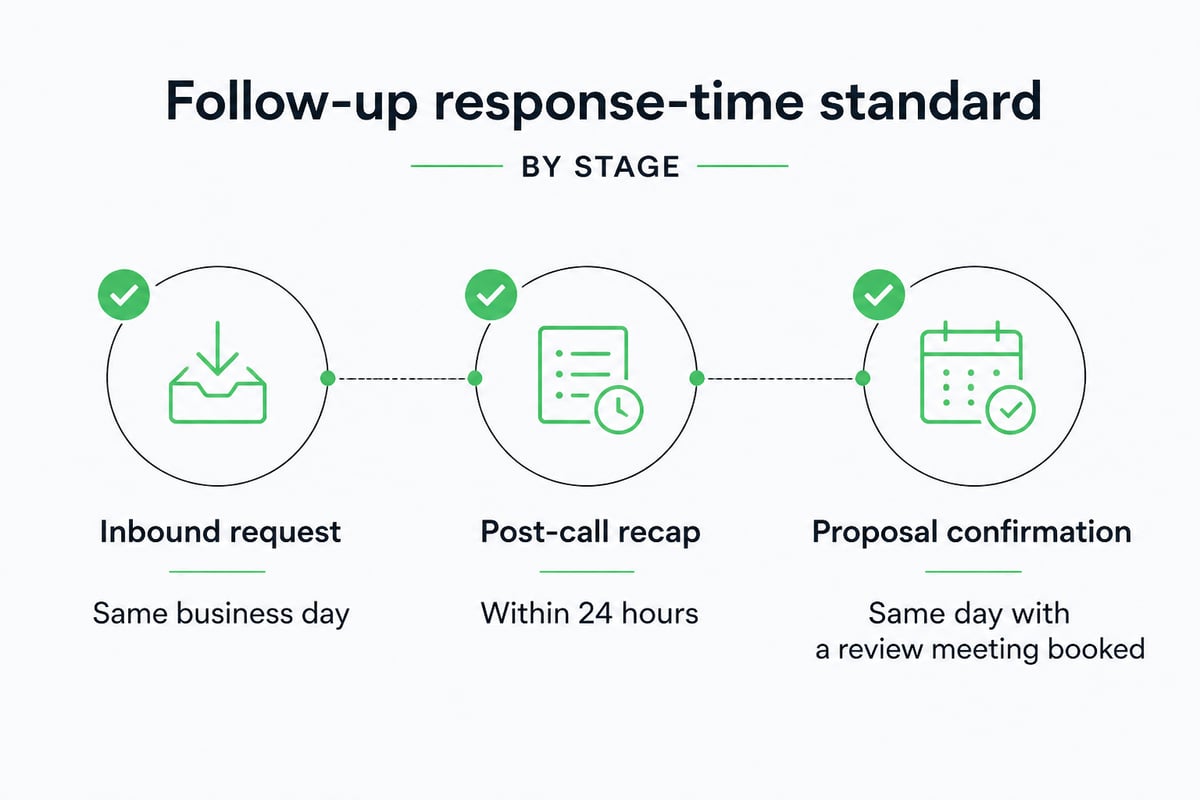
A response-time standard turns "follow up quickly" into a rule a rep can be held to. Set one number for inbound leads and one for post-meeting follow-up, then measure against them.
An analysis of 10 million email threads reported that reps who followed up within a day of first outreach earned a higher average reply rate than those who waited longer. That figure comes from one dataset and your own numbers will differ, but the direction is clear: speed correlates with replies.
A workable starting standard for a small team:
- Inbound requests: reply the same business day.
- After a discovery call or demo: send a recap within 24 hours.
- After a proposal: confirm receipt the same day and book a review conversation.
Speed alone does not make a follow-up good. A fast message that says "just checking in" still annoys. The next steps address what the message should contain.
Step 3: Agree on the Next Step Before the Call Ends
The most effective follow-up begins during the call, when the rep and prospect agree on a specific next action with a date and a name attached. "Let me send you something" is not a next step. "I'll send the pricing summary today, and you'll share it with your finance lead before we meet Thursday at 2:00" is.
This single habit changes the nature of every message that follows. Your follow-up is no longer a request for attention. It is a reminder of a commitment the prospect already made.
Coach reps to close each call with three elements:
- What happens next (the action itself)
- Who owns it (rep or prospect)
- When it happens (a calendar date, not "next week")
This is a coachable behavior, and it is easy to score. Review a sample of calls each week and mark yes or no: did the rep secure a dated next step? Teams that track this one behavior for a month usually find it varies widely between reps. For a broader look at the conversation itself, see how to improve sales conversations.
Step 4: Build a Cadence With Spacing and a Stopping Rule
A good cadence has a fixed number of touches, deliberate spacing, and an end point. Sources differ on the exact count, which tells you there is no universal answer.
| Source | Suggested cadence |
|---|---|
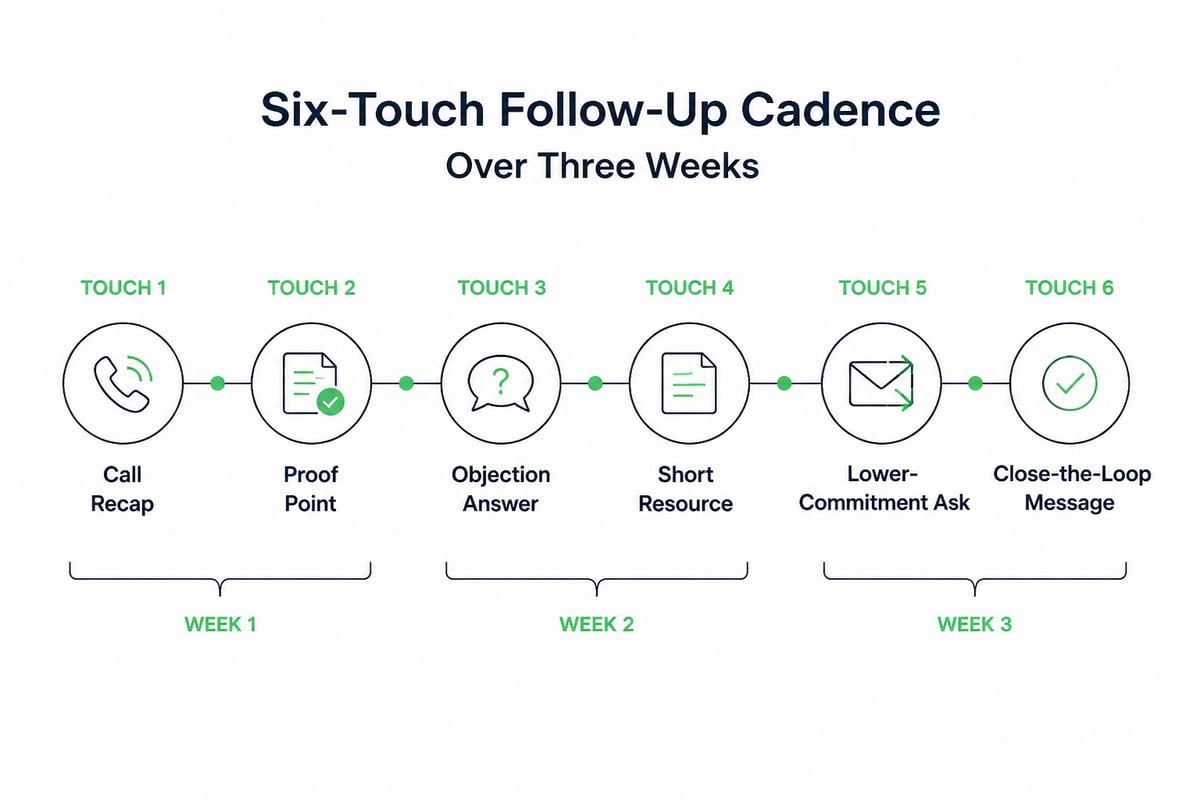
| Nerdy Joe (10M email threads) | Six touches over roughly three weeks, spaced about three to four days apart |
| HubSpot | Five to eight touches over two to three weeks as a starting point |
| Revenue Grid | Eight to twelve touches over two to four weeks across channels |
For a small team with limited rep time, six to eight touches over three weeks is a reasonable default. Start there, then adjust using your own reply and unsubscribe data.
The part owners tend to leave undefined is the stopping rule. HubSpot's guidance recommends setting one, respecting opt-outs, and reviewing conversion and negative-response data to refine the cadence. A stopping rule might read: "After six touches with no reply, send a final close-the-loop message, move the contact to a quarterly check-in list, and stop active outreach."
That final message does real work. A short, honest note ("I'll assume the timing isn't right and will check back in the fall") often draws a reply from prospects who were interested but busy.
Step 5: Make Every Touch Add Something New
Every follow-up should give the prospect a reason to read it that the previous message did not. The test is simple: if you deleted the greeting and signature, would the message still contain new information?
Rotate through value types across your cadence:
- A recap of their stated priority, in their own words from the call
- A relevant proof point, such as a result from a similar-sized company
- A direct answer to an objection they raised
- A short resource tied to a problem they named
- A lower-commitment ask, such as a 15-minute call with just the person who owns the budget
This is where call capture pays off. A rep who remembers only the general mood of a call writes generic messages. A rep working from the actual transcript can quote the prospect's timeline, name the competitor they mentioned, and address the exact concern that came up at minute 22.
HubSpot's guidance makes the same point: each follow-up should add context or value. If a touch cannot, skip it rather than send filler.
Step 6: Use More Than One Channel, With Restraint
Mixing channels widens your chances of being seen, but the mix should feel like one coherent conversation. A typical pattern for a B2B rep is email as the base channel, a phone call or voicemail at the midpoint, and a LinkedIn note near the end.
Keep two guardrails in place:
- Do not send the same message on every channel at once. A voicemail, email, and LinkedIn message arriving within an hour feels like pressure, not persistence.
- Match the channel to the stage. Early post-call recaps belong in email where the prospect can forward them. Proposal discussions often work better by phone.
Where a prospect has replied on a particular channel, stay on it. If someone answers by email, do not escalate to calls without a reason.

Step 7: Multithread Beyond Your Single Contact
Follow-up that depends on one person fails when that person goes quiet, changes jobs, or lacks authority. Use the discovery call to identify who else is involved in the decision, then ask your champion for an introduction.
A short, low-pressure way to do it: "Who else should see this before a decision is made? I'm happy to send a one-page summary you can forward." Then follow up with that second contact only after your champion has agreed.
For small owner-led teams, multithreading often means reaching the person who signs, not just the person who evaluates. Reps tend to avoid that conversation, so make it an explicit item on your call scorecard.
Step 8: Score and Coach the Follow-Up Behaviors
Follow-up improves when you coach it as a set of observable behaviors, one at a time. This is the step that makes the earlier ones stick, because a process nobody reviews drifts back to habit within weeks.
Pick the single biggest gap from your audit and build one coaching focus around it. For example:
- Gap: reps end calls without a dated next step.
- Playbook standard: every call ends with an action, an owner, and a date.
- Practice: the rep rehearses the closing minute of a call with a manager or in role-play.
- Measurable next call: the manager checks the very next recorded call for a dated next step.
Working on one behavior at a time keeps coaching specific and makes progress easy to verify. For approaches to structuring this, see how to coach sales reps and sales roleplay exercises.
If you cannot listen to every call yourself, a tool can do the capture and scoring. Bizware AI Sales Coach records sales conversations, scores each call against your playbook, and gives each rep private coaching and voice or text role-play practice before the next call, with a manager dashboard showing where each rep stands. That lets you check follow-up behaviors across the whole team without sitting through every recording.
Step 9: Review the Numbers and Adjust Monthly
A monthly review keeps your cadence honest by showing what is working and what is generating friction. Track a short list of metrics:
- Reply rate by touch number (which touch earns the most responses)
- Percentage of deals with a dated next step at the end of each call
- Average time from call to first follow-up
- Negative replies and opt-outs per cadence
- Stage-to-stage conversion after follow-up changes
If touch four earns almost no replies while touch two and six do well, shorten the sequence or replace the weak touch. If opt-outs climb, you are sending too often or sending messages without new content. Use the data to change one variable at a time so you can see what caused the difference. More on tracking in sales performance metrics.
Common Mistakes and Troubleshooting
Most follow-up problems trace back to a short list of causes.
"Just checking in" messages. They add nothing and train prospects to ignore you. Replace each with a recap, a proof point, or a specific question.
No stopping rule. Without one, reps either give up silently or keep sending until the prospect complains. Write the rule down and apply it to everyone.
Following up on a vague next step. If the call ended with "I'll send some info," your follow-up has nothing to anchor to. Fix it at the call, not in the email.
Identical cadences for every deal. A $5,000 renewal and a $60,000 new account need different intensity. Let deal size and stage set the number and type of touches.
Fast but generic replies. Speed helps only when the message reflects the conversation. If replies are quick but conversion is flat, the issue is content, so review transcripts against what was actually sent.
Treating a silent prospect as a lost deal too early. Silence often means the project slipped, not that interest ended. Use the close-the-loop message and a quarterly check-in list before writing the deal off. For help spotting what you are leaving behind, read how to identify missed sales opportunities.
Skipping the weekly call sample. If no one reviews calls, next-step discipline erodes. Even five reviewed calls per rep per month reveals the pattern.
FAQ
Why is follow-up important in the sales process?
Most deals do not close on the first conversation, so follow-up carries the opportunity from interest to decision. It keeps your offer connected to the prospect's priorities while their attention is split across other projects. Without it, qualified opportunities stall for reasons that have nothing to do with fit.
How do you follow up with a lead?
Reply promptly, reference something specific the lead said, and propose one clear next step with a date. Keep the message short and add something new each time, such as a relevant result or an answer to a concern they raised. Space touches three to four days apart and end the sequence with a polite close-the-loop message.
What is the 2-2-2 rule in sales?
Sources describe it in different ways, and it is not a single standardized rule. It generally refers to a rhythm of follow-up touches at fixed intervals, such as two days, two weeks, and two months after contact. Treat it as a starting framework and adjust it using your own reply and conversion data.
Pull your last 30 days of stalled deals this week and check which ones ended a call without a dated next step. That one list will show you where your follow-up needs coaching first. If you want every call captured, scored against your playbook, and turned into private coaching for each rep, Bizware AI Sales Coach was built for small owner-led teams like yours, and you can schedule a free demo with Ryan Cook to see how it would run on your own calls.