
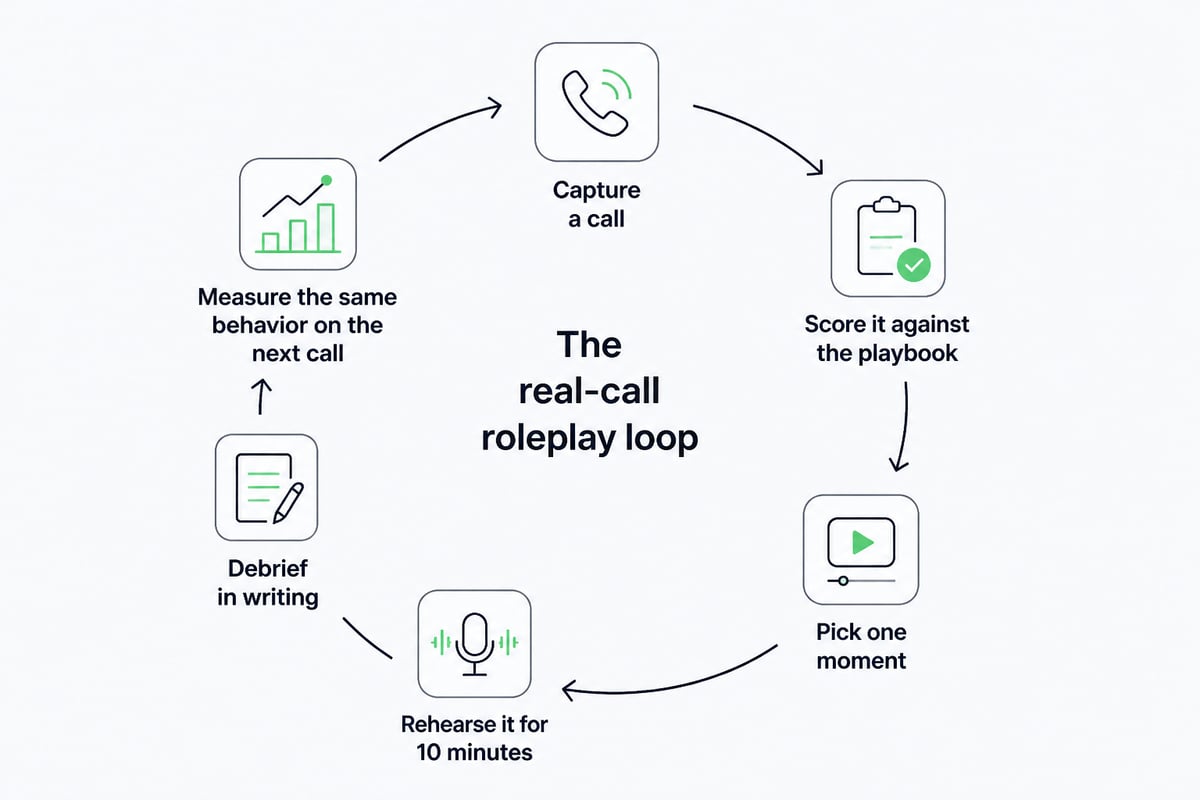
The most effective sales roleplay exercises are short, repeatable rehearsals built from moments in your reps' real calls, followed by a brief debrief and a specific behavior to try on the next call. Invented scenarios and "sell me this pen" drills have their place as warm-ups, but owner-led teams get far more from practicing the exact objection, silence or missed question that cost them a deal last week.
That approach solves a practical problem. If you run a small B2B team, you cannot listen to every call, and you probably do not have a full-time enablement person to write scenarios. This guide covers what roleplay is for, which exercises work, how to build them from real calls, how to debrief, and how to keep the habit alive without consuming your calendar.
What are sales roleplay exercises supposed to accomplish?
Sales roleplay exercises exist to change what a rep does on the next live call, not to produce a polished performance in a training room. A good exercise isolates one behavior, lets the rep attempt it under mild pressure, and ends with feedback specific enough to act on.
That purpose shapes everything else. A rehearsal that feels impressive but targets nothing in particular will not move your close rate. A rehearsal that targets a single gap, such as "reps skip the budget question when the buyer sounds enthusiastic," gives you something to measure on the following call.
Keep three outcomes in mind when you design any exercise:
- Behavior change: the rep does something different in a real conversation within days.
- Confidence: the rep has already heard the hard objection once, out loud, before a buyer raises it.
- Consistency: every rep handles the same recurring moments in a way that matches your playbook.
The last point matters most for owner-led teams. When the founder closes most deals, the founder's instincts are the real playbook, and roleplay is the fastest way to transfer them. If your written process is thin, start by building a sales playbook so there is a standard to rehearse against.
Why do real calls make better roleplay material than scripts?
Real calls make better material because they contain the exact words, tone and hesitations your buyers use, which no generic scenario can reproduce. Reps also take the feedback more seriously when the scenario is something that actually happened to them.
HubSpot's coaching guidance recommends building roleplay into coaching and drawing situations from real calls, then debriefing on what happened and what to practice next. The same logic applies to objections: HubSpot's sales-training guidance suggests collecting objections heard from customers and having reps develop responses, individually or in groups.
Scripted scenarios have a second weakness. Reps know they are artificial, so they perform instead of problem-solving. A scenario lifted from a call two weeks ago removes that distance. The rep remembers the buyer, remembers freezing or rambling, and wants a better answer.
There is a practical constraint, though. Pulling the right moment from a recording means someone has to listen to it. For a manager with a full pipeline of their own, that is the step that usually stops the program. Call capture and scoring tools reduce that burden by surfacing the moments that departed from your playbook, so you are not scrubbing through an hour of audio to find ninety seconds.
Which sales roleplay exercises work best for small B2B teams?
Five formats cover most of what a small team needs: the objection replay, the discovery stall, the silent-buyer drill, the pricing pressure round and the stalled-deal revival. Each takes ten to fifteen minutes and needs only two people.
1. The objection replay
Take a real objection from a recent call, give the rep the buyer's exact words, and have them respond live. Run it twice: once cold, once after a short coaching tip. The comparison between attempt one and attempt two shows the rep what improvement feels like. For deeper technique on this format, see how to handle sales objections.
2. The discovery stall
Start the rehearsal at the point in a real discovery call where the conversation went shallow. The partner plays a buyer who gives vague answers, and the rep has to ask the follow-up they skipped. This exercise fits teams whose reps jump to a demo too early. It pairs well with the techniques in this guide to improving sales discovery calls.
3. The silent-buyer drill
The partner answers every question with one short sentence and then stops talking. The rep practices tolerating silence and asking an open follow-up instead of filling the gap. Reps who over-talk on calls often discover, in this drill, how uncomfortable three seconds of quiet feels.
4. The pricing pressure round
The partner pushes back on price in the way a real prospect did: comparing to a cheaper vendor, asking for a discount before seeing value, or saying the budget is frozen. The rep's goal is to reconnect price to the problem the buyer described earlier, not to concede.
5. The stalled-deal revival
HubSpot's role-play guidance recommends practicing scenarios such as stalled deals, common objections and customers who have already researched the product. Pick a deal that went quiet, and have the rep rehearse the follow-up call or voicemail that would restart it.
Use these formats as templates, then swap in your own call moments. A general-purpose objection will teach less than the specific one your buyers raised in the last thirty days.
How do you build a roleplay exercise from a real call?
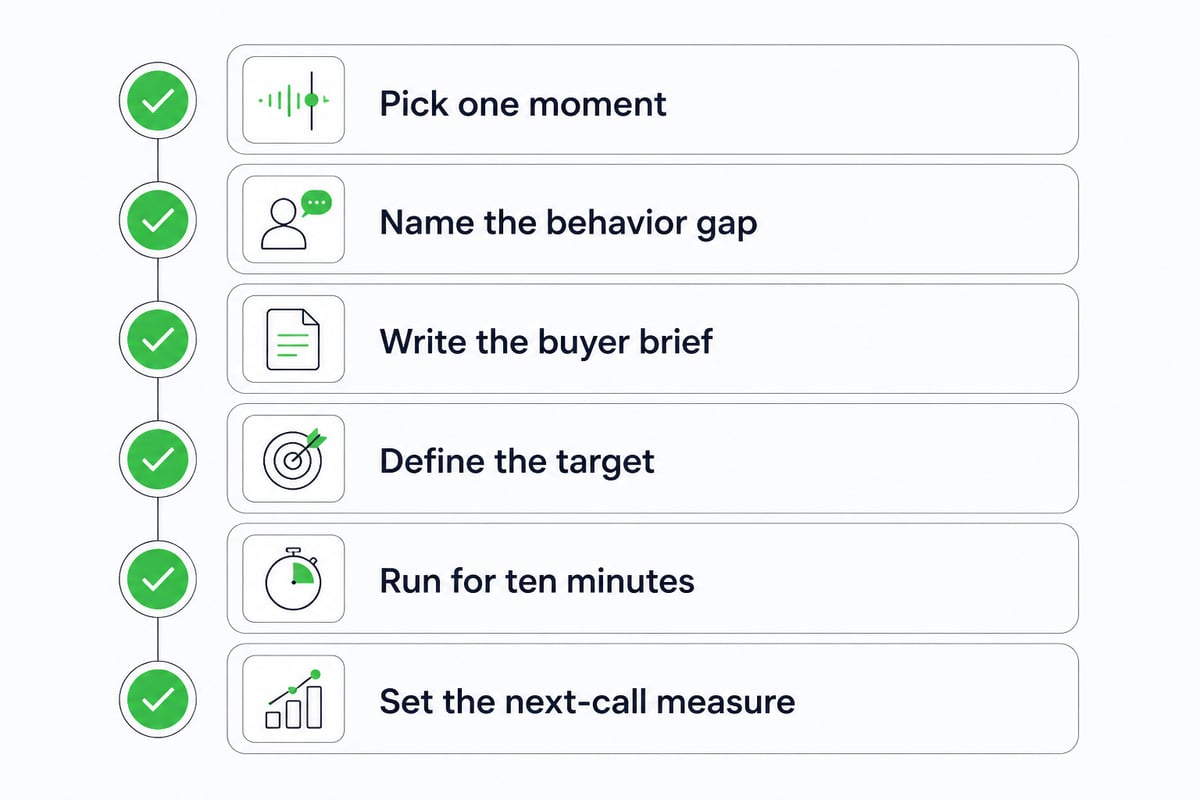
You build one by choosing a single moment from a recent call, writing a short brief for the "buyer," and defining what a good response looks like before anyone starts. The whole preparation takes about five minutes once you have the call in front of you.
Follow these steps:
- Pick one moment. Choose a 30 to 90 second segment where the rep lost control, missed a question or gave a weak answer. One moment per exercise keeps the feedback focused.
- Name the behavior gap. Write it as an observable action: "did not ask what happens if the problem goes unsolved," not "needs better discovery."
- Write the buyer brief. Give the partner the buyer's role, mood, the exact line they said and what they would respond to if handled well.
- Define the target. State the one thing the rep should do differently, for example, "ask one follow-up before offering a solution."
- Run it. Ten minutes is enough. Stop early if the rep nails it.
- Set the next-call measure. Agree on what you will listen for on the next real call.
That last step is what separates practice from entertainment. Without a measurable next call, you cannot tell whether the exercise changed anything. Focusing each coaching cycle on one behavior at a time, rather than a list of five, is also why feedback tends to stick.
How should you run the debrief?
A good debrief takes about five minutes, starts with the rep's own assessment and ends with one written commitment for the next call. HubSpot's guidance suggests pairing a 10-minute roleplay with a five-minute written debrief, and the written part is worth keeping because it creates a record you can check later.
Use this sequence:
- Rep first. Ask what they thought worked and what felt weak. Reps often identify their own gap accurately, and self-diagnosis builds ownership.
- Partner second. The person playing the buyer reports how the response felt from the other side: where they felt heard, where they felt rushed.
- Manager last. Add one observation tied to the target behavior. Resist the urge to list everything you noticed.
- Write the commitment. One sentence: "On my next discovery call, I will ask a follow-up after every first answer."
Avoid grading the rep on a scale. Scores invite defensiveness, and the point of the debrief is a plan. If your team needs a consistent scoring standard for real calls, a framework like the one in this overview of sales call scoring software shows how teams turn playbook criteria into repeatable measures.
What does a weekly cadence look like for a team without a trainer?
A sustainable cadence for a small team is one 15-minute roleplay per rep per week, tied to the behavior gap from that rep's most recent calls. That adds up to roughly an hour of manager time for a four-person team, which most owners can protect.
Here is one way to structure the week:
| Day | Activity | Time |
|---|---|---|
| Monday | Review one call per rep, choose the moment and gap | 30 minutes total |
| Tuesday or Wednesday | Run one roleplay per rep with a debrief | 15 minutes each |
| Thursday | Reps apply the target behavior on live calls | Normal calls |
| Friday | Check one call per rep for the committed behavior | 20 minutes total |
Pairing reps with each other on alternate weeks reduces the load on the manager and gives reps the experience of playing the buyer, which sharpens their listening. Keep the manager in the room at least every other session so the feedback stays aligned with your standard.
Consistency beats intensity. A quarterly all-day workshop produces a burst of enthusiasm and little retention. A short weekly rehearsal tied to real calls compounds. For more on structuring this, see these sales coaching best practices and this overview of how to coach sales reps.

Where does AI fit into sales roleplay practice?
AI fits in two places: finding the right moments in real calls, and giving reps a private partner to rehearse with between coaching sessions. Both address the capacity problem that keeps small teams from practicing regularly.
Adoption is already common. A 2024 Salesforce survey, as summarized by CareerTrainer, found that more than half of sales professionals used AI to practice or prepare for customer conversations. The same summary reports that a clear majority of sales managers said AI could reduce the time needed to prepare for coaching sessions. For a manager who spends Sunday evenings listening to calls, that preparation time is the real cost of coaching.
Evidence on outcomes is still developing, and most of it comes from larger organizations. A 2025 Highspot article reports that enterprise B2B teams using AI in sales coaching programs were more likely to improve revenue outcomes, citing the 2025 State of Sales Enablement Report. Treat that as directional: your results depend on whether the practice targets real gaps.
Private practice has a particular advantage for reps. Many people will not rehearse a clumsy objection response in front of the boss or a peer, but they will repeat it five times with an AI partner until it sounds natural. The manager then sees the improvement on the next live call rather than watching the awkward first attempts.
Bizware AI Sales Coach is built for this workflow. It captures sales calls, scores them against your own playbook, and gives each rep private voice or text roleplay on moments from their real calls, with one behavior gap targeted at a time and a measurable next call. A manager dashboard keeps you informed without requiring you to hear every conversation. You can read more about AI sales roleplay or visit the Bizware AI Sales Coach page for product details.
What mistakes weaken roleplay exercises?
Most failed roleplay programs share the same few errors: practicing too many things at once, choosing scenarios no buyer would raise, letting the exercise run too long, and skipping the follow-up on the real call.
Watch for these:
- Too many targets. Coaching three behaviors in one session means none of them stick. Pick one.
- Unrealistic buyers. A partner who is either hostile or endlessly agreeable teaches nothing. Base the buyer's behavior on the recorded call.
- Performance pressure. If reps feel judged in front of colleagues, they play safe. Start in pairs and keep early sessions private.
- No standard. Without a defined good response, feedback becomes opinion. Tie the exercise to your playbook.
- No follow-through. If nobody checks the next call, reps conclude that practice does not matter.
- Overreliance on gimmicks. The "sell me this pen" exercise is a fine icebreaker, but it does not resemble a B2B conversation with a buyer who has a budget cycle and a committee.
For consultants who advise B2B teams, the follow-through step is where an ongoing service adds value. A one-off workshop fades, while a recurring cycle of call review, targeted practice and next-call measurement gives the client visible progress month over month. If you are building that kind of offer, this overview of sales coaching for small businesses is a useful reference point.
How do you know the exercises are working?
You know they are working when the targeted behavior appears more often on real calls and the related deal metric moves over several weeks. Track the behavior first, because it changes faster than revenue.
Use a simple three-layer check:
- Behavior frequency. Out of the last ten calls, how many show the committed behavior? Move from three to seven and you have evidence of change.
- Stage conversion. If the gap was in discovery, watch the rate of calls that advance to a demo or proposal. If it was in pricing, watch discount requests and proposal-to-close.
- Rep consistency. Compare reps against each other. Narrowing the gap between your strongest and weakest rep on a given behavior is a sign the playbook is spreading.
Give it a fair window. One week of data is noise; four to six weeks of targeted practice on a single behavior is a reasonable test. If a behavior does not shift after that, the gap description was probably too vague, so rewrite it as a more specific observable action and run another cycle. Teams that want a broader view of what to track can use these sales performance metrics as a starting list.
Pick one recent call from your most inconsistent rep this week, choose a single 60-second moment, and run a ten-minute roleplay on it with a written debrief. If you want that cycle to run without you hand-picking moments from recordings, Ryan Cook builds Sales AI systems for small owner-led B2B teams, and the Bizware AI Sales Coach captures calls, scores them against your playbook and gives each rep private practice on one behavior gap at a time. You can see how that would work with your own calls when you schedule a free demo with Ryan Cook.