
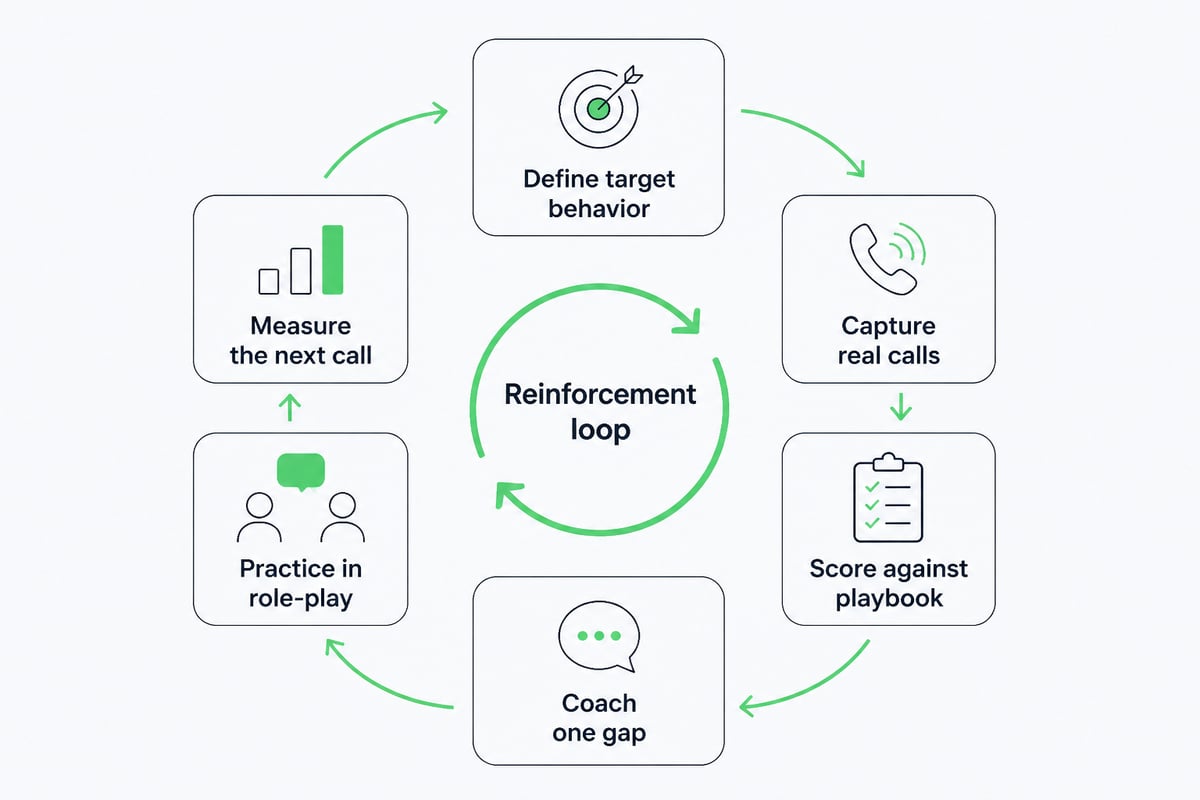
The way to reinforce sales training is to tie every new skill to a specific behavior, measure that behavior on real sales calls, and coach it one gap at a time until it shows up consistently. A workshop transfers knowledge, but only repeated practice and feedback on live conversations turn that knowledge into habit. Without that follow-through, most of what reps learned fades within weeks.
For owners and managers of small B2B teams, the challenge is practical. You cannot sit in on every call, and you likely have no enablement department to run reinforcement programs. This guide gives you a workable system you can run with the people and time you have.
What You Need Before You Start
Reinforcement works only when a few basics are in place first. Gather these before you build your plan:
- A written sales playbook. Even a short one that defines your discovery questions, objection responses, and next-step commitments gives you something to measure against. If you do not have one yet, how to build a sales playbook covers the starting point.
- Access to real calls. Recordings or transcripts of virtual and in-person conversations are the raw material for every step that follows.
- A defined list of trained behaviors. Write down the three to five specific actions the training was meant to change, such as asking a budget question or confirming a mutual next step.
- A baseline. A quick review of recent calls before the workshop, or in the first week after, shows where each rep stands today.
- Thirty to sixty minutes per rep per week. That is the realistic time budget for coaching and practice.
Why Training Fades and What Reinforcement Changes
Training fades because reps return to a full pipeline with no structured reason to practice new behaviors, and old habits are faster under pressure. Reinforcement replaces that drift with a repeating cycle of practice, observation, and feedback.
Research supports the pattern. A study of sales professionals from RAIN Group and Allego found that organizations with highly effective sales training offered more reinforcement activities, more online coaching, and more role-play and simulation than organizations with less effective training. The same study identified regular mentorship and coaching, skills assessments, and effective onboarding as predictors of effective sales training.
The takeaway for a small team is that the workshop itself is the smaller part of the investment. The weeks after it determine whether the spending pays off.
Step 1: Translate the Training Into Observable Behaviors
Start by converting each training topic into a behavior you could see or hear on a call. A topic like "better discovery" is too vague to coach. A behavior like "asks at least two follow-up questions about the prospect's current process before presenting" can be checked in minutes.
For each behavior, write a one-line definition and an example of what good sounds like. Keep the list short. A team that tries to reinforce twelve behaviors at once reinforces none of them.
A useful test: if two managers listened to the same call, would they agree on whether the behavior happened? If not, tighten the definition.
Step 2: Capture Real Conversations in One Place
You cannot reinforce what you cannot see, so collect every sales conversation where the trained behaviors might appear. That includes video calls, phone calls, and in-person meetings, not only the ones that are easy to record.
Many owner-led teams only review calls when a deal goes wrong, which creates a skewed sample. Capturing every conversation lets you see typical performance, not just the memorable failures. For deeper background on the practice, see this overview of sales call recording and analysis.
Step 3: Score Calls Against Your Playbook
Score each call against the behaviors you defined, using your own playbook as the standard. A simple scorecard with yes, partial, or no for each behavior is enough to start. The point is consistency: every rep is measured against the same criteria, and the scores are comparable week to week.
Manual scoring works for a handful of calls, but it breaks down as volume grows. If you manage several reps, scoring every call by hand is rarely sustainable, which is why teams often move to automated scoring. Your scores then reveal patterns, such as one rep who skips next-step commitments and another who rushes through discovery. The article on sales call scoring and behavior gaps explains how to read those patterns.
Step 4: Coach One Behavior Gap at a Time
Pick the single largest gap for each rep and coach only that until it closes. A rep handed five improvement areas will usually work on none of them, while a rep handed one clear target can act on it the same day.
A reliable coaching conversation has four parts:
- Play a short clip or read a transcript excerpt where the gap appeared.
- Ask the rep what they noticed before you offer your view.
- Agree on the specific alternative behavior to try.
- Set a measurable target for the next call, such as "ask the budget question on your two calls this week."
That last part matters most. A measurable next call turns coaching from a conversation into a commitment you can verify. For more on structuring these sessions, see how to coach sales reps.
Step 5: Add Role-Play Between Real Calls
Role-play gives reps a place to rehearse the exact moment they struggled with before they face a live prospect again. Real calls come only a few times a week, so practice fills the gaps between them.
The most effective role-play is built from real calls rather than generic scenarios. If a rep stumbled on a pricing objection last Tuesday, rehearse that objection, in the voice and context of the prospect who raised it. Short, frequent sessions of ten to fifteen minutes beat a single long session.
Manager-led role-play takes scheduling time that small teams rarely have. Voice or text practice that a rep can run privately, on their own schedule, removes that bottleneck and lowers the discomfort some reps feel practicing in front of a boss. More formats are covered in sales role-play exercises.

Step 6: Build a Weekly Rhythm
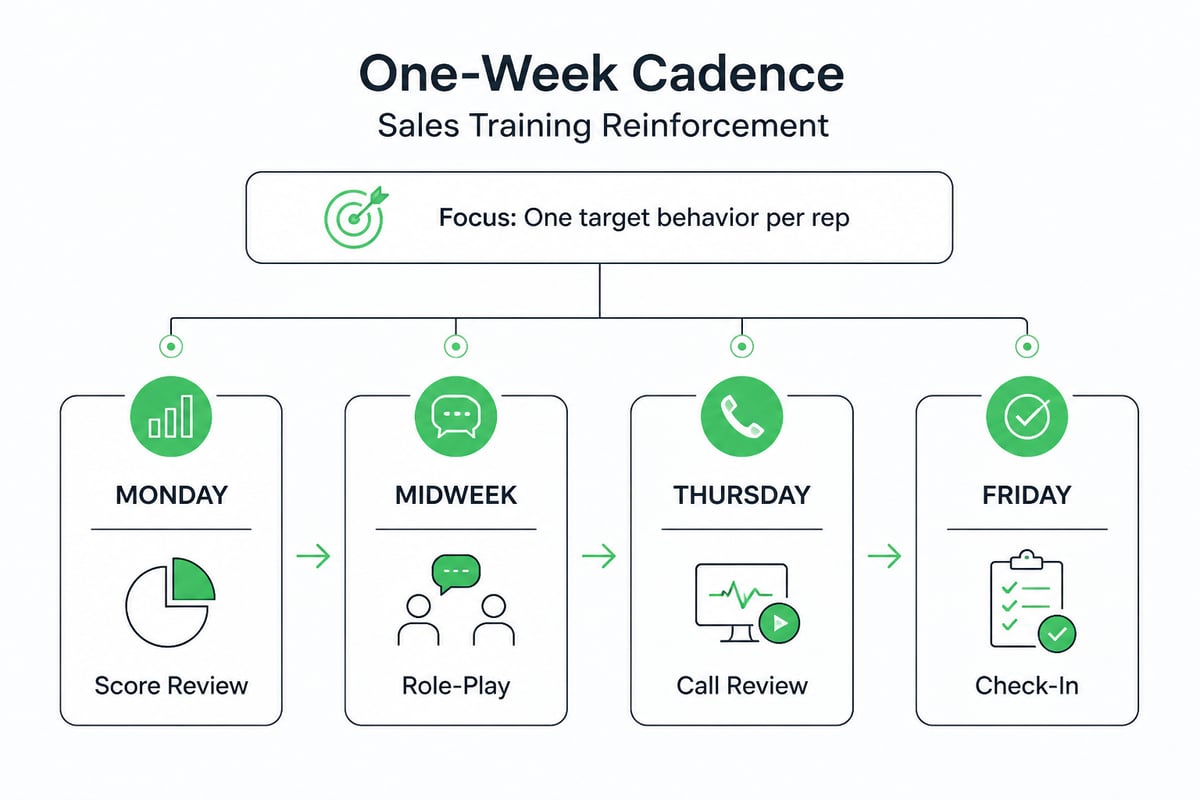
A fixed weekly cadence is what makes reinforcement a habit instead of a one-time push. Consistency matters more than intensity.
| Day | Activity | Time per rep |
|---|---|---|
| Monday | Review last week's scores and confirm the one target behavior | 10 minutes |
| Midweek | Rep completes a short role-play on the target behavior | 10 to 15 minutes |
| Thursday | Manager reviews one or two calls for the target behavior | 15 minutes |
| Friday | Brief check-in on progress and next week's target | 10 minutes |
Adjust the days to fit your calendar, but protect the slots. Reinforcement that depends on free time will lose to urgent deals every week.
Step 7: Measure Whether the Behavior Changed
Measure behavior change first and revenue results second. Close rates and deal sizes lag by weeks or months, so they cannot tell you whether this week's coaching worked. Behavior scores can.
Track these indicators for each rep:
- Behavior adoption rate: the share of calls where the target behavior appears.
- Score trend: whether overall playbook adherence is rising over four to six weeks.
- Gap closure time: how many weeks it takes a rep to move from a coached gap to consistent performance.
- Downstream results: conversion from stage to stage once the behaviors are stable.
When behavior scores climb but outcomes do not, the playbook itself may need revision. When neither moves, the coaching target or the practice method needs a rethink. For help choosing numbers, see how to measure sales rep performance.
Step 8: Use Technology to Do What You Cannot
Technology makes reinforcement possible when you cannot listen to every call yourself. Bizware AI Sales Coach captures sales calls, scores them against your playbook, and gives each rep private coaching and voice or text role-play practice before the next call, with a manager dashboard so you can see progress without sitting in on every conversation. It is built around one behavior gap at a time, which mirrors the approach in Step 4.
Consultants who advise B2B sales teams can use the same approach as an ongoing layer after an engagement ends, so the improvements they helped create are less likely to fade once they leave.
Common Mistakes When Reinforcing Sales Training
Most reinforcement efforts fail for predictable reasons. Watch for these:
- Coaching too many things at once. Overloaded reps default to old habits. Limit each rep to one behavior at a time.
- Reviewing only lost deals. This teaches reps to associate coaching with failure and hides what good looks like in your wins.
- Skipping the measurable next call. Feedback without a verifiable target rarely changes behavior.
- Letting the cadence lapse. Two missed weeks often become two missed months. Put the rhythm on the calendar and treat it as fixed.
- Using generic role-play scenarios. Practice detached from real calls feels like theater and transfers poorly.
- Judging success by revenue too early. Revenue lags. Judge the first month by behavior change.
- Making it manager-only. Reps who can practice and review their own calls privately build ownership faster than reps who only hear feedback in meetings.
Troubleshooting: When Reinforcement Stalls
If progress stalls, work through the likely causes in order.
Reps resist review. This usually signals that call review feels punitive. Reframe it by starting with a strength from the call, and by letting reps self-score before you share your view. Private practice also helps because there is no audience.
Scores do not move after three to four weeks. Check whether the target behavior is defined clearly enough. Vague criteria produce flat scores. Also confirm the rep has actually practiced between calls, not only discussed the gap.
One rep improves and others do not. Compare how coaching differs. Often the improving rep has a sharper target or more practice repetitions. Copy that structure for the rest of the team.
You run out of time. Cut the scope, not the cadence. Reinforce fewer behaviors for fewer reps, or reduce manual review by automating scoring so your time goes to the coaching conversation itself. The broader principles in sales coaching best practices can help you prioritize.
The playbook and the training disagree. If reps follow the workshop and score poorly against the playbook, one of them is wrong. Reconcile them before coaching further, or you will send mixed signals.
How Long Reinforcement Should Last
Plan for at least ninety days of structured reinforcement after any workshop, then move into a lighter ongoing rhythm. The first month establishes the habit, the second consolidates it, and the third confirms it holds without constant attention.
After ninety days, reinforcement should not stop. It should shrink to a sustainable maintenance level: a periodic scorecard review, a new target behavior when the last one stabilizes, and a short refresher practice before major selling seasons. Teams that treat reinforcement as a continuous practice keep gaining, while teams that treat it as a project tend to slide back.
Your next step is to pick one behavior from your last training, score five recent calls against it, and set a measurable target for each rep's next call. If you want that loop to run without you listening to every conversation, Ryan Cook can help you capture calls, score them against your playbook, and coach each rep through Bizware AI Sales Coach; schedule a free demo to see how it would work for your team.