

Sales lead generation is the process of finding people or companies that could buy from you and turning them into conversations your team can pursue. For a small owner-led B2B team, the goal is not a bigger list but a steady flow of qualified conversations, followed by sales calls strong enough to convert them.
That second half is where most small teams lose ground. A lead only has value once a rep talks to it, and the quality of that conversation decides whether the effort behind the lead pays off. This guide covers what leads are, where they come from, how to qualify them, and how to make every call count.
What are sales leads?
A sales lead is a person or organization that has shown some potential to buy and has been identified as worth a sales conversation. A lead is not yet a customer, and it is not yet a confirmed opportunity. It sits at the start of the pipeline.
Leads differ in how much you know about them. A name from a networking event is a lead. So is a company that requested pricing. They are not equally valuable, which is why the distinction between lead types matters.
What are the different types of leads?
The main types of leads are cold leads, warm leads, and qualified leads, and qualified leads split further by who has judged them ready. Each type calls for a different approach from your reps.
- Cold leads match your target profile but have had no contact with your business. They require outreach and context before they will engage.
- Warm leads know who you are. They may have been referred, attended a conversation with you, or responded to earlier outreach.
- Marketing qualified leads (MQLs) have engaged enough to suggest interest, though a salesperson has not yet confirmed fit.
- Sales qualified leads (SQLs) have been vetted by a rep and meet your criteria for budget, need, authority, and timing.
- Customer expansion leads are existing customers who could buy more or refer others.
Small teams rarely need a formal MQL process. In most owner-led companies, the practical question is simpler: is this person worth a real conversation, and what would make that conversation succeed? For a deeper look at the distinction, see this overview of qualified lead generation.
Why does sales lead generation work differently for owner-led teams?
Sales lead generation works differently for owner-led teams because the people generating leads are usually the same people closing them, and there is no separate department to absorb the handoff. The owner or a small group of reps handles prospecting, discovery, demos, and follow-up.
That structure creates three pressures:
- Limited volume capacity. A team of three cannot work 500 leads a month, so each lead must be chosen deliberately.
- Reputation carries weight. In a small market, a poor call can cost future referrals as well as the current deal.
- Founder knowledge stays in one head. The owner often sells well but has never written down how, so new reps improvise.
The last point is the most fixable. Teams that document what a good conversation looks like can coach to it. The founder-led sales transition is largely about moving that knowledge out of one person and into a repeatable playbook.
How do B2B buyers behave before they talk to you?
B2B buyers do much of their research alone before they speak with a salesperson, which means the conversations you do get arrive later and with more informed expectations. In a 2024 survey of 422 U.S. B2B purchasing decision-makers, most preferred to gather product information independently. The same survey found that more than half had purchased a tool in the previous year without meeting the vendor's sales team.
Two other findings from that survey shape how you should plan:
- Buying takes time. Most buyers took between one and six months to purchase a solution.
- Decisions are small group decisions. Most needed buy-in from one or two people at their organization.
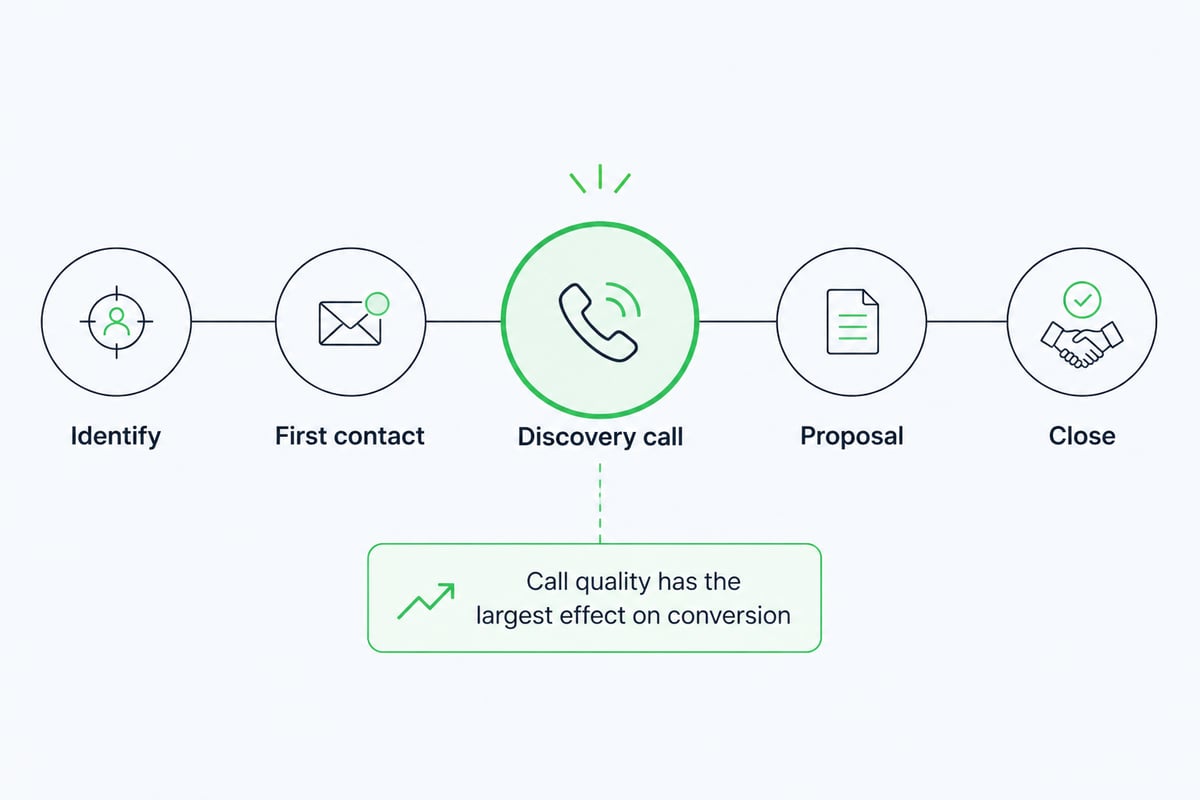
The practical lesson is that when a prospect does agree to a call, that call carries more weight. The buyer has already formed opinions, so a rep who asks generic questions or recites a pitch wastes the rare chance to talk. The conversation must add something the buyer could not find alone, such as a sharper diagnosis of their problem or a clear view of how similar companies solved it.
Where do good B2B leads come from?
The most reliable B2B leads come from sources where trust already exists or can be built quickly, and for small teams these are referrals, existing relationships, direct outreach, and partnerships. Each is manageable without a large operation.
Referrals and existing customers
Happy customers are the cheapest lead source and the easiest to overlook after a sale closes. A short, scheduled check-in 60 to 90 days after onboarding, with a direct ask for an introduction, produces warmer leads than any cold list. LinkedIn reported that many surveyed buyers had purchased from the same seller after that seller moved to another company. Buyers follow people they trust, so relationship quality compounds.
Direct outreach with research
Targeted outreach works when it shows the rep did their homework. The same LinkedIn report found that top-performing sales professionals were twice as likely to hit quota as their peers, and most conducted industry research on prospects. Ten well-researched messages to the right accounts will outperform a hundred generic ones.
Partnerships and professional networks
Complementary service providers, such as accountants, consultants, and implementation firms, often meet your ideal buyer before you do. A firm like Acquire Consultancy Limited, which advises UK accountants on buying and selling practices, is the kind of specialist whose clients may later need adjacent services. A referral arrangement with a trusted adviser can deliver pre-qualified introductions.
Inbound inquiries
Any inquiry that reaches your team, whether from a referral, a recommendation, or an unprompted request, should be treated as high priority. Respond quickly, and have a reliable way to log and route each one so none are lost.
For more tactics on increasing volume without adding headcount, this guide to how to generate more leads is a useful companion.
How do you qualify a lead before investing time?
You qualify a lead by checking a small number of criteria against what you know, then confirming the rest on a short first call. Qualification protects a small team's limited hours.
A simple framework covers four questions:
- Need: Does the prospect have a problem you solve, and can they describe it?
- Authority: Who decides, and who else must agree?
- Budget: Is there money, or a realistic path to it?
- Timing: Is there a reason to act in the next one to six months?
Given the survey data on small decision groups, always ask early who else will weigh in. A champion who cannot bring the second decision-maker to the table will stall.
Write your qualification criteria down and score leads against them. The scoring does not need software at first. A short checklist that every rep uses the same way gives you comparable data, which is the foundation for knowing which lead sources deserve more effort.

What is the 2-2-2 rule in sales?
The 2-2-2 rule is a follow-up cadence often cited in sales circles: contact a new customer or lead within two days, again within two weeks, and again within two months. It is a convention rather than a formal standard, and versions vary.
The principle behind it is sound. Leads go cold when follow-up is inconsistent, and the usual cause is not neglect but the lack of a system. If you adopt a cadence like this, assign an owner to each lead, log each touch, and review the gaps weekly. For a small team, a missed second touch is far more common than a bad first one.
Why does the sales call decide the value of your leads?
The sales call decides the value of your leads because it is the single point where all upstream effort either converts or is wasted. A team can source excellent leads and still lose them through weak discovery, missed objections, or a vague next step.
Consider the arithmetic. If your team books 20 qualified calls a month and closes 20% of them, that is four deals. Improving the close rate to 25% adds one deal a month with no extra lead spend. Raising lead volume by 25% to get the same result costs far more effort. Better conversion is usually the cheaper path.
The obstacle for owners and sales managers is visibility. You cannot sit in on every call, and recordings pile up unheard. Without a view into what reps actually say, coaching defaults to anecdotes and gut feel. Practices that fix this are covered in these sales coaching best practices.
How do you score and coach calls against a playbook?
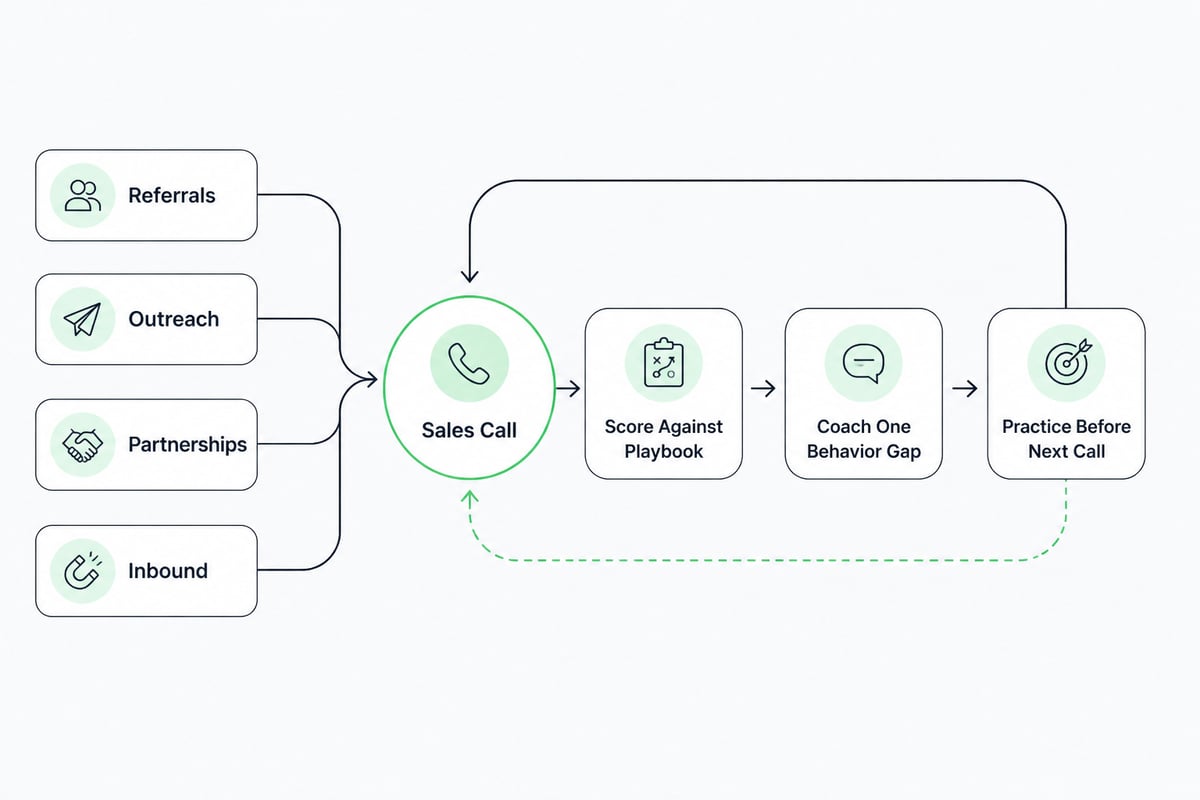
You score calls by comparing what happened to a written standard for what good looks like, then coaching one behavior at a time. This turns subjective impressions into specific, fixable feedback.
- Write the playbook. Document the stages of your best conversations: how to open, which discovery questions to ask, how to handle common objections, and how to secure a next step.
- Score each call. Rate the call against each element of the playbook, ideally the same way every time.
- Pick one gap per rep. Choose the single behavior that most affects outcomes, such as asking about budget too late or failing to confirm the next step.
- Practice before the next call. Role-play the specific moment, using a real objection from the rep's own recent call.
- Measure the next call. Check whether the behavior changed. If it did, move to the next gap. If not, adjust the practice.
Limiting coaching to one gap matters. Reps who receive a list of ten corrections tend to change none of them. A single, observable target with a measurable next call produces visible progress. The approach to how to coach sales reps goes into more detail on running these conversations.
How can a small team make this consistent without listening to every call?
A small team makes call coaching consistent by automating the capture and scoring, so the manager reviews patterns instead of recordings. Manual review does not scale past a handful of calls a week.
Bizware AI Sales Coach is built for this situation. It captures virtual and in-person sales conversations in one place, scores every call against your own sales playbook, and gives each rep private coaching plus voice or text role-play based on moments from their real calls. Each coaching step targets one behavior gap, with a measurable next call, and managers see progress on a dashboard. The underlying frameworks draw on methods behind $2.3 billion in annual sales growth.
Private coaching also helps team culture. Reps can rehearse a difficult objection without an audience, which lowers the fear of getting it wrong. Managers then spend their time on the conversations that need judgment, not on locating the problem. For consultants who advise B2B sales teams, a system like this adds an ongoing service layer between engagements, since clients keep receiving coaching after the workshop ends.
What should you track to know sales lead generation is working?
You know sales lead generation is working when more leads move through each stage and more of them close, so track conversion at each step instead of raw lead counts. A small set of metrics is enough.
| Metric | What it shows | Action if weak |
|---|---|---|
| Leads by source | Which channels produce real conversations | Shift effort to the best source |
| Lead-to-call rate | How well you qualify and reach prospects | Tighten criteria or improve outreach |
| Call-to-proposal rate | Discovery quality | Coach questioning and diagnosis |
| Proposal-to-close rate | Value communication and objection handling | Coach objection handling and next steps |
| Sales cycle length | Speed and clarity of process | Clarify next steps, involve decision-makers earlier |
Review these monthly. If lead-to-call is healthy but call-to-proposal is low, the problem is in the conversation, not the source. That diagnosis saves you from spending more on leads when the real gap is in how calls are run. This breakdown of sales performance metrics can help you choose which numbers to watch.
FAQ
What are lead generation tools?
Lead generation tools are software products that help teams find, capture, organize, or contact potential buyers. They range from contact databases and CRM systems to form builders and outreach sequencers. For small B2B teams, a simple CRM plus a consistent process usually matters more than a large tool stack.
How many leads does a small B2B team need?
It depends on your average deal size, close rate, and sales cycle. Work backward from your revenue target: divide it by average deal value to get the deals needed, then divide by your close rate to get the qualified calls required. A small team with strong close rates may need only a few dozen well-chosen leads a month.
Should owners keep selling as the team grows?
Many owners stay involved in key deals while handing routine calls to reps. The shift works best when the owner's approach is documented in a playbook and reps are coached against it. Without that, results tend to drop when the owner steps back.
The next step is to pull your last five sales calls and check each one against a written list of what a strong conversation includes, then pick the one gap that shows up most often. If you want that process running every week without listening to every recording, Bizware AI Sales Coach captures your calls, scores them against your playbook, and coaches each rep on one behavior at a time. Schedule a free Demo with Ryan Cook to see how it would work with your team's own calls.