
Conversational AI platforms are software systems that use natural language processing and machine learning to understand, respond to, and analyze human conversation across voice and text. For sales teams, they fall into two groups: tools that talk to prospects on your behalf, and tools that listen to your reps' conversations and help them improve. Knowing which group you need is the most important decision in the buying process.
Adoption is moving quickly. A 2025 Twilio survey of 457 business leaders and 4,800 consumers found that most organizations were in the final or complete stages of developing conversational AI. This guide explains the basics, the platform types, the features that matter for B2B sales, and how to select and roll out a platform without wasting a quarter.
What are conversational AI platforms and how do they work?
A conversational AI platform is a software layer that combines speech recognition, natural language understanding, dialogue management, and response generation so machines can take part in or analyze human conversations. The platform converts speech to text where needed, identifies what the person means, decides what should happen next, and either replies or records structured insight.
Most platforms share the same building blocks:
- Speech recognition and transcription: converts spoken audio into text for voice channels.
- Natural language understanding: identifies intent, topics, objections, and sentiment in what was said.
- Dialogue management: tracks context across a conversation so replies make sense.
- Integrations: connects to your CRM, calendar, phone system, and messaging tools.
- Analytics: turns conversation data into patterns you can act on.
Google Cloud maintains documentation for its conversational AI tools that shows how these components fit together in a developer-built deployment. Packaged platforms hide that complexity, but the same layers are working underneath.
Why are conversational AI platforms relevant to sales teams in 2026?
They matter because sales is a conversation business, and conversations are the one asset most small teams never measure. Owners and managers rarely hear more than a fraction of what their reps say to prospects. Conversational AI makes the rest of those conversations visible, searchable, and scoreable.
The market is expanding. Juniper Research forecast that global conversational-AI services revenue would grow from $14.6 billion in 2025 to more than $23 billion by 2027. Twilio's conversational AI report found that many organizations were in late-stage rollout of conversational AI for sales specifically.
Rapid adoption has a cost. In the Twilio survey, many organizations expected to replace their current conversational AI solution in less than a year. Buying carefully matters more than buying quickly.
What types of conversational AI platforms exist?
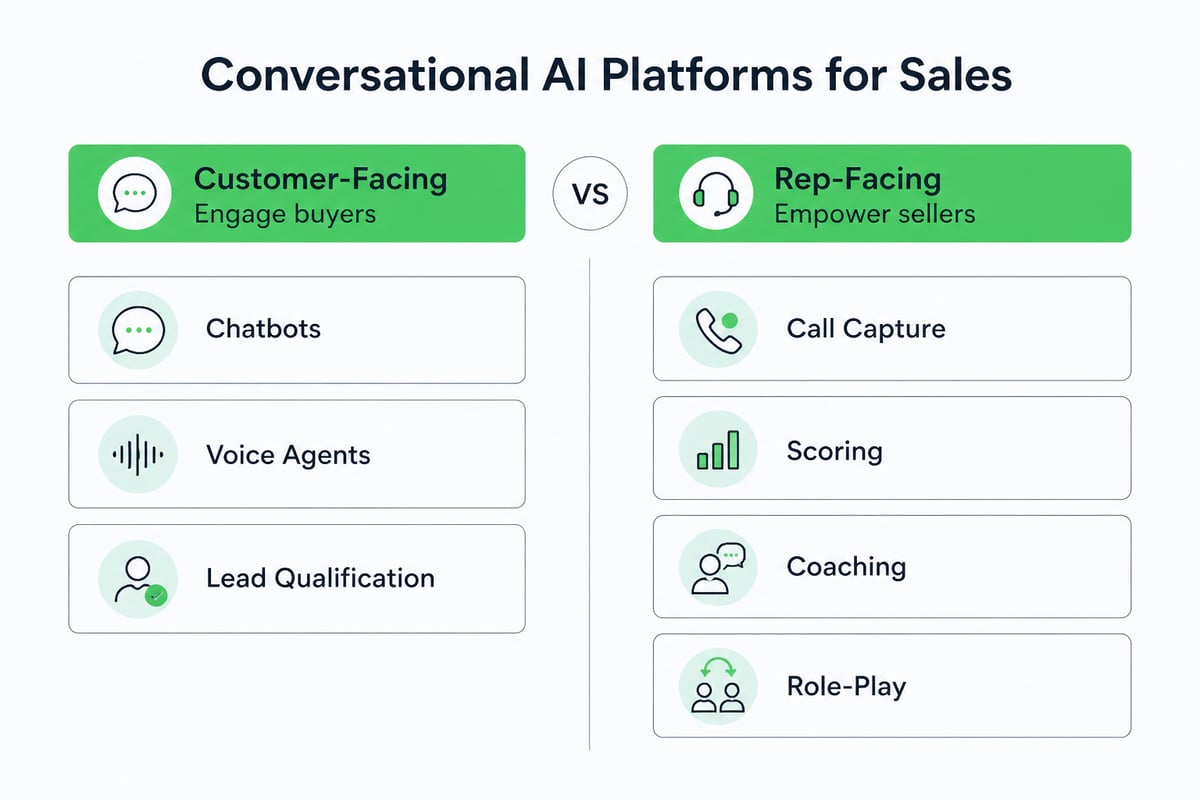
Conversational AI platforms split into four practical types, and each solves a different problem. Most buying mistakes happen when a team purchases one type while needing another.
Customer-facing chat and voice agents
These platforms answer prospect and customer questions on your website, in messaging apps, or over the phone. They suit high-volume, repeatable interactions such as FAQs, appointment booking, and first-touch lead qualification. They work poorly for consultative B2B deals where trust and nuance decide the outcome.
Developer frameworks and builder tools
Open frameworks and cloud builder tools let engineering teams design custom assistants. They offer control over data and behavior, and they require technical staff to build and maintain them. A small owner-led sales team rarely has that capacity.
Contact center and support suites
Large helpdesk and contact center products embed conversational AI for ticket deflection, agent assist, and routing. They are built for service operations, not for improving how salespeople sell.
Conversation intelligence and coaching platforms
These tools sit on the rep side. They capture sales calls and meetings, transcribe them, score them against a defined standard, and feed the results into coaching. For a team whose revenue depends on what reps say live, this is usually the type with the clearest return.
Which features matter most for B2B sales?
The features that matter most are the ones that change rep behavior, not the ones that generate the most data. A platform that produces a transcript and a summary for every call has not coached anyone. Evaluate each candidate against this list:
- Capture across every channel. Virtual calls, phone calls, and in-person meetings all contain selling moments. A platform that only sees video calls leaves gaps.
- Scoring against your own standard. Generic scorecards reward generic behavior. Scoring should reflect your sales playbook, your discovery questions, and your qualification criteria.
- Coaching tied to specific moments. Feedback should point to a timestamp in a real call, not a general suggestion.
- Practice before the next call. Role-play based on a rep's actual weak spots turns feedback into skill.
- Manager visibility without surveillance. Managers need trends across the team. Reps need a private space to work on gaps.
- Measurable follow-through. The next call should show whether the behavior changed.
If you have not documented how your best reps sell, start there. A scoring system is only as good as the standard behind it, and our guide on how to build a sales playbook covers that foundation.
How do you choose a conversational AI platform for a small sales team?
Choose by starting with the problem, then matching platform type, then testing fit with real calls. Work through these steps in order.
- Name the problem in one sentence. "Our reps skip discovery questions and we lose deals at the proposal stage" is a usable problem. "We want AI" is not.
- Decide whether the platform faces prospects or reps. If the problem is inconsistent live selling, a chatbot will not fix it.
- Check channel coverage. List where your reps actually talk to prospects, and confirm the platform captures all of it.
- Confirm it can score against your playbook. Ask to see how your own criteria get loaded and applied.
- Test with a handful of real calls. Review the scores yourself. If they match your judgment, the platform understands your standard.
- Look at the coaching loop. Ask what happens after a score is produced. Insight without a next step is a report.
- Plan for change. Twilio's survey found that 99% of organizations expected their conversational AI strategy to change within 12 months, and 80% of business directors said keeping up with changing AI models was expensive. Favor vendors that handle model updates for you.
Consultants advising B2B teams can apply the same sequence when recommending a tool to a client, and a platform that supports ongoing coaching gives you a recurring service to build around.

How should sales teams roll out conversational AI?
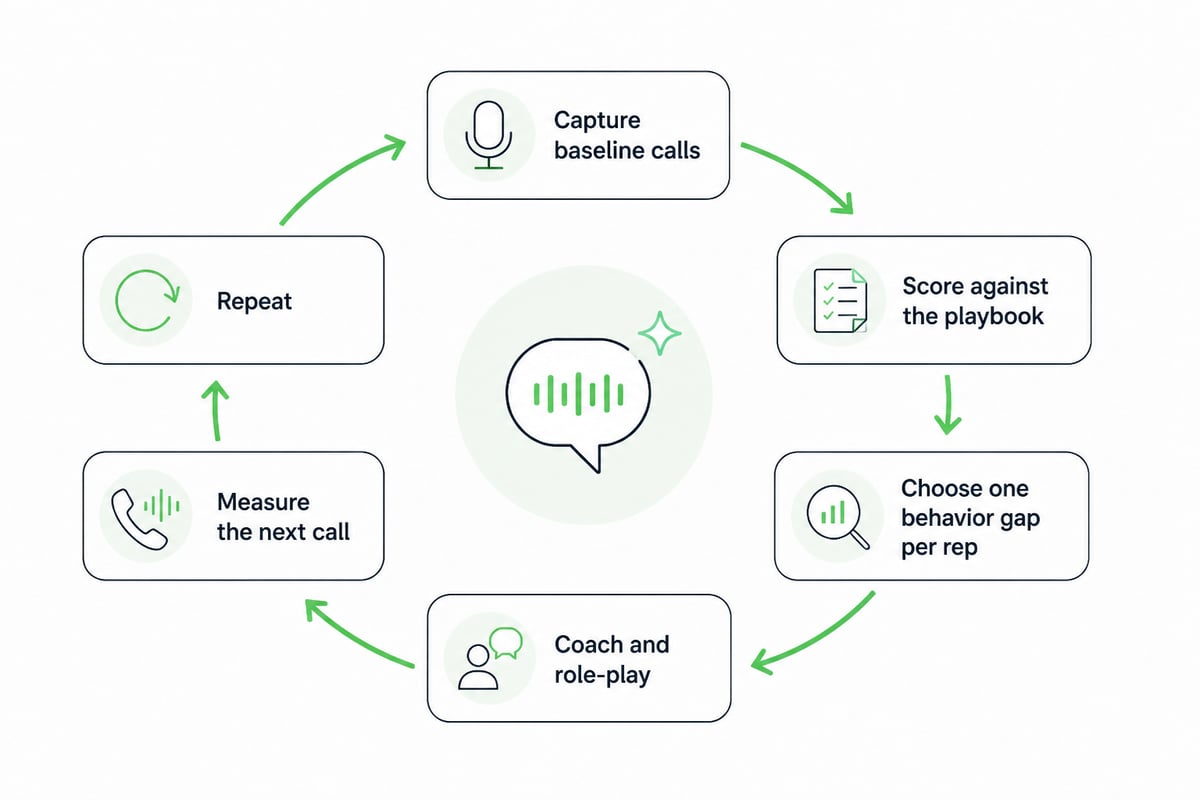
Roll out in small stages, with one behavior target at a time. Teams that switch on every feature at once overwhelm reps and learn nothing about what worked.
Set the baseline
Capture two to four weeks of calls before changing anything. Score them against your playbook so you know where each rep stands today. This baseline is what makes later improvement measurable, and it connects to the wider question of how to measure sales rep performance.
Pick one gap per rep
Resist the urge to fix everything. Choose the single behavior most likely to move results for each rep, such as asking about budget earlier or confirming next steps before ending a call. Narrow targets produce visible change. Broad ones produce vague advice.
Close the loop with the next call
Every coaching step should end with a specific thing to try on the next call, and the next call's score should show whether it happened. Reinforcement is what separates coaching from training events, a point we cover in how to reinforce sales training.
Be transparent with reps
Tell reps what is recorded, who sees it, and why. Private coaching feedback, visible only to the rep, builds trust and encourages honest practice. Managers see trends and can step in where needed.
What risks and limits should buyers understand?
The main risks are poor scoring standards, privacy gaps, and expecting technology to replace management. Each is manageable when you plan for it.
Weak standards produce weak scores. If your playbook is vague, scoring will be vague. Write down what good looks like before you configure anything.
Consent and privacy rules apply. Recording laws differ by state and country. Confirm your consent process for calls and in-person meetings, and review how the vendor stores and protects conversation data.
Perception can drift from reality. Twilio found that organizations were far more likely than consumers to believe their customers were satisfied with conversational AI experiences. Sales leaders face the same blind spot: managers often believe their reps sell better than the calls show. Scoring real conversations closes that gap.
Technology does not replace the manager. A platform can find the problem and prepare the practice. A manager still sets expectations, reviews progress, and holds the team to them. Our piece on sales team accountability explains how to pair tools with management habits.
Where does Bizware AI Sales Coach fit?
It fits the rep-facing side of the market, for small B2B teams where the owner or manager cannot listen to every call. Bizware AI Sales Coach captures virtual and in-person sales conversations in one place, scores each call against your own sales playbook, and gives every rep private coaching plus voice or text role-play built from moments in their real calls. Each coaching step targets one behavior gap, with a measurable next call. The approach draws on established sales frameworks.
It is not designed for enterprise forecasting or deal analytics across hundreds of reps, and it is not a standalone practice tool without call capture. Teams that want consistent, rep-by-rep coaching without adding management hours are the intended fit. For pricing, setup details, and supported call sources, check the product pages or contact the team directly.
How do you tell whether the platform is working?
You can tell by tracking behavior change first and revenue results second. Behavior moves within weeks. Revenue follows over a sales cycle or two.
Track these indicators:
- Playbook score trend per rep. Scores on the targeted behavior should rise across consecutive calls.
- Gap closure rate. How many coaching targets get resolved, and how quickly.
- Call consistency. Whether the spread between your strongest and weakest rep narrows.
- Stage conversion. Movement from discovery to proposal, or proposal to close, on calls where the coached behavior appeared.
- Manager time. Hours spent reviewing calls should fall while coverage rises.
Pair these with a regular review. A short weekly check on each rep's current gap and latest score keeps the system alive. For a wider set of measures, see our guide to sales performance improvement strategies.
Frequently asked questions
Are conversational AI platforms the same as chatbots?
No. Chatbots are one application. Conversational AI platforms also include voice agents, conversation analysis, and coaching tools that work on human-to-human calls.
Do small teams need an enterprise platform?
Usually not. Enterprise suites bring configuration and administration that a team of a few reps will not use. Choose a tool sized to your team and your actual problem.
Can conversational AI replace sales coaching?
It can deliver coaching at a scale one manager cannot, but it works best alongside a manager who sets standards and reviews progress.
How many calls do you need before scoring is useful?
There is no universal number. Start with a sample large enough to see each rep's patterns, then check whether the scores match your own judgment of those calls.
What should a consultant look for when recommending a platform to a client?
Look for scoring against the client's own playbook, private rep coaching, clear manager reporting, and a loop that ties each coaching step to a measurable next call.
Take one action this week: pull five recent sales calls from your team, and write down the single behavior you wish every rep did the same way on each of them. That list is the beginning of a scoring standard. If you want those behaviors captured, scored, and coached on every call without adding hours to your calendar, Ryan Cook can show you how the system works when you schedule a free demo.