
The fastest way to learn how to identify missed sales opportunities is to review your recorded calls for the specific moments where a buyer offered a signal and the rep did not follow it. Those moments are rarely dramatic: an unexplored pain point, a budget remark that went unanswered, a call that ended without a dated next step. For owners and managers who cannot listen to every conversation, the work comes down to capturing calls consistently, defining what a missed opportunity looks like, and scoring every call against the same standard.
What counts as a missed sales opportunity in a call?
A missed sales opportunity is any moment in a conversation where a buyer gave a reason to advance the deal and the rep did not act on it. That is different from a lost sale, which is a deal that ended without a purchase. A lost sale is the outcome. A missed opportunity is one of the moments that caused it, and it often happens in deals you eventually win, at a lower price or a slower pace than necessary.
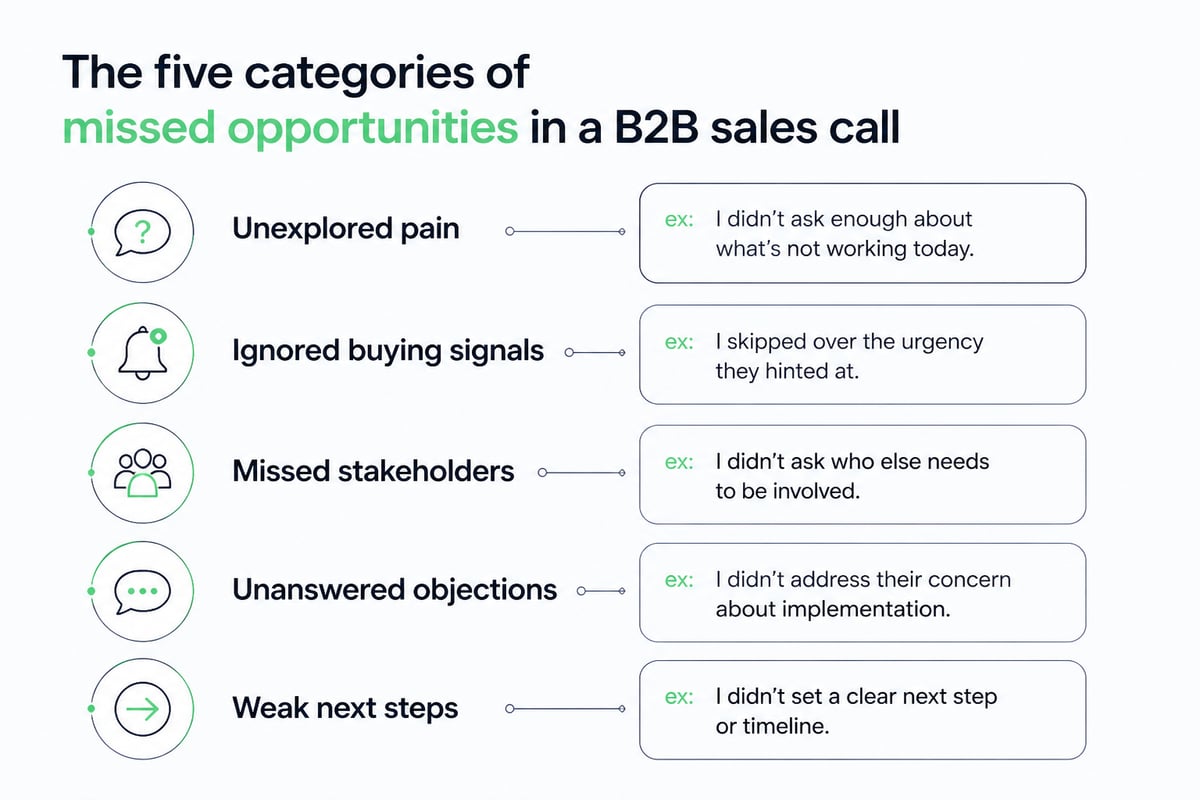
Most missed opportunities fall into five categories:
- Unexplored pain: the buyer mentions a problem and the rep moves on without asking about its cost or timeline.
- Ignored buying signals: questions about implementation, pricing, or onboarding that the rep answers briefly instead of using to advance the deal.
- Missed stakeholders: a colleague or approver is mentioned and never added to the conversation.
- Unanswered objections: the rep accepts "we'll think about it" without isolating the real concern. The guide to handling sales objections covers how to respond in the moment.
- Weak next steps: the call ends with "I'll follow up next week" rather than a scheduled meeting with an agenda.
Why owner-led teams miss opportunities without noticing
Small teams miss opportunities because nobody is positioned to hear them. In a team of three to ten reps, the owner often sells as well, and call review gets pushed behind customer work. Reps are asked to self-report, and self-reporting is unreliable: a rep who skipped a pricing question rarely remembers skipping it.
Volume compounds the problem. Industry reporting suggests sales representatives are analyzing more recorded calls each year, so volume keeps growing. Even if your team runs far fewer calls, spot-checking two or three conversations a month leaves most of the evidence unheard.
The fix is not more listening hours. It is a repeatable method that tells you which moments to look at.
How to identify missed sales opportunities: a five-step review routine
The most reliable approach is a short, fixed routine applied to every recorded call, ideally with scoring done automatically so you review only the flagged moments. Here is a sequence that works for small B2B teams.
- Define the standard first. You cannot spot a miss without a definition of a hit. Write down what a good discovery call, demo, and follow-up contain. If you have no written standard, start with a sales playbook covering the questions reps must ask and the commitments they must secure.
- Capture every conversation. Virtual calls, phone calls, and in-person meetings all count. Gaps in capture become gaps in your picture of the pipeline.
- Score each call against the standard. Use the same criteria for every rep so results are comparable across people and weeks.
- Tag the moments, not the whole call. Mark the timestamp where the signal appeared and the response that followed. A 40-minute call usually contains three to five moments that matter.
- Group misses by behavior, then pick one. Patterns matter more than individual errors. If four of six reps skip budget questions, that is a coaching priority, not a rep problem.
Signals to listen for in a recorded call
Buyers rarely announce their intent, so you need to know the phrases that carry it. Review transcripts for the following categories and note what the rep did next.
Buying signals
These include questions about price structure, contract length, onboarding time, or who else uses the product. A buyer asking "how long does setup take?" is picturing ownership. If the rep answers in one sentence and returns to the demo script, the signal was missed.
Pain without quantification
When a buyer says "our follow-up is inconsistent," the opportunity is in the next question: what does that cost, who is affected, and what has been tried. Calls where pain is named but never sized tend to stall at the proposal stage. Strengthening this skill is the focus of the guide on improving sales discovery calls.
Talk-time imbalance
A rep speaking for most of a discovery call has usually not asked enough. Check the ratio, then read the transcript to see which questions were skipped.
Competitor and alternative mentions
When a buyer mentions another vendor or an internal workaround, the rep should ask what they like about it and what is missing. A mention that passes without a follow-up question is a lost chance to learn the decision criteria.
Ambiguous endings
Phrases like "send me something" or "let's circle back" signal a call that ended without commitment. Count how many of your calls close with a dated, mutually agreed next step.
Where in the funnel to look first
Not every call deserves the same attention. Start where a missed moment costs the most. Late-stage calls with a proposal outstanding carry the highest cost per miss, so review those first for unanswered objections and unmapped stakeholders. Discovery calls come second, because a shallow discovery weakens everything after it. Early outbound calls are worth sampling for the opening and the ask.
A useful habit is to compare calls from deals you won with calls from deals that stalled. Look for the behaviors that differ, such as whether the economic buyer appeared before the proposal, and whether the rep confirmed a decision date. That comparison turns scattered observations into a short list of behaviors worth coaching, which feeds directly into improving sales close rates.
Turn findings into coaching, not a report
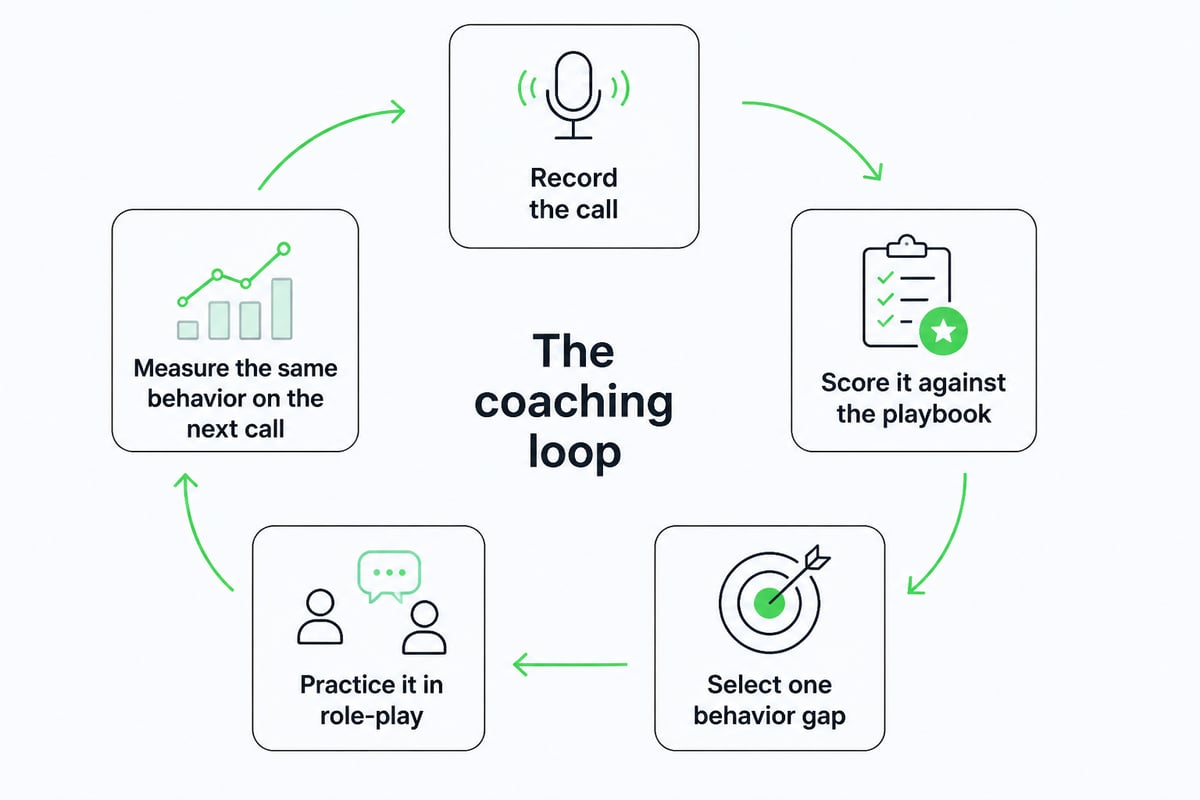
Identifying a miss only pays off when the rep changes behavior on the next call. Reports that list ten problems per rep tend to produce no change. Pick one behavior gap per rep, define what good looks like, and set a measurable target for the next call, such as "ask a cost-of-problem question in every discovery call."
Role-play closes the loop. Reps who practice the specific moment where they stumbled, such as responding to a pricing question, carry that fluency into live calls. If you need ideas for structuring practice, see these sales role-play exercises and the broader guide to coaching sales reps.
7 tools that help surface missed opportunities in calls
The tools below record, transcribe, or score calls so you can find missed moments without listening to everything. Pricing varies by plan and billing term and changes over time, so check each vendor's current listing. For a wider comparison of recording and analysis options, Folk's roundup of sales call recording and analysis tools is a useful reference. Sales call coaching software overall ranges widely in price, from modest per-user fees to well above $150 per user per month, depending on platform capabilities.
1. Avoma
Avoma records meetings, generates notes, and scores calls with AI against customizable scorecards. It supports frameworks such as MEDDIC and SPICED, which makes it straightforward to check whether reps covered required discovery topics. Pricing starts at $19 per recorder per month billed annually, with a conversation-intelligence add-on at $29 per seat per month, and a 14-day trial is offered.
Suits: teams that want structured call notes and scorecard-based coaching without enterprise pricing.
Verdict: a solid fit for framework-driven teams that already know which criteria to score.
2. Dialpad Sell
Dialpad Sell is a phone-based platform with real-time transcription, Live Coach Cards, AI Playbooks, and live sentiment monitoring. Prompts appear during the call, so a rep can be reminded of a required question while the buyer is still talking. Pricing is $39 per user per month.
Suits: phone-based teams that want in-call prompts rather than after-the-fact review.
Verdict: best where the miss you want to prevent happens live, over the phone.
3. Aircall
Aircall is a cloud phone system with a power dialer, voicemail drops, 250+ integrations, and automatic or on-demand call recording. Plans start at $30 per license per month billed annually, with a three-license minimum. Recording gives you the raw material for review, though scoring depends on your own process or an integration.
Suits: phone-first outbound teams of three or more seats that need recorded calls tied to their other tools.
Verdict: strong telephony and recording; plan on adding your own review method.
4. Fireflies.ai
Fireflies.ai provides automated meeting transcription, searchable transcripts, and AI notes and summaries. The Pro plan runs from $10 per user per month billed annually and includes unlimited transcription, and a free plan is available. Searching transcripts for words like "budget" or "timeline" is a fast way to find unexplored signals.
Suits: small teams on a tight budget that want searchable transcripts.
Verdict: an inexpensive starting point for transcript search, with coaching handled separately.
5. Claap
Claap offers call recording with scoring, coaching, and CRM updates. The free plan includes 10 recordings per user and 300 minutes total. Pro is $32 per license per month billed yearly, with unlimited recordings and 1,000 minutes per month. Business is $60 per license per month, with unlimited minutes, AI coaching, and CRM auto-fill.
Suits: teams that want scoring and CRM updates in one place and can fit the minute caps on lower tiers.
Verdict: a capable middle option, though AI coaching sits in the top tier.
6. Bizware AI Sales Coach
Bizware AI Sales Coach captures sales calls, scores them against your own playbook, and gives each rep private coaching plus voice or text role-play before the next call, with a manager dashboard. Coaching targets one behavior gap at a time with a measurable next call, so a missed opportunity becomes a specific practice task. Pricing starts from $77 per user per month billed annually (Starter).
Suits: small owner-led B2B teams where the manager cannot hear every call and wants consistent, rep-by-rep coaching rather than a transcript library.
Verdict: best when the goal is changing rep behavior, not only finding the misses. It is less suited to teams that only need notes or summaries.
7. HubSpot Sales Hub
HubSpot Sales Hub Professional includes call recording and transcription, with 750 transcription hours per month, and associates calls with CRM records. It is listed at $90 per seat per month billed annually plus a $1,500 onboarding fee. Starter is advertised from about $7 per seat per month, but recording sits in Professional.
Suits: teams already running contacts and deals in HubSpot that want calls attached to those records.
Verdict: convenient if HubSpot is your system of record; costly if you are adopting it only for call review.
Tool comparison at a glance
| Tool | Approx. price (Nov 2026) | Key capability | Best fit |
|---|---|---|---|
| Avoma | From $19/recorder/mo; $29/seat/mo add-on | AI scorecards (MEDDIC, SPICED) | Structured notes and coaching |
| Dialpad Sell | $39/user/mo | Live Coach Cards, real-time transcription | Phone teams needing in-call prompts |
| Aircall | From $30/license/mo, 3-license minimum | Recording, power dialer, 250+ integrations | Phone-first outbound |
| Fireflies.ai | Free; Pro from $10/user/mo | Searchable transcripts, AI summaries | Budget-conscious teams |
| Claap | Free; $32 or $60/license/mo | Scoring, coaching, CRM auto-fill | Scoring plus CRM updates |
| Bizware AI Sales Coach | From $77/user/mo | Playbook scoring, private coaching, role-play | Owner-led B2B teams |
| HubSpot Sales Hub | $90/seat/mo Pro, $1,500 onboarding | Recording tied to CRM records | Teams already in HubSpot |
How to choose a method that fits your team size
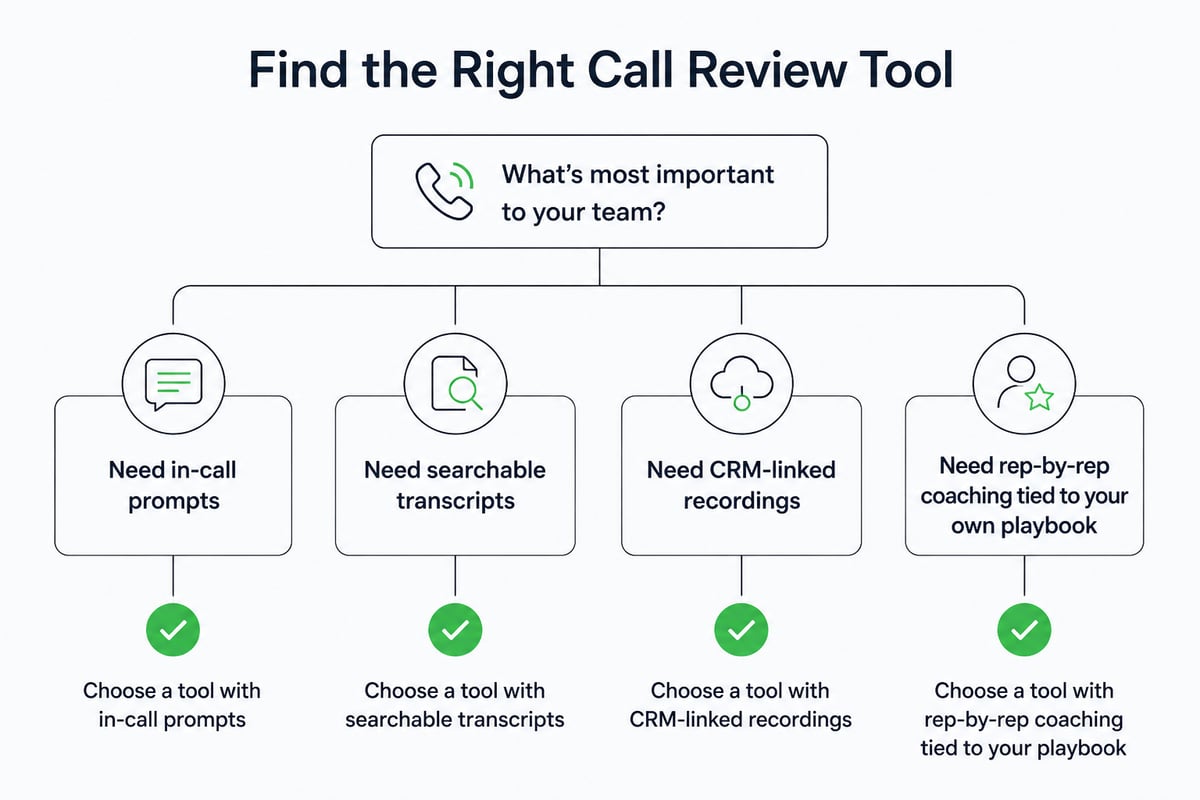
Match the tool to the gap you are trying to close. If your problem is visibility, a transcript tool is enough. If it is consistency, you need scoring against a written standard. If it is behavior change, you need coaching and practice attached to the findings, which is the premise behind automated sales coaching.
Before buying anything, run a two-week pilot. Record every call, score ten against your playbook by hand, and note how many misses you found per call and which behavior appeared most often. That baseline lets you judge whether any tool is saving you time or only adding dashboards.
FAQ
What is considered a lost sale?
A lost sale is a deal that ended without a purchase, whether the buyer chose a competitor, picked an internal workaround, or stopped responding. It differs from a missed opportunity, which is a moment inside a call where the rep failed to advance the deal. Tracking both helps you separate outcome problems from behavior problems.
How can I identify new sales opportunities?
Review recorded calls for mentions of related pains, additional stakeholders, expansion plans, and timelines the original conversation did not cover. Existing customers and stalled deals often hold more unexplored opportunity than cold outreach. Ask reps to note every new problem a buyer raises, then score whether the follow-up question was asked.
What is the 2 2 2 rule in sales?
The phrase is used loosely and has no single standard definition, so teams should confirm what a source means before adopting it. A more dependable habit is to set explicit follow-up cadences and a dated next step on every call, then check call recordings to confirm those commitments were made.
Pick your last five discovery or demo calls and mark every moment where the buyer raised a pain, a stakeholder, or a timeline and the rep did not ask a follow-up question. If that exercise shows more than you can review by hand, Bizware AI Sales Coach scores each call against your playbook and turns each miss into private coaching and role-play with a measurable next call. To see how that works for a small B2B team, Ryan Cook can walk you through it in a demo.