

An SOP, short for standard operating procedure, is a written set of steps that tells people exactly how to complete a recurring task the same way every time. For a sales team, an SOP covers the work that decides revenue: how to run a discovery call, how to follow up after a demo, how to log a deal, and how to hand off a closed account. This guide explains what a sales SOP contains, how to write one, and how to check that reps actually follow it.
What Is an SOP in Sales?
A sales SOP is a documented procedure for a repeatable sales activity, written clearly enough that a new rep could perform it correctly without asking the owner.
The term itself is broader than sales. Manufacturing, healthcare, and finance all rely on SOPs to reduce variation. In a small B2B team, the same idea applies to the moments that matter most: qualifying a lead, running a call, sending a proposal, and following up.
It helps to separate three documents that often get confused:
- SOP: the step-by-step procedure for one task, such as "How to run a discovery call."
- Sales playbook: the broader guide covering your buyer, messaging, objections, and the standards for each stage. If you need one, see how to build a sales playbook.
- Checklist: a short list of items to confirm, usually drawn from an SOP.
The SOP is the operational layer. The playbook explains what good looks like. The SOP explains what to do, in what order, and who does it.
Why Do Sales Teams Need an SOP?
Sales teams need an SOP because without one, every rep invents their own process, and results depend on individual habit rather than a repeatable method.
Small owner-led teams feel this most. When the owner closes most deals, the process lives in their head. The first hires copy fragments of it, then drift. Ramp time stretches, forecasts become guesses, and coaching turns into opinion.
The broader sales environment shows why time and consistency matter. A 2024 survey of sales professionals reported by Salesforce found that reps spent a large share of their time on non-selling tasks. The same survey found that most reps said they had missed quota the previous year. A clear procedure for administrative work frees time for selling, and a clear procedure for calls makes performance easier to diagnose.
Practical benefits of a sales SOP include:
- Faster onboarding, because new reps learn from a document instead of shadowing for months
- Fewer dropped steps, such as missed follow-ups or incomplete CRM notes
- A shared standard that makes feedback objective
- Less owner dependency, since the process no longer sits in one person's memory
Which Sales Processes Deserve an SOP First?
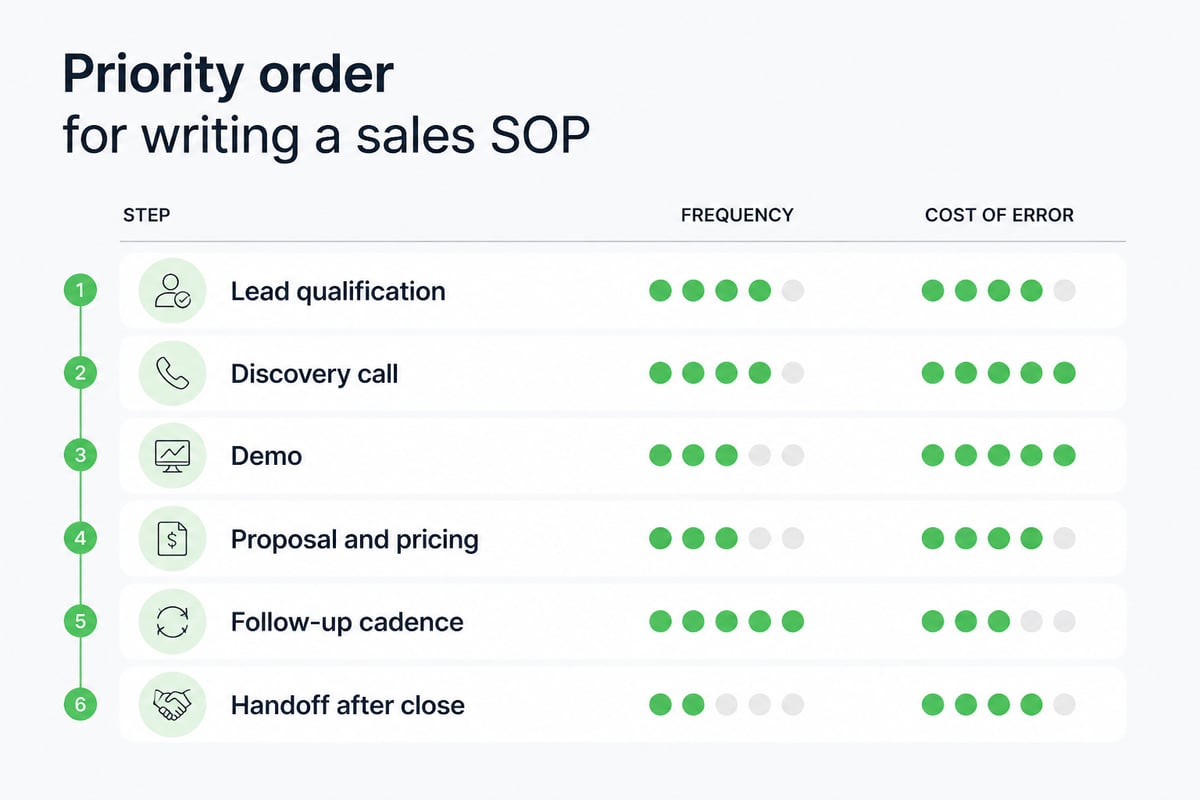
Start with the sales processes that happen most often and have the biggest effect on revenue, because those return the most for the writing effort.
Not every task needs a procedure. A one-off exception does not. A repeated action that varies between reps does. Rank candidates by two questions: how often does this happen, and how much does a mistake cost?
Strong first candidates for a small B2B team:
- Lead qualification: the criteria and questions that decide whether a lead moves forward
- Discovery call: the structure, required questions, and how findings are recorded
- Demo or presentation: the flow, who attends, and how value is tied to the buyer's stated problem
- Proposal and pricing: who approves, what the document contains, and how quickly it goes out
- Follow-up cadence: timing, channel, and content after each stage
- Handoff after close: what information moves to delivery or onboarding
If follow-up is your weakest area, how to improve sales follow-up pairs well with writing that SOP. For discovery, how to improve sales discovery calls gives you the behaviors to build into your steps.
What Should a Sales SOP Include?
A sales SOP should include a purpose, scope, owner, trigger, ordered steps, standards for each step, and a way to measure whether it was followed.
Keep the structure the same across every SOP so reps learn one format. A reliable template looks like this:
| Section | What it answers |
|---|---|
| Purpose | Why this procedure exists and what outcome it protects |
| Scope | Which roles, deal types, and situations it covers |
| Owner | Who maintains and approves changes |
| Trigger | The event that starts the procedure |
| Steps | The ordered actions, each starting with a verb |
| Standards | What "done well" looks like for each step |
| Tools and inputs | CRM fields, templates, call scripts, or documents needed |
| Measures | How you will know the SOP was followed |
| Version and date | When it was last updated |
The standards and measures rows are where most sales procedures fall short. A step like "Ask about budget" is easy to skip or botch. A step like "Ask about budget before minute 25 and confirm who approves spending" can be checked against a recording.
How Detailed Should an SOP Be?
An SOP should be detailed enough that a competent new hire can follow it without guessing, and no more detailed than that.
Too little detail leaves room for drift. Too much detail produces a document nobody reads. A useful test is the new-hire test: hand the SOP to someone who has never done the task and ask whether they could complete it. If they would need to ask basic questions, add detail. If they would skip half the page because it states the obvious, cut it.
Match detail to risk:
- High-risk, high-variation steps (pricing approval, contract terms, discovery questions) deserve specific wording and examples.
- Low-risk, routine steps (updating a CRM stage) need only a short instruction.
- Judgment calls (handling an objection) should state the goal and boundaries, not a rigid script.
A one-page SOP that gets used beats a ten-page one that sits in a folder.
How Do You Write a Sales SOP Step by Step?
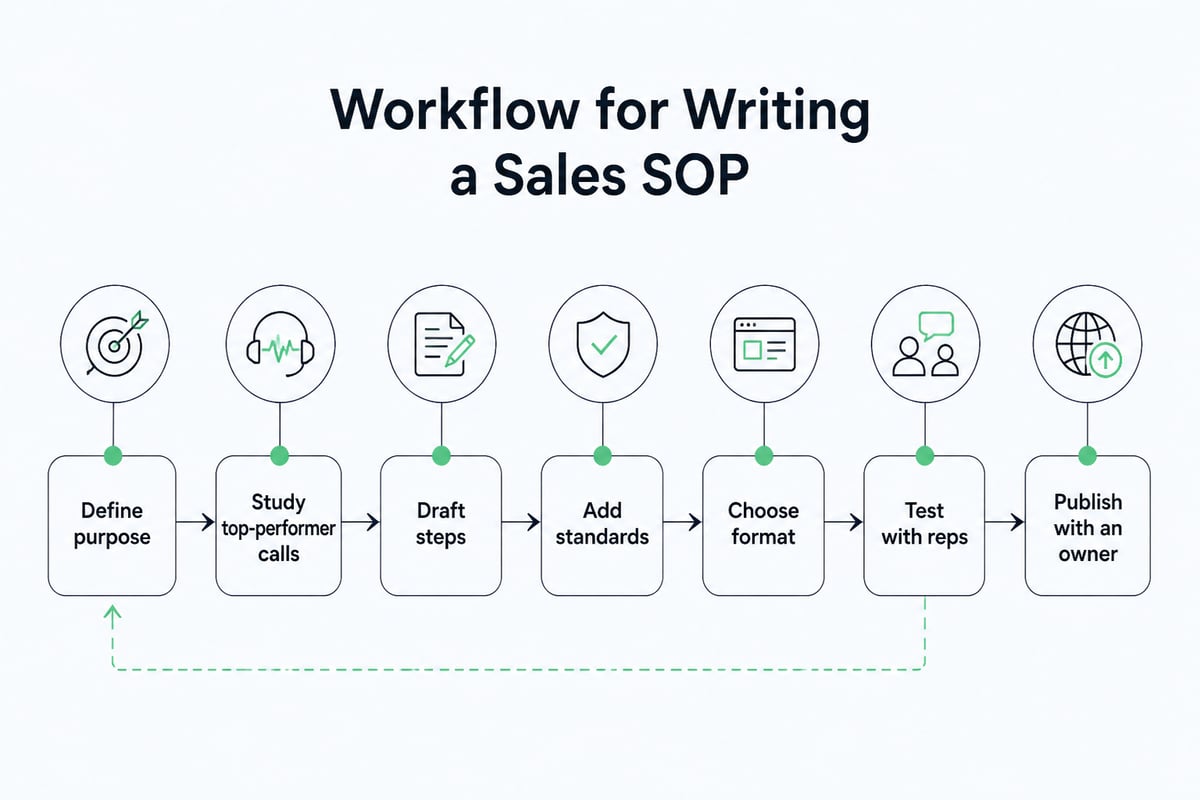
You write a sales SOP by observing how your best reps already do the task, drafting the steps with them, and testing the draft on real work before you publish it.
- Define the purpose and the outcome. State in one sentence what success looks like, such as "Every discovery call ends with a confirmed problem, a decision maker, and a dated next step."
- Capture how top performers work. Listen to recordings of your strongest calls and note what they do in order. Copy behavior that wins deals, not habits that merely feel comfortable.
- Draft the steps. Write short, verb-led instructions. One action per step.
- Add standards. For each step, describe what a good execution sounds or looks like.
- Choose the format. A one-page document, a checklist, or a short video walkthrough all work. Pick the one your reps will open during the workday.
- Test with two or three reps. Ask them to follow it on live deals and report where it was unclear.
- Publish and assign an owner. Store it where reps already work and name the person responsible for updates.
Reps who helped shape the procedure tend to follow it more readily. Involve them early, and keep the first version short. You can refine it after real use.
How Do You Get Reps to Actually Follow the SOP?
Reps follow an SOP when it is easy to find, tied to coaching, and checked against what happens on real calls.
Publishing a document does not change behavior. Most SOPs fail at this stage, not at the writing stage. A few practices make the difference:
- Put it in the flow of work. Link the SOP inside the CRM or the call-prep template so reps see it at the moment they need it.
- Train on it, then reinforce it. One walkthrough is not enough. How to reinforce sales training covers how to keep new habits from fading within weeks.
- Practice the hard parts. Role-play the steps that reps skip or rush. Sales roleplay exercises offers formats you can run in a short team session.
- Coach to one behavior at a time. A rep who is told to fix six things fixes none. Pick the single step they miss most and work on that before the next call.
The main constraint for owners and managers is time. You cannot listen to every call, so you cannot confirm the SOP is followed by memory or by sampling a few recordings.
How Do You Measure Whether an SOP Works?
You measure an SOP by checking two things: whether reps follow the steps, and whether following the steps improves outcomes such as conversion and close rate.
Adherence and results are separate questions. A rep can follow every step and still lose, which tells you the SOP needs revision. A rep can ignore the steps and win, which tells you the SOP may be missing something that rep does well.
Track a small set of measures:
- Step adherence: the share of calls where each required step happened
- Stage conversion: the rate at which deals move from one stage to the next
- Time to next step: how quickly follow-up occurs after a call
- Close rate by rep and by SOP step compliance: whether adherence correlates with wins
For definitions and benchmarks, see sales performance metrics and how to measure sales rep performance. Review these monthly, and compare them against the version of the SOP in force during that period so you know which change caused which result.

How Can Call Recordings Keep an SOP Honest?
Call recordings keep an SOP honest because they show what reps actually say, which often differs from what they report or believe they do.
A written procedure describes intent. A recording shows execution. When you score calls against the SOP, you find which steps are skipped, which are done poorly, and which reps need help. Sales call recording and analysis describes how to set this up, and how to improve sales conversations turns findings into coaching points.
Doing this by hand is slow. A manager listening to even a fraction of a six-rep team's calls loses hours each week. This is the gap Bizware AI Sales Coach addresses: it captures virtual and in-person sales conversations in one place, scores each call against your own sales playbook, and gives each rep private coaching and voice or text role-play based on their real calls. Each coaching step targets one behavior gap with a measurable next call, so the SOP becomes something you can verify rather than something you hope is followed.
Salesforce's 2024 survey also found that teams using AI were more likely to report revenue growth than teams not using AI, according to Salesforce's State of Sales findings. That finding reflects teams using AI broadly, not any single product, but it supports the case for using technology to handle the review work a manager cannot do alone.
How Often Should You Update a Sales SOP?
Review each sales SOP at least twice a year, and update it sooner whenever your product, pricing, buyer, or sales results change.
Stale procedures cause as much harm as missing ones. Reps learn to ignore a document they know is out of date. Set a review date on every SOP, and tie updates to triggers:
- A new product, package, or pricing model
- A shift in your target buyer or deal size
- A consistent gap between the SOP and what winning reps do
- A drop in conversion at the stage the SOP covers
Keep a short change log at the bottom of each document with the date and the reason for the edit. Announce changes to the team in a sentence or two, and coach to the new version in the following week's reviews.
What Mistakes Make a Sales SOP Fail?
A sales SOP fails when it is too long, written without rep input, never enforced, or never updated.
The most common causes:
- Writing for the manual, not the rep. Dense paragraphs get skipped. Use short steps and plain language.
- Scripting everything. Reps who read word for word sound robotic. Specify the goal and required elements, and let reps use their own voice.
- Skipping the owner. An SOP with no named maintainer drifts out of date within a quarter.
- No link to coaching. If nothing happens when a step is missed, the step becomes optional.
- Copying another company's process. A procedure built for a large enterprise sales cycle rarely fits a small team selling a focused B2B offer.
If your team is small and you are the main closer, founder-led sales explains how to turn your own approach into something others can repeat. For setting up regular review, sales coaching for small businesses offers a workable rhythm.
Is SOP Capitalized, and What Does the Word Mean?
SOP is written in capital letters because it is an abbreviation, and it is pronounced either as the letters S-O-P or, less often, as a single word.
Spell out "standard operating procedure" in lowercase on first use, then use the capitalized acronym afterward. Plural is "SOPs" with no apostrophe. This is the standard convention in business writing.
Separately, "sop" in lowercase is an unrelated English word. As a noun, it describes a piece of bread dipped in liquid, and by extension a concession offered to calm someone. As a verb, it means to soak up or mop up liquid. It comes from Old English "sopp," related to the idea of soaking. In a business setting, "SOP" nearly always means standard operating procedure, though in other contexts it can stand for "statement of purpose" in admissions.
FAQ
Is an SOP the same as a sales playbook?
No. An SOP gives the ordered steps for one repeatable task, while a sales playbook covers the wider guidance on buyers, messaging, objections, and stage standards. Most teams keep several SOPs that sit under one playbook.
How many SOPs does a small sales team need?
Most small teams do well with three to six, covering qualification, discovery, demos, proposals, follow-up, and handoff. Add more only when you see a repeated task that varies between reps and costs you deals.
Who should write the sales SOP?
The owner or sales manager should lead, with input from the reps who perform the task best. A consultant can also draft one for a client team, as long as the final steps reflect how the team actually sells.
Pick one process this week, probably your discovery call, and write a one-page SOP for it using the template above. Then check it against five recent calls to see where reps depart from it. If you want that checking done on every call without adding hours to your week, Bizware AI Sales Coach scores calls against your playbook and coaches each rep on one behavior gap at a time. To see how it fits your team, Ryan Cook invites you to schedule a free demo and review your own calls against your own procedures.