

SOP stands for standard operating procedure: a written, step-by-step set of instructions that tells employees how to complete a recurring task the same way every time. In a sales team, a standard operating procedure covers the repeatable parts of selling, such as how a rep qualifies a lead, runs a discovery call, logs notes, and follows up after a meeting. The sections below explain what an SOP is, how it works, what it looks like in sales, and how to keep it alive once it is written.
What does SOP stand for in business?
In a business setting, SOP stands for standard operating procedure, a documented process that defines who does what, in what order, and to what standard. The purpose is consistency. When a task has a written procedure, the result no longer depends on which employee happens to perform it.
The UK Home Office describes SOPs as clear, precise instructions for employees to perform their duties in line with legislation, regulation, policy, and best practice. That definition comes from a regulated environment, but the logic transfers directly to a sales floor. A procedure turns individual habit into shared practice.
An SOP is different from a policy and from a playbook:
- Policy: states a rule or principle ("all prospects receive a written follow-up within 24 hours").
- SOP: explains exactly how to carry out the task behind the rule, step by step.
- Playbook: describes how the team sells overall, including messaging, qualification criteria, and objection handling.
The three work together. A policy sets the expectation, the playbook sets the approach, and the SOP shows the steps.
Other meanings of SOP
SOP also has a few meanings outside business, and the right one depends on context. The abbreviation is common enough that readers searching for SOP meaning often land on pages covering several of them.
- Statement of purpose: an essay applicants submit to universities or graduate programs, describing their goals and background.
- Sop (the word): as a noun, a piece of bread dipped in liquid, or a concession offered to calm someone down, as in "the discount was a sop to unhappy customers." As a verb, it means to soak or mop up.
- Slang usage: in casual online speech, SOP is sometimes used as shorthand for "standard operating procedure" in a joking sense, meaning "the usual way things get done" ("showing up late is SOP around here").
- Standard of practice: a term used in some professions, such as law, medicine, and real estate, for the accepted level of conduct.
For anyone working in sales, operations, or management, the first meaning, standard operating procedure, is the one that matters. Everything below uses it.
How does an SOP work?
An SOP works by breaking a repeatable task into ordered steps, assigning ownership, and defining what a correct result looks like, so any trained employee can follow it and get a predictable outcome. Good procedures are short, specific, and written from the point of view of the person doing the work.
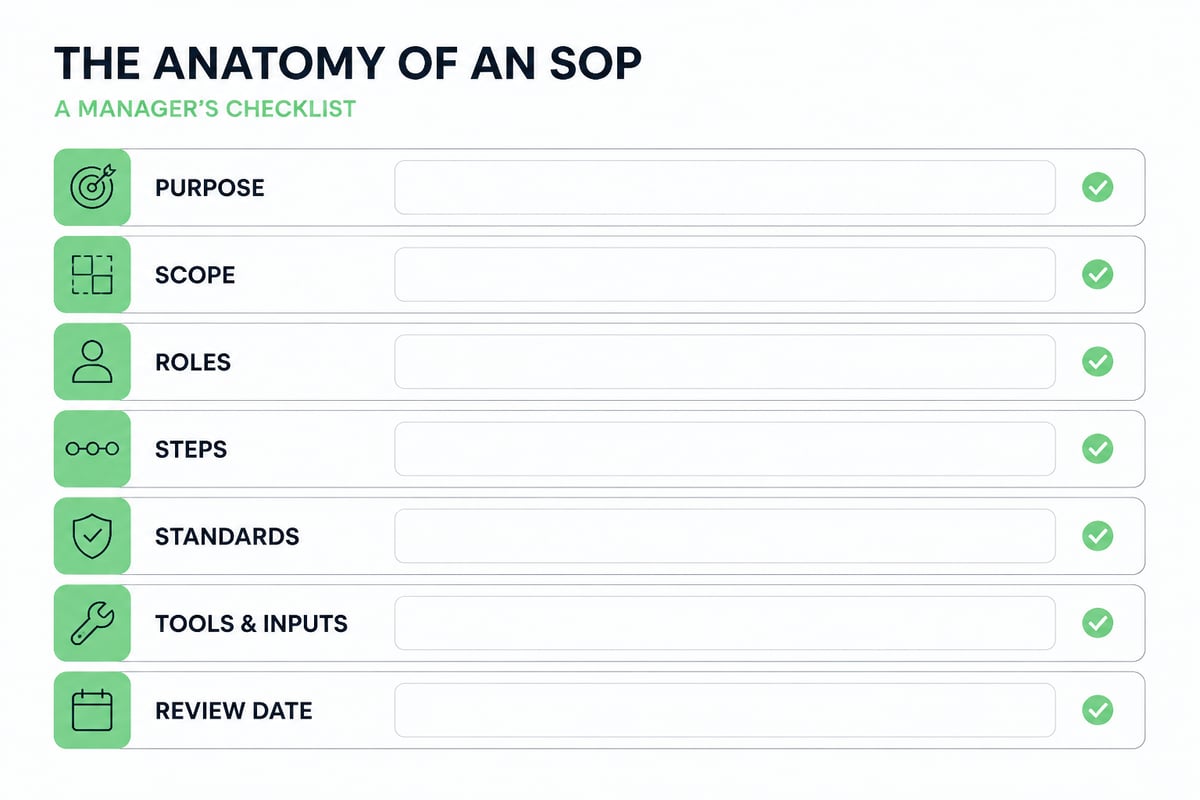
Most SOPs share the same core parts:
- Purpose: one or two sentences on why the procedure exists and what it protects or produces.
- Scope: who must follow it and in which situations it applies.
- Roles: who owns each step, including who approves exceptions.
- Steps: the actions in order, written as short imperative statements.
- Standards: what "done well" looks like, ideally something observable or measurable.
- Tools and inputs: the systems, templates, or documents the task requires.
- Review date: when the procedure was last updated and when it will next be reviewed.
Regulated industries add heavier requirements for approvals and record keeping, but the structure stays recognizable.
SOP formats
Format should match the task. A short checklist suits a five-step routine such as logging a call. A numbered procedure suits a longer sequence such as onboarding a new account. A flowchart suits a process with decisions, such as routing an inbound lead by company size. Organizations often collect these formats into a single SOP manual so that every procedure sits in one reference.
What is an SOP for a job?
An SOP for a job is the set of written procedures that define how the main recurring tasks of that role are performed, so a new hire can learn the work and a manager can judge it against a clear standard. It does not describe the whole role the way a job description does. It describes the how behind the tasks.
A job description says a sales rep "conducts discovery calls." The SOP for that task says what a discovery call must include, in what order, what gets recorded afterward, and what the rep does if the prospect cannot name a decision maker.
This distinction matters for onboarding. Job descriptions tell candidates what the role is. SOPs tell new employees how the work gets done in this company, which is knowledge that otherwise lives in the heads of senior staff. For small teams where the owner or one veteran rep carries most of that knowledge, writing it down is a form of risk management.
Examples of SOPs in a sales team
Sales SOPs cover the repeatable steps of a deal, from first contact to handoff, and each one pairs a clear sequence with an observable standard. The examples below show what that looks like in practice.
| Sales SOP | What it standardizes | Observable standard |
|---|---|---|
| Lead qualification | The questions a rep must answer before booking a meeting | Budget, authority, need, and timeline recorded for every opportunity |
| Discovery call | Opening, question sequence, and recap | Prospect's problem stated in their own words and confirmed |
| Demo or proposal | Structure and required content | Proposal tied to the pain points raised in discovery |
| Follow-up | Timing and content after each meeting | Written summary and a dated next step sent within one business day |
| CRM hygiene | What gets logged and when | Notes, stage, and next action updated the same day |
| Handoff to delivery | Information passed to the service team | Handoff checklist completed before kickoff |
A sample discovery call SOP
Hypothetical example: a B2B services team writes a discovery call procedure with these steps.
- Open by stating the purpose of the call and confirming the time available.
- Ask about the prospect's current process and what prompted the search.
- Quantify the problem: how often it happens and what it costs.
- Identify who else is involved in the decision and how it will be made.
- Recap the problem in the prospect's words and ask for confirmation.
- Agree on a specific next step with a date before ending the call.
Each step can be checked against a recording. That is what separates a useful SOP from a vague one: a manager can tell whether a step happened.
Why do SOPs matter for small sales teams?
SOPs matter because they replace guesswork with a shared standard, which makes performance easier to measure, coach, and repeat. In a small owner-led team, they also protect revenue from depending on one or two people's instincts.
The main benefits show up in four places:
- Consistency: prospects get a similar quality of experience regardless of which rep they speak with.
- Faster onboarding: new reps learn the team's way of selling from a written reference instead of by shadowing.
- Clear coaching targets: when a procedure exists, a manager can point to the exact step a rep skipped or rushed.
- Fewer dropped handoffs: written follow-up and handoff steps reduce the deals that stall because nobody knew who owned the next move.
The UK Home Office guidance also notes that SOPs should cover end-to-end management of the relevant activity, with examples such as customer and supplier checks. For sales, that principle argues against documenting only the call itself. The procedure should also cover what happens before the call and after it.
There is a coaching link as well. An owner who cannot listen to every rep's calls has no practical way to know whether the written procedure is being followed. Teams that pair SOPs with a structured sales playbook and regular sales call recording and analysis close that gap, because the procedure defines the standard and the recordings show whether reps meet it.

How to write a sales SOP
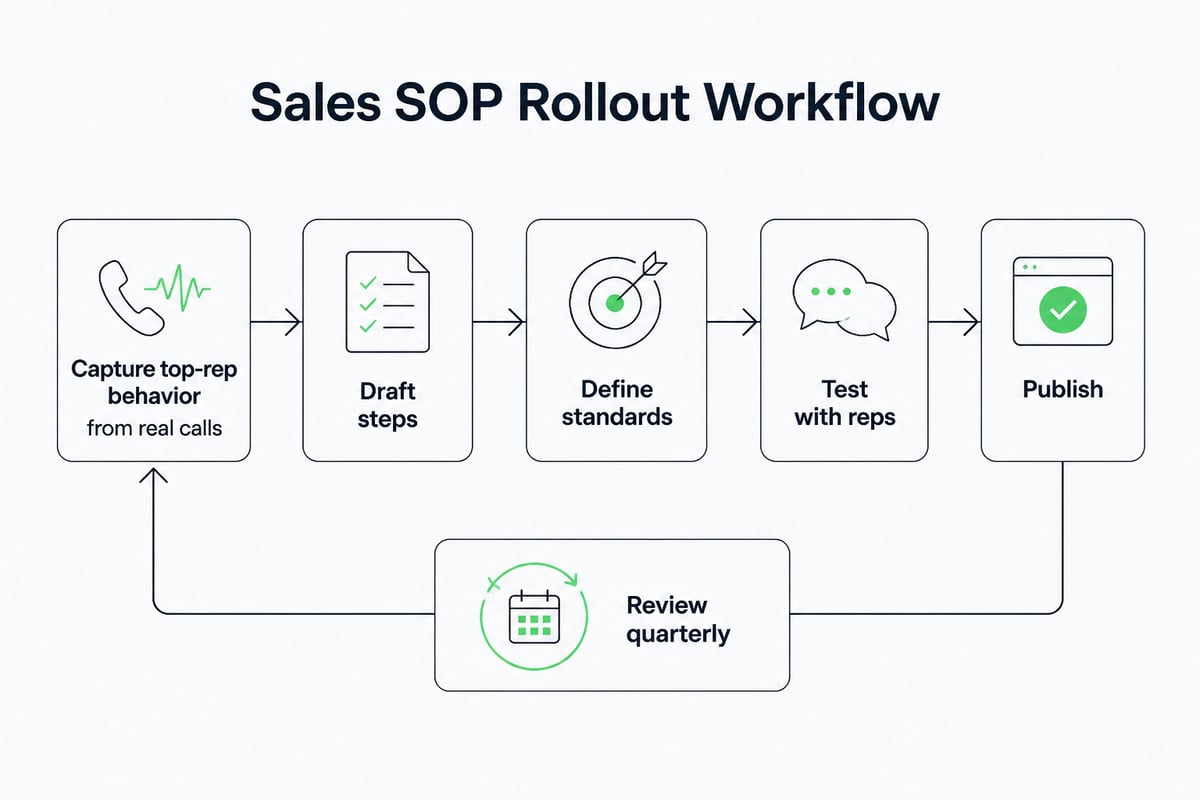
To write a sales SOP, pick one repeatable task, document how your best reps actually perform it, turn that into numbered steps with observable standards, and test it with the people who will use it. Start narrow. A single well-written discovery call procedure is worth more than a forty-page manual nobody opens.
- Choose one process. Pick the task where inconsistency costs the most, often discovery calls, follow-up, or qualification.
- Capture what works. Review calls from your strongest reps and note the steps that appear in their best conversations. Writing from real behavior produces more credible SOPs than writing from theory.
- Draft the steps. Use short, active sentences. Each step should start with a verb and describe one action.
- Define the standard. For every step, state what a reviewer would see or hear if it were done correctly.
- Test it. Have two or three reps follow the draft on live calls and report which steps are unclear or unrealistic.
- Publish where reps work. An SOP buried in a shared drive does not get used. Keep it accessible from the tools reps open daily.
- Assign an owner and review date. Someone must be responsible for updating it.
For sales, the guiding rule is to document behaviors that influence outcomes, not every click in the CRM.
Common mistakes
- Writing the SOP in a conference room without input from the reps who will follow it.
- Describing ideal behavior no rep actually performs, which makes the document feel disconnected from reality.
- Listing steps without standards, so nobody can tell whether a step was done well.
- Covering too many processes at once and finishing none of them.
How to keep an SOP followed and current
An SOP stays useful only if reps follow it and someone updates it as the business changes, which means pairing the written procedure with call review, coaching, and a scheduled revision cycle. A procedure that is written once and never checked turns into shelfware within a quarter.
The UK Home Office guidance, updated on July 2, 2025, recommends that SOPs be regularly reviewed and updated, and that employees can access them and understand the parts relevant to their roles. Both points apply to sales. Access means reps can find the procedure in seconds. Understanding means they have practiced it, not merely read it.
Practical habits that keep a sales SOP alive:
- Review on a schedule. Set a quarterly check and revise after any change in offer, pricing, or target customer.
- Score calls against it. Compare real conversations to the procedure and note which steps are consistently missed.
- Coach one gap at a time. Reps improve faster when feedback targets a single behavior with a clear next call to try it on, rather than a long list of corrections. This approach is covered in more depth in how to reinforce sales training.
- Practice before the next call. Role-play lets a rep rehearse the exact moment that went wrong, which builds the habit faster than reading the document again. See these sales role-play exercises for formats that work in small teams.
- Revise from the field. When a rep finds a better way to handle a step, test it and update the procedure.
Where manual review breaks down
For an owner or sales manager running a team of three to ten reps, the hard part is verification. Listening to every call is not realistic, so the SOP is followed on trust. Bizware AI Sales Coach addresses this by capturing sales calls, scoring them against the team's own playbook, and giving each rep private coaching and voice or text role-play practice before the next call, with a manager dashboard that shows where the team stands. The SOP becomes something measurable rather than something assumed.
Consultants who advise B2B sales teams face a related problem. A procedure delivered in a workshop fades unless there is an ongoing way to check it. A system that scores real calls against the agreed standard gives the consultant evidence to coach from between engagements.
SOP vs. playbook vs. checklist
An SOP, a playbook, and a checklist are three different documents, and mixing them up leads to procedures that are either too vague to follow or too detailed to read. The distinction comes down to scope and purpose.
- Checklist: a short list of items to confirm, with no explanation. Good for tasks reps already know how to do but might forget.
- SOP: ordered instructions for one specific process, with roles and standards. Good for tasks where the method matters.
- Playbook: the broader guide to how the team sells, covering ideal customer, messaging, stages, and objection handling. It usually references several SOPs.
A practical arrangement for a small team is one playbook, a handful of SOPs for the highest-impact processes, and checklists for routine tasks like pre-call preparation.
Related terms
Several terms appear alongside SOP, and knowing them helps when reading business or compliance documents:
- Work instruction: a more granular document explaining how to perform a single step inside an SOP.
- Process map: a diagram showing the flow of a process, often used before writing the SOP.
- Quality management system (QMS): the framework in regulated industries that organizes SOPs, records, and audits.
- KPI: a measurable indicator used to judge whether a process produces the intended result.
- Onboarding documentation: the set of materials, including SOPs, that brings new hires up to speed. Related reading: employee onboarding automation.
- Compliance: adherence to legal or regulatory requirements, which SOPs in regulated fields are written to demonstrate.
FAQ
What does the slang term "SOP" mean?
In casual speech, SOP is shorthand for "standard operating procedure," used to mean "the usual way things are done," often with a joking tone, as in "that's SOP for Mondays." It borrows the business meaning and applies it to everyday habits.
Is an SOP the same as a policy?
No. A policy states what must happen and why, while an SOP explains exactly how to carry it out. A policy might require a written follow-up after every sales meeting, and the SOP lists the steps, timing, and template for sending it.
How long should an SOP be?
Most sales SOPs fit on one to two pages. If a procedure runs longer, it usually covers more than one process and should be split. Short documents get read, followed, and updated.
Pick one process this week, such as your discovery call, and write its steps in six lines or fewer, then check the next five recorded calls against it. If you want that checking done automatically across every rep, Bizware AI Sales Coach scores each call against your own playbook and gives reps private coaching and role-play on the gaps it finds. To see how this would work with your team's procedures, Ryan Cook can walk you through it when you schedule a free demo.